
Last updated on August 25th, 2026 at 12:40 pm
The Engine Control Module (ECM) in your 2004 Mercedes-Benz C-Class manages fuel injection, ignition timing, and emissions systems. Failures may cause erratic engine behavior, poor performance, or complete no-start conditions due to corrupted data or electrical faults.
If your 2004 Mercedes-Benz C-Class has been experiencing unexplained stalling, rough idling, or a refusal to start, the Engine Control Module (ECM) may be the culprit. This small but critical computer oversees nearly every aspect of your engine’s operation, from fuel mixture to ignition timing. When it fails, the symptoms can range from subtle performance hiccups to a complete breakdown. Replacing the ECM isn’t just about swapping a part—it involves careful handling, proper installation, and often, a factory-mandated relearn procedure to ensure the new unit communicates correctly with the rest of your vehicle’s systems. Understanding the role of the ECM, where it’s located, and what to expect during replacement can save you time and frustration. This guide walks you through the process, from identifying failure symptoms to the final steps of getting your C-Class back on the road reliably.
The Engine Control Module (ECM) in your 2004 Mercedes-Benz C-Class is the brain behind your engine’s performance. It continuously monitors data from sensors throughout the vehicle, adjusting fuel injection, ignition timing, and emissions controls to optimize efficiency and power. Without a properly functioning ECM, your engine may run poorly, waste fuel, or fail to start altogether. This module is particularly sensitive to voltage fluctuations and moisture, which can corrupt its internal programming or damage its circuitry. When replacement becomes necessary, choosing replacement engine control modules for the C-Class ensures compatibility with your vehicle’s specific engine and transmission setup. The ECM’s role extends beyond basic engine management—it also interacts with the transmission control module to ensure smooth shifting, making it a linchpin in your vehicle’s drivetrain performance.
2004 Mercedes-Benz C-Class
OEM programmed ECM for your 2004 Mercedes-Benz C-Class — plug & play, no dealer visit.
Free shipping · Lifetime warranty
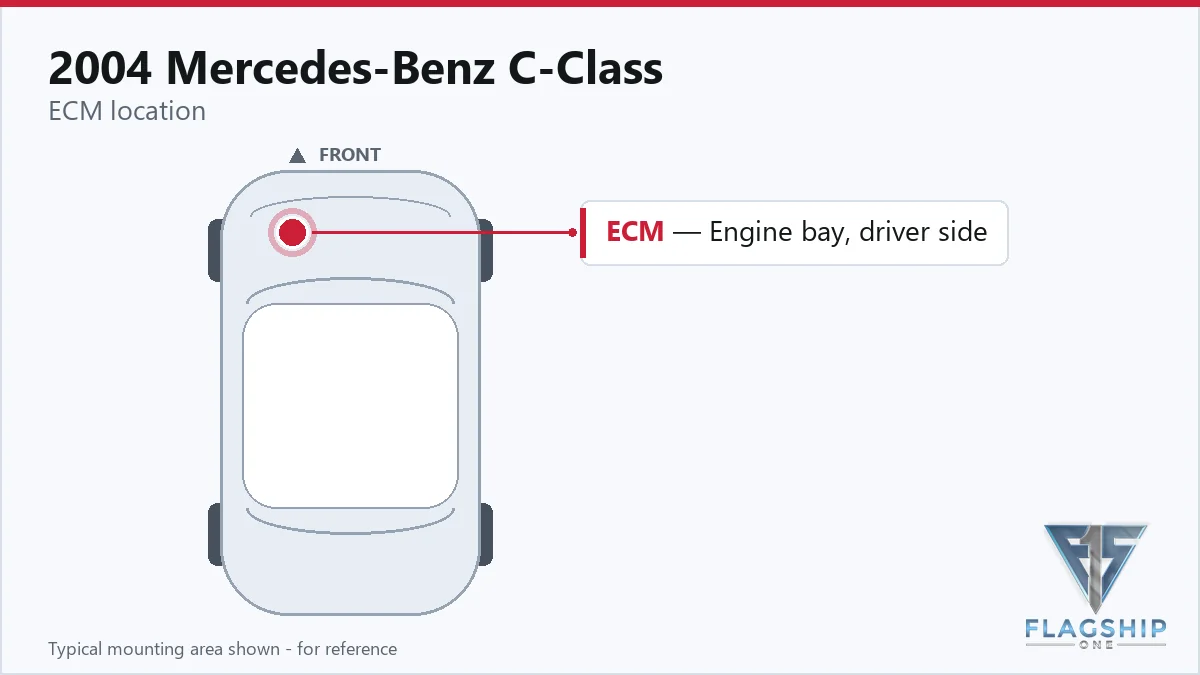
In the 2004 Mercedes-Benz C-Class, the ME control unit is mounted on the left side of the engine bay, near the air filter housing. Accessing it requires removing the air filter box and possibly disconnecting adjacent components to clear a path. The replacement process typically involves unplugging the electrical connector, removing the mounting bolts, and installing the new unit in reverse order. Labor estimates for this job range from 0.5 to 0.9 hours, depending on the technician’s familiarity with the vehicle and whether additional components need to be moved. While the physical swap is straightforward, proper handling is critical—static electricity or improper torque on mounting bolts may damage the new module or cause intermittent electrical issues.
Work with the ignition off, and treat the module as static-sensitive: avoid touching the connector pins at any point.
| Operation | Configuration | Book Time |
|---|---|---|
| Engine Control Module R&R | All configurations | 0.5 hr |
| Engine Control Module R&R | All configurations | 0.9 hr |
| Powertrain Control Module Relearn | All configurations | 0.5 hr |
After installing a new Engine Control Module in your 2004 Mercedes-Benz C-Class, the factory procedure typically requires a powertrain control module relearn, which adds approximately 0.5 hours to the job. This step ensures the ECM synchronizes with the vehicle’s sensors and transmission, preventing drivability issues like rough shifting or poor throttle response. However, if you opt for a VIN-programmed replacement unit, these post-install steps are already completed. The module arrives pre-configured to your vehicle’s specifications, eliminating the need for additional flashing or relearn procedures. This not only saves time but also reduces the risk of errors during the programming process, which can occur if the procedure isn’t followed precisely.
When the Engine Control Module in your 2004 Mercedes-Benz C-Class begins to fail, the symptoms can vary widely but often include intermittent stalling, especially at idle or during deceleration. You may also notice the engine misfiring or running roughly, as if it’s struggling to maintain a consistent air-fuel mixture. In some cases, the vehicle may refuse to start altogether, leaving you with a cranking engine that never fires. Another common sign is poor communication with a scan tool, where the ECM fails to respond to diagnostic requests or returns incomplete data. If the module is partially functional, you might see a checksum error in the ECM’s memory, indicating internal corruption that could lead to unpredictable behavior. Shifting issues, such as delayed or harsh gear changes, may also arise if the ECM isn’t properly coordinating with the transmission control module. These symptoms often worsen over time, so addressing them early can prevent more serious drivability problems down the road.
Mercedes-Benz has issued several service bulletins addressing Engine Control Module (ECM) updates for the 2004 C-Class. Bulletin S-B-07.61/27a outlines a software update procedure via flashing the ME-SFI 2.8 control unit to resolve drivability issues. Additionally, bulletins S-B-07.61/89a and S-B-54.21/244a cover ECM flashing procedures applicable to all model years of the C-Class. These updates are designed to correct software-related glitches that may cause symptoms like rough idling, poor acceleration, or transmission shifting problems. If your vehicle exhibits these issues, checking for applicable bulletins before replacing the ECM could save time and expense.
| Bulletin | Subject | What It Addresses |
|---|---|---|
| — | S-B-07.61/27a: Software Update via Flashing Engine Control Module (ME-SFI 2.8) | — |
| — | S-B-07.61/89a S-B-54.21/244a: Engine Control Module (N3/10) Flashing MY-All Models All | — |
Stalling at idle or during deceleration is a common symptom of ECM failure in the 2004 C-Class. The module may struggle to maintain the correct air-fuel mixture or ignition timing, causing the engine to cut out. A scan tool can help determine if the ECM is the root cause by checking for related trouble codes.
While the physical replacement of the ECM is straightforward, the process requires careful handling to avoid static damage or connector issues. Additionally, the factory mandates a relearn procedure after installation, which may require specialized tools. If you’re not comfortable with these steps, professional installation is recommended.
If your vehicle exhibits symptoms like rough idling, poor acceleration, or transmission shifting issues, a software update may be necessary. Mercedes-Benz service bulletins outline specific updates for the ECM, which can be performed via flashing. A diagnostic scan can confirm whether your ECM’s software is up to date.
ECM failures in the C-Class are often caused by voltage spikes, moisture intrusion, or internal corrosion. Poor battery or charging system health can also contribute to premature failure. Regular maintenance of electrical components can help extend the life of the ECM.
A used ECM may physically fit, but it will not function correctly without proper programming. The module must be matched to your vehicle’s VIN and undergo a relearn procedure to ensure compatibility with your engine and transmission. A pre-programmed replacement unit is the most reliable option.
If your 2004 Mercedes-Benz C-Class is showing signs of ECM failure, you have two main options: repair or replacement. While some issues can be resolved with a software update or connector cleaning, persistent problems often require a new module. Opting for a pre-programmed replacement unit eliminates the need for post-install programming, saving time and reducing the risk of errors. Whether you choose to tackle the job yourself or leave it to a professional, understanding the process ensures a smoother repair experience.
Flagship One stocks a refurbished, VIN-programmed PCM for the 2004 Mercedes-Benz C-Class with a lifetime warranty, free shipping and no core charge. The full Mercedes-Benz C-Class module lineup covers other engine configurations as well.
The Engine Control Module plays a vital role in keeping your 2004 Mercedes-Benz C-Class running smoothly. When it fails, the symptoms can range from minor annoyances to complete drivability issues. By recognizing the warning signs early and opting for a pre-programmed replacement unit, you can restore your vehicle’s performance with minimal downtime. Regular maintenance and prompt attention to trouble codes will help protect your new ECM and keep your C-Class reliable for miles to come.