
Last updated on August 25th, 2026 at 12:53 pm
The Powertrain Control Module and Engine Control Module in your 2005 Chrysler Crossfire are the central computers managing engine operation, transmission shifting, fuel delivery, and emissions systems. When these modules fail, the vehicle may exhibit drivability issues or fail to start entirely due to internal processor faults.
If your 2005 Chrysler Crossfire is experiencing starting issues, stalling, or unexpected transmission behavior, the Powertrain Control Module or Engine Control Module may be the culprit. These compact computers serve as the brain of your 3.2L V6 engine, continuously monitoring sensors and adjusting fuel delivery, ignition timing, and shift points to maintain smooth operation. Unlike simple sensor failures that trigger external diagnostic trouble codes, module internal failures often present with confusing symptoms and may even prevent scan tools from communicating with the vehicle’s systems. This guide explains how these control modules function in your Crossfire, what symptoms typically indicate failure, and what the replacement and programming process involves. Whether you are diagnosing a no-start condition or evaluating repair options, understanding the role of the PCM and ECM will help you make informed decisions about service. The information here covers factory service procedures, common failure patterns, and practical steps to protect your investment after replacement.
The Powertrain Control Module in your 2005 Chrysler Crossfire is an integrated unit that handles both engine management and transmission control functions. This single module receives input from dozens of sensors throughout the vehicle, including the crankshaft position sensor, camshaft position sensors, throttle position sensor, and various temperature and pressure transducers. Based on this sensor data, the PCM calculates optimal fuel injector pulse width, spark advance angle, and transmission shift timing every few milliseconds. The Engine Control Module portion specifically manages the 3.2L V6’s air-fuel ratio, idle speed, and emissions control systems including the catalytic converters and evaporative emissions system. When the internal processor encounters a fault condition, the module may store a code such as P0606, which indicates a processor communication failure within the PCM itself. This type of failure is different from external sensor problems because it represents a hardware or firmware issue inside the module housing. Replacement requires replacement engine computers for the Crossfire that are programmed with the correct VIN and vehicle-specific calibration files before installation. Without proper programming, the engine will crank but not start, and transmission gear selection may be disabled entirely.
2005 Chrysler Crossfire
OEM programmed ECM for your 2005 Chrysler Crossfire — plug & play, no dealer visit.
Free shipping · Lifetime warranty
The Powertrain Control Module on the 2005 Chrysler Crossfire is located in the passenger-side front wheel well, behind the interior trim panel near the fender. Access requires removing the wheel well liner and possibly the front passenger seat to reach the mounting bracket. The module connects to the vehicle wiring harness through a multi-pin connector that should be carefully inspected for corrosion or bent pins before disconnecting. The book time for Powertrain Control Module R&R is 0.4 hours, which covers the physical removal and installation of the unit. However, this labor time does not include diagnostic time to confirm the module is faulty or the programming procedure afterward. When replacing the module, ensure the replacement unit is secured to the mounting bracket using the factory fasteners and torque specifications should be followed if provided in the service manual. After the module is physically installed, the wiring connector must be fully seated and the retention clip secured to prevent vibration-related intermittent connections.
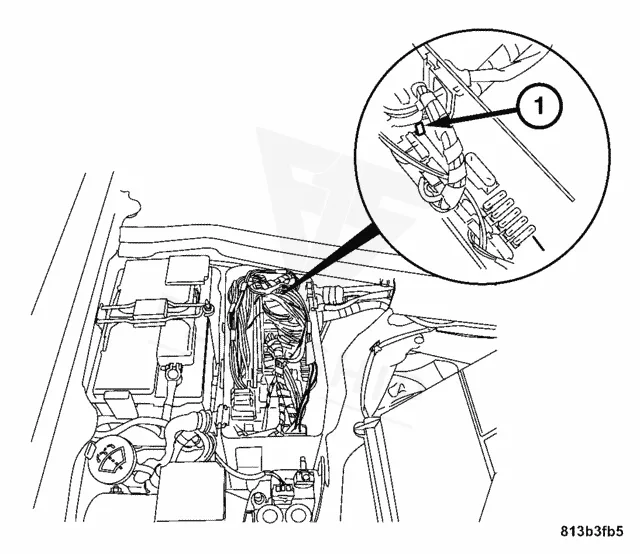
Work with the ignition off, and treat the module as static-sensitive: avoid touching the connector pins at any point.
| Operation | Configuration | Book Time |
|---|---|---|
| Powertrain Control Module Relearn | All configurations | 0.5 hr |
| Powertrain Control Module R&R | All configurations | 0.4 hr |
| Engine Control Module Relearn | All configurations | 0.5 hr |
| Engine Control Module Reset | All configurations | 0.3 hr |
| Engine Control Module R&R | All configurations | 0.4 hr |
After installing a replacement PCM in your 2005 Chrysler Crossfire, the factory procedure requires an initialization process to establish communication between the new module and the vehicle’s remaining control systems. The service bulletin #08-030-06 Rev. A covers Powertrain Control Module Initialization and outlines the specific steps dealers must follow using Chrysler’s diagnostic equipment. This initialization process includes a relearn procedure that takes approximately 0.5 hours to complete, during which the PCM learns idle airflow characteristics, fuel trims, and transmission adaptive shift patterns specific to your vehicle. The Engine Control Module Reset procedure is separate and requires an additional 0.3 hours of labor. Flagship One addresses this factory requirement by shipping a VIN-programmed replacement unit that arrives ready to install, meaning the initialization and relearn procedures have already been performed during quality control testing at their facility. This pre-programming eliminates the need for dealer visits or specialized scan tools after installation, saving both time and labor costs.
When the PCM or ECM fails on a 2005 Chrysler Crossfire, the symptoms can range from subtle drivability complaints to complete no-start conditions. One of the most common indications of module internal failure is a no-start condition where the engine cranks normally but receives no fuel or spark because the PCM has shut down outputs to protect itself. Scan tool communication may be lost entirely, preventing technicians from retrieving diagnostic trouble codes or viewing sensor data. In some cases, the vehicle may start and run but exhibit erratic behavior such as stalling at idle, hesitation under acceleration, or unpredictable transmission shifting. The Check Engine light may illuminate with multiple unrelated codes set simultaneously, which is a hallmark pattern suggesting the module itself is generating false fault information. If your Crossfire displays processor fault in control module along with other codes that clear and return quickly, this strongly indicates an internal PCM failure rather than a sensor or wiring issue. Other symptoms may include inconsistent throttle response, rough idle, and transmission engagement harshness that comes and goes depending on module temperature or vibration.
The module-internal trouble code documented for this vehicle is P0606, which specifically indicates a processor fault within the Powertrain Control Module. This code is set when the internal microprocessor detects an abnormal condition in its own memory or communication pathways and cannot guarantee accurate output signals.
| Code | Meaning | Full Guide |
|---|---|---|
| P0606 | Module processor failure | Full P0606 guide → |
| Bulletin | Subject | What It Addresses |
|---|---|---|
| 08-030-06 Rev. A | 08-030-06 Rev. A Powertrain Control Module Initialization | — |
A used PCM from a salvage yard will require VIN programming to match your specific vehicle, which typically requires dealer-level diagnostic equipment. Additionally, used modules may have underlying damage that caused the original failure, making them a risky choice compared to a remanufactured unit from a reputable supplier.
No. The 2005 Chrysler Crossfire requires the replacement PCM to be programmed with the correct VIN and calibration files before the engine will start and run. An unprogrammed unit will allow the engine to crank but will not enable fuel injection or spark delivery.
If your Crossfire displays multiple unrelated trouble codes simultaneously, cannot communicate with a scan tool, or exhibits symptoms that change unpredictably, the PCM itself is likely faulty. A professional diagnostic procedure can confirm whether the issue originates from the module or external components.
Yes. The 2005 Chrysler Crossfire uses an integrated Powertrain Control Module that handles both engine control and transmission control functions in a single housing. This differs from some vehicles that use separate Engine Control Module and Transmission Control Module units.
The relearn procedure (0.5 hours) teaches the new module your vehicle’s specific idle airflow and fuel trim characteristics, while the reset procedure (0.3 hours) clears stored adaptive values and prepares the module for fresh learning. Both procedures are part of the factory post-install process.
If your 2005 Chrysler Crossfire has been diagnosed with a failed PCM or ECM, you have two primary repair paths. The first option is a remanufactured replacement unit from Flagship One, which arrives pre-programmed with your VIN and ready to install, eliminating the need for dealer programming appointments. The second option is to remove your existing module and send it for repair, which may take longer but can be less expensive depending on the extent of damage. For most owners, a quality remanufactured unit provides the best balance of reliability and convenience, particularly when the alternative involves coordinating dealer service visits and potentially paying additional initialization fees.
Flagship One stocks a refurbished, VIN-programmed PCM for the 2005 Chrysler Crossfire with a lifetime warranty, free shipping and no core charge. The full Chrysler Crossfire module lineup covers other engine configurations as well.
The Powertrain Control Module in your 2005 Chrysler Crossfire is a critical component that manages engine and transmission functions. When internal failures occur, the vehicle may exhibit no-start conditions, stalling, or erratic shifting that can leave you stranded. Understanding the replacement process, including the programming requirements and factory relearn procedures, helps you make informed service decisions. Whether you choose a remanufactured replacement or repair option, addressing PCM failures promptly prevents secondary damage and gets your Crossfire back on the road reliably.