
Last updated on August 25th, 2026 at 12:54 pm
The Powertrain Control Module (PCM) in the 2004 Chrysler Crossfire manages engine and transmission functions. Failures may cause erratic performance, no-start conditions, or transmission shifting problems due to corrupted data or electrical faults.
If your 2004 Chrysler Crossfire has been stalling, misfiring, or refusing to start, the Powertrain Control Module (PCM) may be the culprit. This small but critical computer oversees everything from fuel delivery to transmission shifts, and when it fails, your vehicle’s performance suffers. Replacing or reprogramming the PCM isn’t just about swapping a part—it involves precise steps to ensure the new module communicates correctly with the engine and transmission. Understanding these procedures helps you avoid unnecessary trips to the dealer and ensures your Crossfire runs smoothly after the repair. Whether you’re diagnosing symptoms or preparing for a replacement, knowing what to expect can save time and frustration.
The Powertrain Control Module (PCM) in the 2004 Chrysler Crossfire acts as the brain for both the engine and transmission. It processes data from sensors to optimize fuel injection, ignition timing, and shift points, ensuring efficient performance. Without a functioning PCM, your vehicle may struggle to start, idle roughly, or shift unpredictably. The module’s role is especially critical in the Crossfire’s 3.2L engine, where precise control over air-fuel ratios and timing directly impacts power and drivability. When the PCM fails, it often triggers warning lights or leaves the vehicle in limp mode, limiting speed and responsiveness. Replacing it requires not just a physical swap but also initialization to sync with the vehicle’s systems. For owners, replacement engine computers for the Crossfire offer a reliable solution, but proper installation and programming are key to restoring full functionality.
2004 Chrysler Crossfire
OEM programmed ECM for your 2004 Chrysler Crossfire — plug & play, no dealer visit.
Free shipping · Lifetime warranty
In the 2004 Chrysler Crossfire, the PCM is located in the engine bay, typically mounted near the firewall or on the driver’s side fender well. Accessing it involves removing a protective cover or air intake components, though the exact steps may vary depending on the vehicle’s configuration. Replacement is straightforward, with labor times estimated at 0.4 hours for removal and reinstallation. The module is secured with bolts or clips, and the electrical connector must be carefully disconnected to avoid damaging the pins. Once the old unit is removed, the new PCM is installed in the same location, ensuring all connections are secure. No special tools are required beyond basic hand tools, but care should be taken to avoid static discharge, which can damage sensitive electronics.
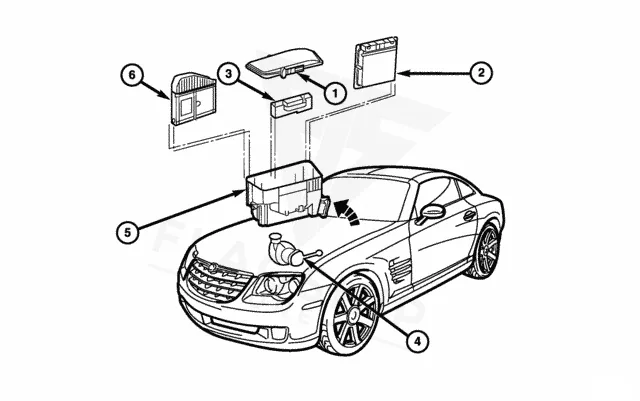
Work with the ignition off, and treat the module as static-sensitive: avoid touching the connector pins at any point.
| Operation | Configuration | Book Time |
|---|---|---|
| Powertrain Control Module Relearn | All configurations | 0.5 hr |
| Powertrain Control Module R&R | All configurations | 0.4 hr |
| Engine Control Module Relearn | All configurations | 0.5 hr |
| Engine Control Module Reset | All configurations | 0.3 hr |
| Engine Control Module R&R | All configurations | 0.4 hr |
After installing a new PCM in the 2004 Chrysler Crossfire, the factory procedure requires an initialization process to ensure the module communicates correctly with the engine and transmission. This typically involves a relearn sequence, which can take up to 0.5 hours of labor. The process may include resetting adaptive values, calibrating sensors, and verifying communication with the vehicle’s network. However, when you opt for a VIN-programmed replacement unit, these steps are already completed, saving you time and avoiding the need for dealer programming. This means your Crossfire can be back on the road faster, with the new PCM fully integrated into the vehicle’s systems from the moment it’s installed.
When the PCM in your 2004 Chrysler Crossfire begins to fail, you may notice a range of symptoms that disrupt normal driving. One of the most common signs is a no-start condition, where the engine cranks but refuses to fire. Stalling or rough idling may also occur, especially during warm-up or at stoplights, as the PCM struggles to maintain consistent fuel and ignition timing. Misfires are another frequent issue, often accompanied by a check engine light and stored trouble codes like internal control module memory checksum error. Transmission shifting problems, such as delayed or harsh gear changes, can also arise if the PCM fails to communicate properly with the transmission control module. In some cases, the vehicle may enter limp mode, limiting speed and responsiveness to prevent further damage. Scan tool communication errors, where the PCM fails to respond to diagnostic requests, are another red flag, indicating a potential failure of the module itself or its electrical connections.
Chrysler issued service bulletin #08-030-06 Rev. A to address Powertrain Control Module initialization in the 2004 Crossfire. The bulletin outlines the factory procedure for resetting and relearning the PCM after replacement or battery disconnects. This process ensures the module synchronizes with the vehicle’s engine and transmission systems, preventing drivability issues like stalling or erratic shifting. Following the bulletin’s steps is critical for restoring full functionality, though it adds time to the repair process.
| Bulletin | Subject | What It Addresses |
|---|---|---|
| 08-030-06 Rev. A | 08-030-06 Rev. A Powertrain Control Module Initialization | — |
A battery disconnect can reset the PCM’s adaptive values, causing temporary stalling or rough idling. The module needs time to relearn fuel and ignition parameters, which may take several drive cycles. If stalling persists, a PCM initialization procedure may be required to restore proper function.
While the vehicle may still run, a P0601 code indicates a potential internal PCM fault. Driving with this code can lead to performance issues like misfires or stalling. It’s best to address the code promptly to avoid further complications or potential damage to other components.
Sensor issues often trigger specific codes related to their function, such as oxygen sensor or throttle position faults. PCM failures, however, may produce broader codes like P0601 or cause multiple unrelated symptoms. A professional scan tool can help distinguish between the two by checking for communication errors or internal module faults.
Yes, the factory requires a relearn procedure to ensure the new PCM synchronizes with the engine and transmission. This step is critical for restoring proper drivability and preventing issues like stalling or erratic shifting. Using a pre-programmed replacement unit eliminates the need for this step.
PCM failures can result from electrical issues like voltage spikes, moisture intrusion, or corrosion in the connector. Over time, heat and vibration may also degrade internal components, leading to memory corruption or communication errors. Regular maintenance of the vehicle’s electrical system can help prevent premature failure.
When your 2004 Chrysler Crossfire’s PCM fails, you have two main options: repair or replacement. While repairs may seem cost-effective, they often provide only a temporary fix, especially if the module has internal damage. A replacement PCM, particularly one that arrives pre-programmed with your vehicle’s VIN, ensures a seamless installation and immediate functionality. This approach saves time and avoids the hassle of dealer programming, getting your Crossfire back on the road faster.
Flagship One stocks a refurbished, VIN-programmed PCM for the 2004 Chrysler Crossfire with a lifetime warranty, free shipping and no core charge. The full Chrysler Crossfire module lineup covers other engine configurations as well.
The 2004 Chrysler Crossfire relies on its PCM to manage critical engine and transmission functions, and when it fails, the vehicle’s performance suffers. Whether you’re dealing with stalling, misfires, or no-start conditions, understanding the replacement and initialization process can help you make informed decisions. With the right approach, your Crossfire can regain its reliability and drivability, ensuring smooth operation for miles to come.