
Last updated on August 25th, 2026 at 12:55 pm
The powertrain control module (PCM) in your 2019 Audi A8 manages engine and transmission functions. Failure may cause erratic behavior, poor performance, or complete shutdowns, often triggered by electrical issues or internal faults.
If your 2019 Audi A8 has started stalling unexpectedly, refusing to start, or displaying warning lights, the powertrain control module (PCM) may be the culprit. This critical component oversees engine performance, fuel delivery, and transmission behavior, ensuring smooth operation. When it fails, symptoms can range from subtle drivability issues to complete vehicle shutdowns. Replacing the PCM isn’t just about swapping a part—it involves precise access, proper installation, and often, programming steps to sync the new module with your vehicle’s systems. Understanding the process helps you anticipate labor time, costs, and what to expect during repairs. Whether you’re diagnosing an issue or preparing for a replacement, knowing the facts about your Audi A8’s PCM ensures you make informed decisions without unnecessary delays or surprises.
The powertrain control module (PCM) in your 2019 Audi A8 acts as the brain for both the engine and transmission, coordinating fuel injection, ignition timing, and gear shifts to optimize performance and efficiency. It constantly monitors sensor data, adjusting parameters in real time to maintain smooth operation. A faulty PCM may disrupt these processes, leading to poor acceleration, rough idling, or even a vehicle that won’t start. Because the PCM integrates with nearly every major system, its reliability is crucial for daily driving. When replacement becomes necessary, you’ll need replacement engine control modules for the Audi A8 that match your vehicle’s specifications. Without proper functionality, even minor PCM issues can escalate into more severe drivability problems, making timely attention essential.
The PCM in your 2019 Audi A8 is located in the plenum chamber at the base of the windshield, requiring removal of interior trim panels and possibly the windshield wiper assembly for access. Factory procedures specify that replacing the module involves disconnecting the battery, removing the necessary covers, and carefully unplugging the wiring harness. Labor estimates for powertrain control module removal and reinstallation typically run about 0.5 hours, though additional time may be needed if corrosion or damaged connectors complicate the process. After installation, the module must be relearned to the vehicle’s systems, which can add another 0.5 hours of labor. Proper torque on mounting bolts and secure connector seating are critical to prevent future electrical issues.
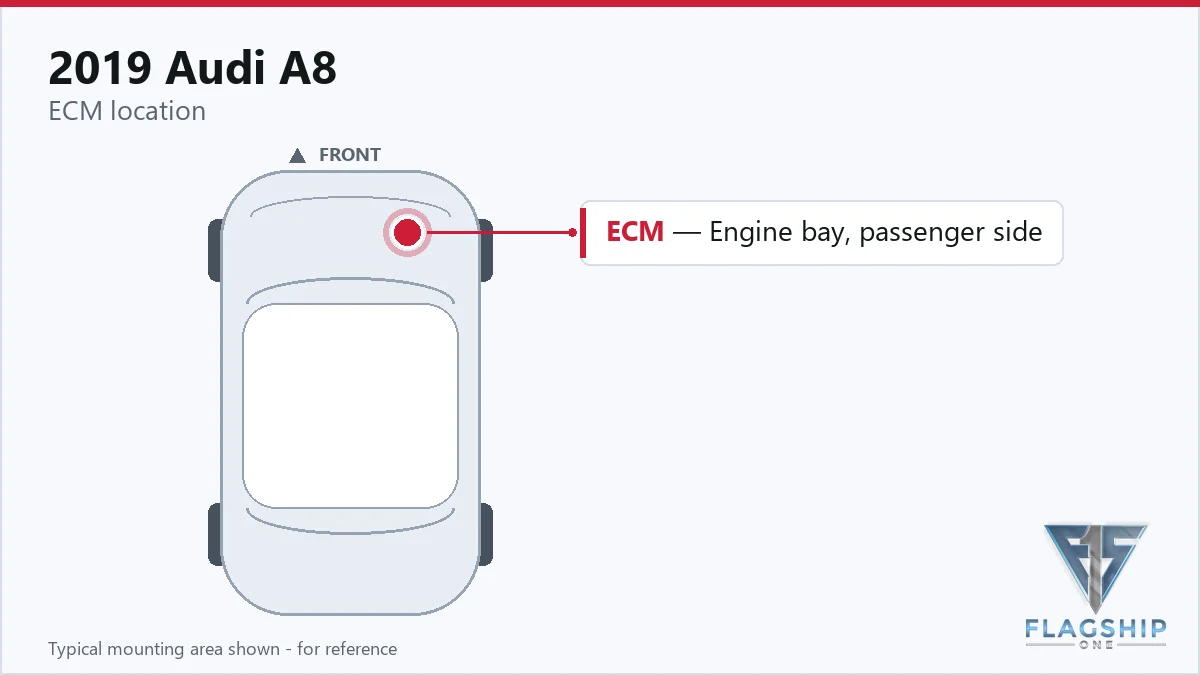
Work with the ignition off, and treat the module as static-sensitive: avoid touching the connector pins at any point.
| Operation | Configuration | Book Time |
|---|---|---|
| Powertrain Control Module R&R | All configurations | 0.5 hr |
| Powertrain Control Module Relearn | All configurations | 0.5 hr |
| Engine Control Module Relearn | All configurations | 0.5 hr |
| Engine Control Module Reset | All configurations | 0.3 hr |
| Engine Control Module R&R | All configurations | 0.5 hr |
2019 Audi A8
OEM programmed ECM for your 2019 Audi A8 — plug & play, no dealer visit.
Free shipping · Lifetime warranty
After replacing the PCM in your 2019 Audi A8, the factory procedure requires a relearn process to synchronize the new module with the vehicle’s systems. This typically involves resetting the engine control module and performing a powertrain control module relearn, each taking about 0.5 hours of labor. These steps ensure the module communicates correctly with sensors, the transmission, and other critical components. However, a VIN-programmed replacement unit from Flagship One arrives pre-configured to your vehicle’s specifications, eliminating the need for these additional programming steps. This not only saves time but also reduces the risk of errors during the relearn process, allowing your Audi A8 to return to normal operation more quickly.
When the PCM in your 2019 Audi A8 begins to fail, symptoms often start subtly but can escalate quickly. You may notice the engine stalling unexpectedly, especially at idle or during deceleration, or the vehicle refusing to start despite a healthy battery. Warning lights, such as the check engine or transmission malfunction indicators, may illuminate on the dashboard. Poor acceleration, rough shifting, or erratic transmission behavior are also common signs of PCM issues. In some cases, the vehicle may enter a reduced-power mode to prevent further damage. Diagnostic trouble codes like internal control module memory checksum error frequently appear during a scan, pointing to internal faults within the module. If your Audi A8 exhibits any of these symptoms, prompt diagnosis is recommended to avoid further drivability problems or potential breakdowns.
The 2019 Audi A8 may log several trouble codes when the PCM experiences internal faults. These codes often indicate issues with memory, processor performance, or communication errors within the module itself. Addressing them promptly can prevent further complications.
| Code | Meaning | Full Guide |
|---|---|---|
| P0601 | Internal memory checksum error | Full P0601 guide → |
| P0606 | Module processor failure | Full P0606 guide → |
| P0607 | Module performance fault | Full P0607 guide → |
| P060B | Module-internal fault | — |
| P0613 | Module-internal fault | Full P0613 guide → |
| P0614 | Module-internal fault | Full P0614 guide → |
| P061A | Module-internal fault | — |
| P061B | Module-internal fault | — |
| P062F | Internal EEPROM error | Full P062F guide → |
| P0634 | Module-internal fault | Full P0634 guide → |
| P0642 | Module-internal fault | Full P0642 guide → |
| P0643 | Module-internal fault | Full P0643 guide → |
Common signs include stalling, no-start conditions, warning lights, or erratic transmission behavior. A diagnostic scan may reveal trouble codes like P0601 or P0606, indicating internal module faults. If these symptoms appear, professional testing can confirm whether the PCM is the root cause.
Driving with a faulty PCM may lead to unpredictable behavior, such as stalling or transmission issues. In some cases, the vehicle may enter a reduced-power mode or fail to start. If you suspect PCM problems, it’s best to address them promptly to avoid potential breakdowns.
A reset clears temporary data from the module, while a relearn reprograms the PCM to recognize the vehicle’s sensors and systems. The 2019 Audi A8 typically requires a relearn after replacement, which takes about 0.5 hours of labor to complete.
The relearn process ensures the new PCM synchronizes with the vehicle’s transmission, sensors, and other critical components. Without it, the module may not communicate properly, leading to performance issues or warning lights. Factory procedures specify this step to restore full functionality.
Replacing the PCM typically takes about 0.5 hours for removal and reinstallation. However, additional time may be needed for relearn procedures, which can add another 0.5 hours. Labor times may vary if corrosion or damaged connectors complicate the process.
If your 2019 Audi A8 is experiencing PCM-related issues, you have options for repair or replacement. While some shops may attempt to reflash or repair the existing module, a replacement ensures long-term reliability. Flagship One provides VIN-programmed units designed to match your vehicle’s specifications, reducing installation time and eliminating the need for additional programming steps. Whether you choose a new or refurbished module, proper installation and synchronization are key to restoring your Audi A8’s performance.
Flagship One stocks a refurbished, VIN-programmed PCM for the 2019 Audi A8 with a lifetime warranty, free shipping and no core charge. The full Audi A8 module lineup covers other engine configurations as well.
The powertrain control module in your 2019 Audi A8 plays a vital role in engine and transmission performance. When it fails, symptoms like stalling, no-start conditions, or warning lights can disrupt your driving experience. Understanding the replacement process, including location, labor time, and programming requirements, helps you make informed decisions. With the right approach, your Audi A8 can return to smooth, reliable operation without unnecessary delays.