
Last updated on August 25th, 2026 at 12:56 pm
The engine control module in your 2017 Audi S8 manages fuel delivery, ignition timing, and emissions systems. Failures may trigger drivability issues, warning lights, or prevent the engine from starting.
If your 2017 Audi S8 is experiencing unexplained stalling, a no-start condition, or warning lights tied to the engine control system, the issue may stem from the powertrain control module. This component acts as the brain for engine management, coordinating fuel, ignition, and emissions functions. Replacing it involves more than just swapping hardware—proper installation and programming are critical to restore full functionality. Understanding the process, labor expectations, and symptoms can help you make informed decisions about repairs or replacements.
In your 2017 Audi S8, the powertrain control module regulates engine performance by adjusting fuel injection, ignition timing, and emissions controls based on sensor inputs. Its role is essential for smooth operation, fuel efficiency, and compliance with emissions standards. When this module fails, you may notice drivability issues or warning lights on the dashboard. Replacement typically involves installing one of the replacement engine control modules for the Audi S8, which must be compatible with your vehicle’s specifications to ensure proper functionality.
2017 Audi S8
OEM programmed ECM for your 2017 Audi S8 — plug & play, no dealer visit.
Free shipping · Lifetime warranty
The control module in your 2017 Audi S8 is positioned in the plenum chamber at the base of the windshield. Accessing it requires removing components in the engine bay, a process that typically takes 2.4 hours according to factory labor estimates. Once exposed, the module can be unbolted and disconnected. Reinstallation follows the reverse procedure, ensuring all electrical connections are secure. No additional torque specifications are provided for this step, but proper seating of connectors is critical to avoid future faults.
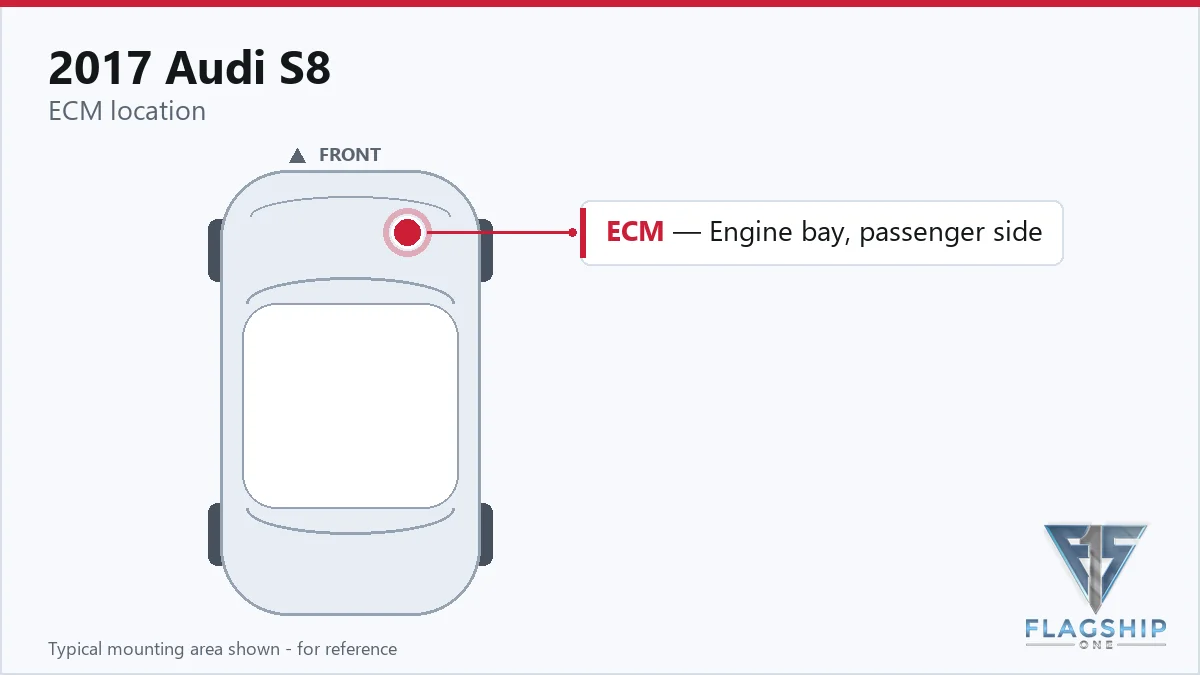
Work with the ignition off, and treat the module as static-sensitive: avoid touching the connector pins at any point.
| Operation | Configuration | Book Time |
|---|---|---|
| Engine Control Module Relearn | A8 Quattro | 0.5 hr |
| Engine Control Module Relearn | S8 | 0.5 hr |
| Engine Control Module R&R | A8 Quattro | 2.4 hr |
| Engine Control Module R&R | S8 | 2.4 hr |
| Powertrain Control Module R&R | A8 Quattro | 2.4 hr |
| Powertrain Control Module R&R | S8 | 2.4 hr |
| Powertrain Control Module Relearn | A8 Quattro | 0.5 hr |
| Powertrain Control Module Relearn | S8 | 0.5 hr |
After replacing the control module in your 2017 Audi S8, the factory procedure requires a 0.5-hour relearn process to synchronize the new unit with the vehicle’s systems. This step ensures proper communication with sensors and other onboard computers. However, a VIN-programmed replacement unit from Flagship One arrives pre-configured, eliminating the need for this additional programming step and reducing overall labor time.
A failing control module in your 2017 Audi S8 may cause a range of symptoms, including intermittent stalling, a no-start condition, or erratic engine behavior. You might also notice warning lights on the dashboard or difficulty communicating with a scan tool. Internal faults, such as control module keep-alive memory error, often indicate deeper issues with the module’s ability to retain data or process commands. If these symptoms appear, prompt diagnosis is recommended to avoid further drivability problems.
The following trouble codes are documented for internal faults in the control module of your 2017 Audi S8. These codes may appear during diagnostic scans and typically point to hardware or software issues within the module itself.
| Code | Meaning | Full Guide |
|---|---|---|
| P0603 | Keep-alive memory (KAM) error | Full P0603 guide → |
| P0605 | Internal ROM error | Full P0605 guide → |
| P060A | Module-internal fault | — |
| P060B | Module-internal fault | — |
| P0613 | Module-internal fault | Full P0613 guide → |
| P0667 | Module-internal fault | Full P0667 guide → |
Common signs include stalling, a no-start condition, or warning lights tied to engine performance. Diagnostic trouble codes like P0603 or P0605 may also indicate module failure. A professional scan can confirm the issue.
While physically replacing the module is possible, it requires access to the plenum chamber and proper handling of electrical connections. Programming the new unit typically requires dealer-level tools unless using a pre-programmed replacement.
The module must be synchronized with your vehicle’s specific sensors and systems to function correctly. Factory procedures include a relearn process to ensure compatibility, which is already completed in pre-programmed units.
If your 2017 Audi S8 is experiencing control module issues, you have options. A dealer replacement includes programming but may involve higher costs and longer downtime. A pre-programmed unit from Flagship One simplifies the process, reducing labor time and ensuring compatibility with your vehicle’s systems.
Flagship One stocks a refurbished, VIN-programmed PCM for the 2017 Audi S8 with a lifetime warranty, free shipping and no core charge. The full Audi S8 module lineup covers other engine configurations as well.
Replacing the control module in your 2017 Audi S8 can resolve persistent drivability issues and restore reliable performance. Whether you opt for a dealer-installed unit or a pre-programmed replacement, understanding the process and symptoms helps you make the best choice for your vehicle.