
Last updated on August 25th, 2026 at 12:57 pm
The engine control module (ECM) in the 2016 Audi S4 manages fuel delivery, ignition timing, and emissions systems. Internal faults may cause drivability issues, communication errors, or complete engine shutdown.
If your 2016 Audi S4 suddenly stalls, refuses to start, or logs cryptic trouble codes, the engine control module (ECM) may be failing. This critical computer oversees fuel injection, spark timing, and emissions systems, and its failure can leave you stranded. Replacing it involves more than just swapping hardware—factory procedures demand a relearn process to sync the new module with your vehicle’s systems. Understanding the location, labor requirements, and programming steps can help you avoid unexpected delays or costs. Whether you’re diagnosing symptoms or planning a replacement, knowing what to expect ensures a smoother repair process.
The engine control module in your 2016 Audi S4 acts as the brain of the powertrain, continuously adjusting fuel mixtures and ignition timing for optimal performance. It also monitors emissions systems and communicates with other onboard computers to ensure smooth operation. When this module fails, your vehicle may experience erratic behavior, from rough idling to complete engine shutdown. Replacing it requires replacement engine computers for the Audi S4, which must be programmed to match your VIN for proper functionality. Without correct calibration, even a new module may trigger fault codes or fail to start the engine.
The ECM in the 2016 Audi S4 is located in the plenum chamber at the base of the windshield, making access more involved than in some vehicles. To replace it, the technician must first remove the windshield cowl and possibly other trim components to reach the module. Factory labor estimates for removal and reinstallation are 1.4 hours, reflecting the time needed to safely access and secure the unit. Once installed, the module must be reconnected, and the vehicle’s battery should be checked to ensure stable voltage during the relearn process.
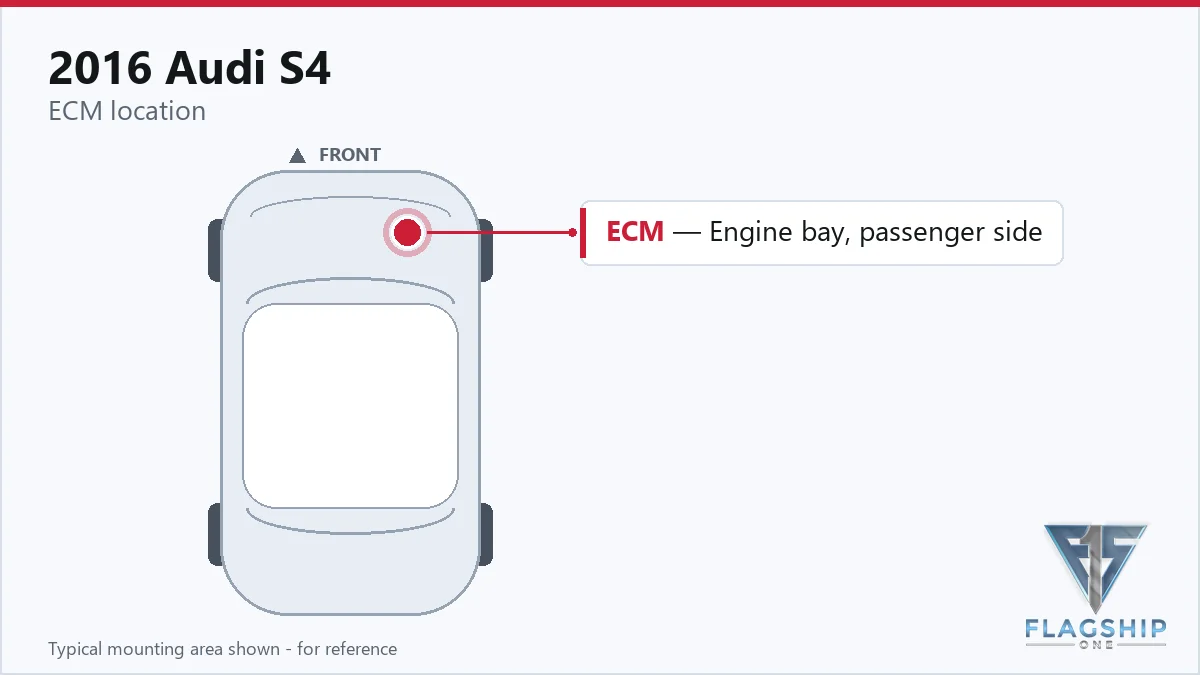
Work with the ignition off, and treat the module as static-sensitive: avoid touching the connector pins at any point.
| Operation | Configuration | Book Time |
|---|---|---|
| Powertrain Control Module Relearn | A4 | 0.5 hr |
| Powertrain Control Module Relearn | A4 Quattro | 0.5 hr |
| Powertrain Control Module Relearn | S4 | 0.5 hr |
| Engine Control Module Relearn | A4 | 0.5 hr |
| Engine Control Module Relearn | A4 Quattro | 0.5 hr |
| Engine Control Module Relearn | S4 | 0.5 hr |
| Engine Control Module R&R | A4 | 1.4 hr |
| Engine Control Module R&R | A4 Quattro | 1.4 hr |
2016 Audi S4
OEM programmed ECM for your 2016 Audi S4 — plug & play, no dealer visit.
Free shipping · Lifetime warranty
After installing a new ECM in your 2016 Audi S4, the factory procedure requires a 0.5-hour relearn process to synchronize the module with the vehicle’s systems. This step ensures proper communication with the transmission, emissions controls, and other onboard computers. However, a VIN-programmed replacement unit from Flagship One arrives pre-configured to your vehicle’s specifications, eliminating the need for this additional dealer visit. This saves time and reduces the risk of programming errors during setup.
A failing ECM in your 2016 Audi S4 may cause a range of symptoms, from intermittent stalling to a complete no-start condition. You might notice rough idling, poor acceleration, or warning lights on the dashboard. In some cases, the vehicle may enter a limp mode, limiting power to prevent further damage. Scan tools may fail to communicate with the module, or you could see codes like internal control module performance issues. If these symptoms appear, prompt diagnosis is recommended to avoid unexpected breakdowns.
The 2016 Audi S4 may log specific trouble codes when the ECM develops internal faults. These codes often indicate communication errors, memory corruption, or processor failures within the module itself.
| Code | Meaning | Full Guide |
|---|---|---|
| P0603 | Keep-alive memory (KAM) error | Full P0603 guide → |
| P0604 | Internal RAM error | Full P0604 guide → |
| P0605 | Internal ROM error | Full P0605 guide → |
| P0606 | Module processor failure | Full P0606 guide → |
| P0608 | Module-internal fault | Full P0608 guide → |
| P060A | Module-internal fault | — |
| P060B | Module-internal fault | — |
| P0613 | Module-internal fault | Full P0613 guide → |
| P062F | Internal EEPROM error | Full P062F guide → |
| P0667 | Module-internal fault | Full P0667 guide → |
| U0100 | Module-internal fault | Full U0100 guide → |
The relearn process synchronizes the new module with your vehicle’s transmission, emissions, and other systems. Without it, the ECM may not communicate properly, leading to drivability issues or fault codes. This step is required by the factory to ensure full functionality.
While the physical replacement is possible, the location under the windshield plenum makes access challenging. Additionally, the factory requires a relearn procedure, which typically requires dealer-level tools. A pre-programmed unit can simplify the process.
Ignoring codes like P060A or P0606 may lead to worsening drivability issues, including stalling or failure to start. Over time, unresolved faults can cause additional damage to other systems, increasing repair costs.
If your 2016 Audi S4 is experiencing ECM-related issues, you have options beyond a costly dealer replacement. A refurbished or new module, pre-programmed to your VIN, can restore functionality without the need for additional programming. Given the labor involved in accessing the ECM, choosing a unit that skips the relearn step can save time and reduce diagnostic complexity.
Flagship One stocks a refurbished, VIN-programmed PCM for the 2016 Audi S4 with a lifetime warranty, free shipping and no core charge. The full Audi S4 module lineup covers other engine configurations as well.
The 2016 Audi S4 relies on its ECM for smooth operation, and addressing failures promptly can prevent further complications. Whether you opt for a dealer replacement or a pre-programmed unit, understanding the location, labor, and programming requirements ensures a more efficient repair. Keeping your vehicle’s electrical system in good condition can also help extend the life of this critical component.