
Last updated on August 25th, 2026 at 12:59 pm
The PCM/ECM in the 2010 Audi Q7 3.6L manages engine timing, fuel delivery, and sensor integration. When it fails, the vehicle may stall, misfire, or lose power.
When a 2010 Audi Q7 3.6L exhibits erratic engine behavior—such as stalling, misfires, or a complete no‑start—the most common culprit is a failure in the PCM/ECM. This guide explains exactly where the module is located, how long it takes to replace it, and what steps you must follow after the new unit is installed. By understanding the replacement process, you can ensure that your vehicle will resume reliable operation and avoid costly mistakes. The information below is tailored specifically for the 2010 Audi Q7 3.6L, covering the exact labor times and factory procedures that apply to this model.
The PCM/ECM in the 2010 Audi Q7 3.6L is the central control unit that coordinates engine timing, fuel injection, and sensor data to maintain smooth operation. It interprets inputs from various sensors—such as crankshaft position, intake temperature, and oxygen sensors—and sends commands to actuators that adjust fuel delivery, ignition timing, and idle speed. Replacement PCM for the 2010 Audi Q7 3.6L If the PCM/ECM malfunctions, the vehicle may experience stalling, misfires, or a loss of power, all of which compromise safety and performance. Because the PCM/ECM sits in the plenum chamber beneath the windshield, it must be accessed with care, and any damage to surrounding components can lead to further complications.
2010 Audi Q7 3.6L
OEM programmed ECM for your 2010 Audi Q7 3.6L — plug & play, no dealer visit.
Free shipping · Lifetime warranty
The PCM/ECM is located in the plenum chamber at the base of the windshield in the 2010 Audi Q7 3.6L. To reach it, the factory removal procedure requires removal of the windshield assembly or a partial access panel, after which the module can be disconnected from its harness. The labor book times reflect that relearning the module takes 0.5 hours, while a full removal and reinstallation takes 0.6 hours. Once the new unit is seated, a short relearn procedure restores the engine’s calibration to the vehicle’s specifications.
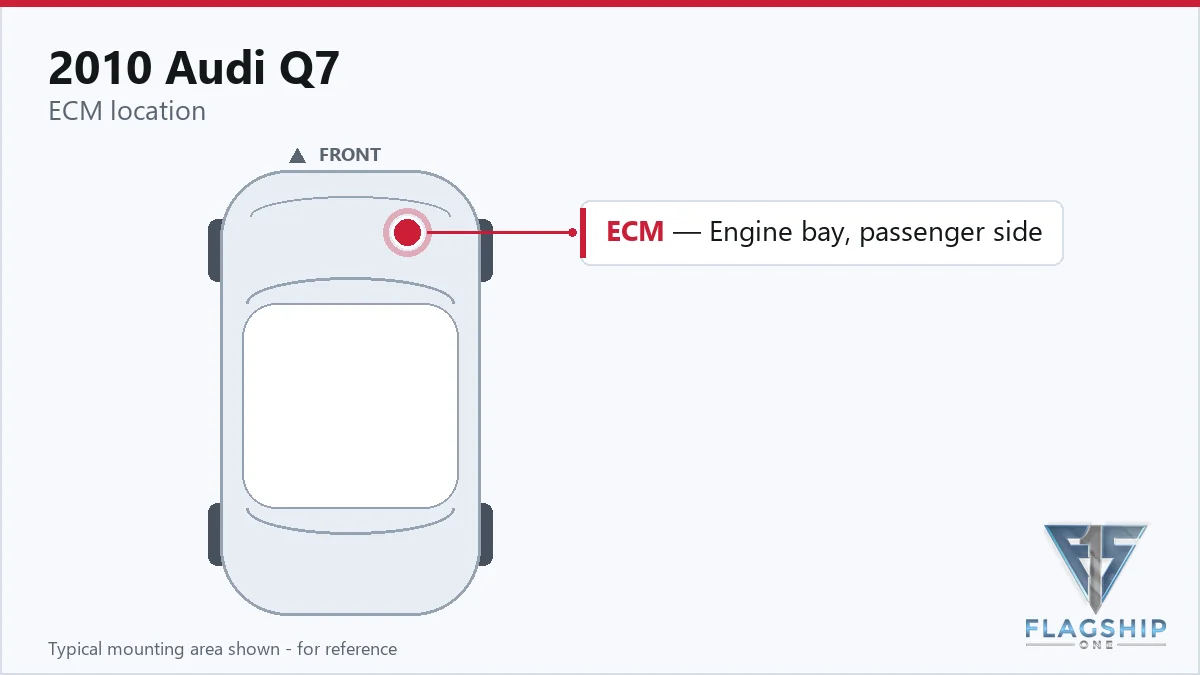
Work with the ignition off, and treat the module as static-sensitive: avoid touching the connector pins at any point.
| Operation | Configuration | Book Time |
|---|---|---|
| Engine Control Module Relearn | All configurations | 0.5 hr |
| Engine Control Module R&R | All configurations | 0.6 hr |
| Powertrain Control Module R&R | All configurations | 0.3 hr |
| Powertrain Control Module Relearn | All configurations | 0.5 hr |
After the new PCM/ECM is installed, the factory procedure mandates a relearn sequence that calibrates ignition timing and idle parameters. Flagship One units arrive already VIN‑programmed, so that relearn step is effectively skipped. VIN‑programmed replacement unit This means you can avoid the time‑consuming factory process and have the module ready to use immediately after installation.
When the PCM/ECM in a 2010 Audi Q7 3.6L fails, you may notice a range of symptoms. Common issues include engine stalling, irregular idle, misfire codes, or a complete no‑start condition. The vehicle may also display a dead scan‑tool connection, making it impossible to retrieve trouble codes. If you encounter a P0601 code, it indicates a problem with the PCM/ECM control module, which often points to a hardware failure or a communication error between the module and the rest of the engine control network. Addressing these symptoms promptly helps prevent further damage to the engine and associated components.
The book time for relearn is 0.5 hours, and a complete removal and reinstallation takes 0.6 hours. These times are based on factory procedures and may vary slightly depending on shop conditions.
No special tool is required beyond standard automotive hand tools and a properly rated torque wrench. The module is accessed through the plenum chamber beneath the windshield, so careful removal of the windshield or panel is necessary.
The factory procedure includes a relearn step, but Flagship One units come VIN‑programmed, which eliminates that step. The new unit is ready to operate immediately after installation.
Common symptoms are engine stalling, misfires, a dead scan‑tool connection, and the appearance of a P0601 code, which signifies a PCM/ECM control module issue.
Driving with a defective PCM/ECM can lead to unpredictable engine behavior and may cause further damage. It is recommended to replace or repair the module as soon as possible.
Whether you choose a professional repair or a refurbished PCM/ECM replacement, the goal is the same: restore reliable performance to your 2010 Audi Q7 3.6L. Professional service ensures that the module is installed correctly and that all factory procedures are observed, while a refurbished unit can offer a cost‑effective alternative that still meets the vehicle’s specifications.
Flagship One stocks a refurbished, VIN-programmed PCM for the 2010 Audi Q7 with a lifetime warranty, free shipping and no core charge. The full Audi Q7 module lineup covers other engine configurations as well.
Your 2010 Audi Q7 3.6L relies on a well‑functioning PCM/ECM for smooth operation. By understanding the location, labor times, and factory procedures, you can make an informed decision about repair or replacement. If you suspect a PCM/ECM issue, consult a qualified technician or consider a pre‑programmed unit for a faster, reliable solution.