
Last updated on August 25th, 2026 at 12:59 pm
In the 2009 Audi R8 4.2L, the Powertrain Control Module (PCM) manages engine timing, fuel delivery, and transmission shift logic. Failure can lead to misfires, loss of power, or engine shutdowns.
If your 2009 Audi R8 4.2L is experiencing engine misfires, stalling, or a check engine light that points to a PCM issue, you may need to replace the module that controls the powertrain. This article explains what the PCM does in your specific car, why a replacement matters, where it sits, how the programming works, and what symptoms to watch for. By the end, you’ll understand the steps, timing, and benefits of using a pre‑programmed replacement unit from Flagship One, so you can decide on the best path forward.
The Powertrain Control Module in a 2009 Audi R8 4.2L orchestrates the interaction between the engine and transmission. It receives sensor data, calculates fuel and ignition timing, and sends shift commands to the transmission control. This module is central to performance and reliability. When it malfunctions, the car can misfire, lose power, or trigger the MIL. 2009 Audi R8 4.2L PCM replacement The PCM’s health is vital because it coordinates all engine management functions; a failure disrupts fuel injection, ignition, and shift logic, leading to a cascade of performance issues.
2009 Audi R8 4.2L
OEM programmed ECM for your 2009 Audi R8 4.2L — plug & play, no dealer visit.
Free shipping · Lifetime warranty
The PCM is located in the engine bay near the firewall, behind the intake manifold. Replacing it involves disconnecting the battery, removing the module from its mounting bracket, and installing the new unit. The shop book states a 0.9‑hour job for the R&R, and a 0.5‑hour relearn step for the Engine Control Module. The installation requires standard torque tools but no special tools beyond those listed in the book.
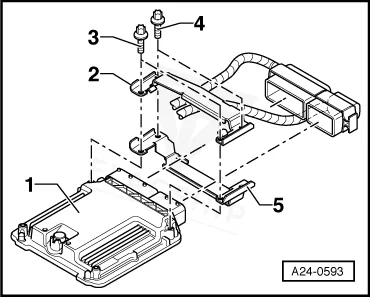
Work with the ignition off, and treat the module as static-sensitive: avoid touching the connector pins at any point.
| Operation | Configuration | Book Time |
|---|---|---|
| Powertrain Control Module R&R | All configurations | 0.9 hr |
| Engine Control Module Relearn | All configurations | 0.5 hr |
| Engine Control Module R&R | All configurations | 0.9 hr |
After the PCM is installed, the factory requires a relearn procedure to re‑establish communication with the engine sensors. Flagship One units arrive VIN‑programmed, so that relearn step is already complete. The technician will simply verify that the module is active and that all sensor data is within expected ranges. VIN‑programmed replacement unit No additional programming tools are needed beyond the standard diagnostic interface.
A failing PCM in the 2009 Audi R8 4.2L can manifest as a sudden loss of power, stalling under load, or the check engine light turning on with misfire codes. You may also notice rough idle, hesitation during acceleration, or a reduction in fuel efficiency. The MIL may illuminate with codes such as P0300‑P0310, indicating misfire conditions. Misfire detected These symptoms often point to a loss of communication between the PCM and engine sensors, which a replacement can resolve.
A factory bulletin addresses a 01 MIL condition triggered by P0300 or P0301–P0310 codes stored in the ECM. The bulletin recommends a PCM replacement to resolve the issue.
| Bulletin | Subject | What It Addresses |
|---|---|---|
| — | 01 MIL on (P0300 and/or P0301 – P0310 stored in ECM) | — |
If the MIL is solely due to P0300 and other diagnostics confirm no sensor or wiring issues, a PCM replacement can resolve the misfire. However, it is advisable to rule out spark plug or fuel injector faults first.
Yes, because the PCM sends shift commands to the transmission. After replacement, the transmission may need a relearn or reset of shift patterns to ensure smooth operation.
Flagship One units come VIN‑programmed, so the factory relearn is already complete. No extra updates are required beyond standard diagnostic checks.
Using a generic PCM is not recommended because it may not support the specific sensors or shift logic of the 4.2L engine, leading to incompatibility issues.
Shop books indicate 0.9 hours for the module removal and installation, plus 0.5 hours for the engine control module relearn.
When the 2009 Audi R8 4.2L’s PCM is out of commission, you can either repair it in a shop or opt for a refurbished replacement. A refurbished unit from a reputable source offers a cost‑effective solution while maintaining performance. Consider the benefits of a pre‑programmed unit that eliminates the relearn step and reduces downtime.
Flagship One stocks a refurbished, VIN-programmed PCM for the 2009 Audi R8 with a lifetime warranty, free shipping and no core charge. The full Audi R8 module lineup covers other engine configurations as well.
The 2009 Audi R8 4.2L depends on its PCM for smooth engine and transmission operation. If you encounter misfire codes or a check engine light, a PCM replacement may be the answer. Use a pre‑programmed unit to streamline the process and keep your car running at peak performance.