
Last updated on August 25th, 2026 at 12:59 pm
The powertrain control module (PCM) in the 2009 Audi Q7 3.6L is the central computer that manages engine and transmission functions. When it fails, you may experience no-start, stalling, or check-engine lights with diagnostic trouble codes like P0327.
If you own a 2009 Audi Q7 with the 3.6L V6, you may eventually face a check-engine light or drivability issue that points to the engine computer. The powertrain control module (PCM) — also called the engine control module (ECM) in Audi service literature — is the brain behind fuel delivery, ignition timing, transmission shifting, and emissions monitoring. When this module begins to fail, the vehicle can become unreliable, with symptoms ranging from a persistent MIL to a no-start condition. Understanding what the PCM does, where it lives, and what replacement involves can save you time and money. This guide covers the factory labor times, the specific location in the plenum chamber, a relevant service bulletin for knock sensor codes, and what to expect during a swap. Whether you are a DIY owner or a shop technician, the information here will help you diagnose the problem and decide whether to repair or replace the module. We also explain how a pre-programmed replacement unit from Flagship One can simplify the process by skipping the dealer relearn step.
2009 Audi Q7 3.6L
OEM programmed ECM for your 2009 Audi Q7 3.6L — plug & play, no dealer visit.
Free shipping · Lifetime warranty
The PCM in the 2009 Audi Q7 3.6L is a single module that integrates engine and transmission control. It receives input from sensors such as the crankshaft position sensor, throttle position sensor, and knock sensors, then adjusts fuel injector pulse width, ignition timing, and shift solenoids accordingly. This vehicle uses a Bosch Motronic system, and the PCM communicates with other modules over the CAN bus. A failing PCM can cause erratic behavior because it may misinterpret sensor data or fail to send proper commands. For example, if the knock sensor circuit (monitored by DTC P0327 or P0325) reports incorrectly, the PCM may pull timing aggressively, reducing power and fuel economy. The module also stores diagnostic trouble codes that help pinpoint issues. When the PCM fails completely, the engine may crank but not start, or the transmission may default to a limp-home mode. Because the PCM is integral to so many systems, a proper replacement requires matching the exact hardware revision and software calibration for your Q7. That is why replacement ECMs for the 2009 Audi Q7 must be sourced carefully — an incorrect part can lead to communication faults or drivability problems. The module’s role in emissions compliance also means that any replacement must be correctly programmed to avoid a persistent MIL.
The factory removal procedure for the 2009 Audi Q7 3.6L places the PCM in the plenum chamber at the base of the windshield, on the passenger side. To access it, you must remove the wiper arms and the plastic cowl cover that spans the width of the windshield. The module is mounted in a metal bracket and is secured with a few bolts. Disconnecting the two large electrical connectors requires releasing the locking levers. According to published labor times, removing and replacing the PCM (listed as Powertrain Control Module R&R) takes 0.4 hours. If you are replacing the Engine Control Module specifically, the book time is 0.6 hours. After installation, a factory relearn procedure is required, which adds 0.5 hours. The plenum chamber location is somewhat protected from weather, but water intrusion from a clogged cowl drain can reach the module and cause corrosion. When reinstalling, ensure the drain channels are clear and the cowl seal is properly seated to prevent future moisture damage.
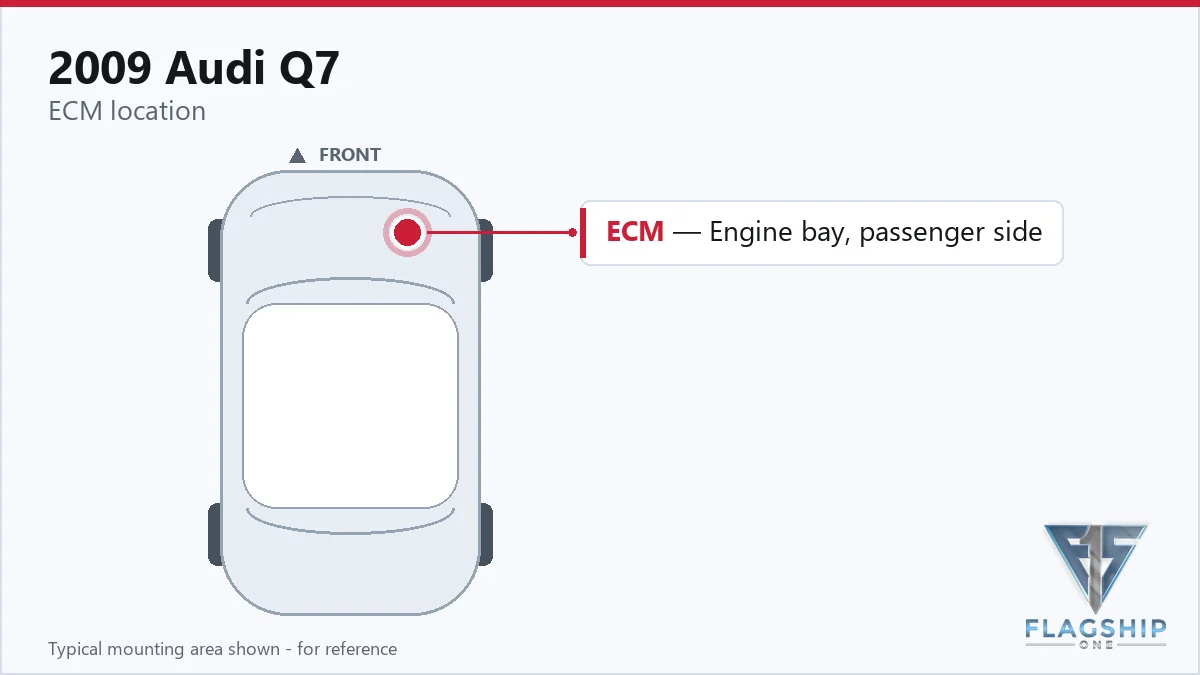
Work with the ignition off, and treat the module as static-sensitive: avoid touching the connector pins at any point.
| Operation | Configuration | Book Time |
|---|---|---|
| Powertrain Control Module R&R | All configurations | 0.4 hr |
| Engine Control Module Relearn | All configurations | 0.5 hr |
| Engine Control Module R&R | All configurations | 0.6 hr |
After installing a new or used PCM in the 2009 Audi Q7 3.6L, the factory procedure requires a relearn process. This involves using a diagnostic tool to perform an Engine Control Module Relearn, which takes 0.5 hours according to labor guides. During this step, the tool synchronizes the module with the vehicle’s immobilizer system, adapts the throttle position, and resets learned fuel trims. Without this relearn, the engine may run poorly or the immobilizer may prevent starting. Flagship One eliminates this step by shipping a VIN-programmed replacement unit that is already matched to your vehicle’s immobilizer and calibration data. The module arrives ready to install, so you can simply plug it in, reconnect the battery, and start the engine. No dealer visit or specialized scan tool is needed for the relearn. However, you should still perform a basic idle relearn if the throttle body was disturbed, which is a simple procedure of turning the ignition on for 10 seconds then off.
A failing PCM in the 2009 Audi Q7 3.6L can produce a wide range of symptoms that mimic other component failures. The most common sign is an illuminated check-engine light with codes related to sensor circuits or internal module faults. You may experience intermittent stalling, especially when the engine is hot, or a no-start condition where the engine cranks but never fires. The transmission may shift erratically or get stuck in a single gear because the PCM controls shift solenoids. Another clue is a loss of communication with a scan tool — if the tool cannot connect to the PCM, the module itself may be dead. Misfire codes (P0300–P0306) can appear even after replacing spark plugs and coils, pointing to a PCM that is not firing the injectors or ignition coils correctly. The service bulletin 01 specifically mentions knock sensor circuit low input and P0325, which indicate the PCM is not receiving a valid signal from the knock sensors. This can cause the PCM to default to a conservative timing map, resulting in reduced power and poor fuel economy. Other symptoms include the battery draining overnight if a PCM internal short occurs, or the vehicle entering a limp-home mode with reduced engine speed.
Audi issued service bulletin 01 for the 2009 Q7 3.6L addressing a check-engine light illuminated with diagnostic trouble codes P0327 or P0325 stored in the ECM. These codes indicate a knock sensor 1 circuit low input or knock sensor 1 circuit malfunction, respectively. The bulletin likely directs technicians to inspect the knock sensor wiring and connector for damage or corrosion, and to replace the sensor if no wiring issues are found. In some cases, the ECM itself may need reprogramming or replacement if the fault persists after sensor replacement. This bulletin underscores the importance of addressing knock sensor codes promptly, as a faulty sensor can lead to engine damage from undetected detonation.
| Bulletin | Subject | What It Addresses |
|---|---|---|
| — | 01 MIL on (DTC P0327 or P0325 in ECM) | — |
Yes, if you have basic mechanical skills. The PCM is accessible under the windshield cowl, and the labor time is only 0.4 to 0.6 hours. However, you will need a factory-level scan tool to perform the immobilizer relearn unless you use a pre-programmed unit from Flagship One.
The relearn procedure synchronizes the new PCM with the vehicle’s immobilizer system, adapts the electronic throttle, and resets fuel trim values. It requires a diagnostic tool capable of communicating with Audi’s CAN bus, such as VCDS or a dealer-level scanner.
Audi often uses the terms interchangeably for this vehicle. The labor guide lists Powertrain Control Module R&R at 0.4 hours and Engine Control Module R&R at 0.6 hours, likely reflecting different access steps or connector counts. In practice, they refer to the same physical module.
A used PCM must come from an identical vehicle with the same engine, transmission, and software calibration. Even then, it will need to be reprogrammed to your VIN and immobilizer data. Flagship One’s pre-programmed units are a more reliable option because they are matched to your specific vehicle.
P0327 indicates the knock sensor 1 circuit has a low input voltage. This can be caused by a faulty knock sensor, damaged wiring, or a failing PCM. The service bulletin 01 addresses this code and recommends inspecting the sensor and wiring before replacing the module.
When your 2009 Audi Q7 3.6L needs a new PCM, you have two paths: have a dealer install a new module and perform the relearn, or choose a refurbished replacement that arrives pre-programmed. The dealer route often costs more due to labor and programming fees. A pre-programmed unit from Flagship One eliminates the relearn step and is ready to install in the plenum chamber, saving you time and money while restoring full drivability.
Flagship One stocks a refurbished, VIN-programmed PCM for the 2009 Audi Q7 with a lifetime warranty, free shipping and no core charge. The full Audi Q7 module lineup covers other engine configurations as well.
The 2009 Audi Q7 3.6L relies on its PCM for engine and transmission control. When failure occurs, symptoms like MIL illumination with codes P0327 or P0325, stalling, or no-start can appear. Replacing the module is straightforward with the right part. A pre-programmed unit from Flagship One simplifies the process by removing the need for a dealer relearn, getting your Q7 back on the road quickly.