
Last updated on August 25th, 2026 at 01:01 pm
The engine control module in your 2003 Audi S8 manages fuel injection, ignition timing, and emissions systems. If it fails, you may experience erratic engine behavior, poor performance, or a complete no-start condition due to disrupted sensor communication.
If your 2003 Audi S8 is experiencing unexplained stalling, rough idling, or a refusal to start, the engine control module may be the culprit. This critical component acts as the brain of your vehicle’s powertrain, coordinating fuel injection, ignition timing, and emissions controls. When it malfunctions, the effects can range from subtle performance issues to a complete breakdown. Replacing the module involves more than just swapping parts—it requires precise installation and programming to ensure proper communication with the engine’s sensors. Understanding the location, labor involved, and post-replacement steps can help you make an informed decision. Whether you’re a DIY enthusiast or relying on a professional, knowing what to expect can save time and prevent unnecessary complications. This guide covers everything from identifying symptoms to the replacement process, so you can restore your S8’s performance with confidence.
The engine control module in your 2003 Audi S8 is a specialized computer responsible for managing the engine’s most critical functions. It processes data from sensors monitoring air intake, throttle position, oxygen levels, and engine temperature to optimize fuel delivery and ignition timing. This ensures efficient combustion, smooth acceleration, and compliance with emissions standards. Without a properly functioning module, your vehicle may struggle with poor fuel economy, hesitation under load, or even fail to start. The module also plays a role in diagnosing issues by storing trouble codes when sensor readings fall outside expected ranges. If you’re considering a replacement, replacement engine control modules for the Audi S8 are designed to restore factory-level performance. However, not all replacements are equal—some require additional programming, while others arrive ready to install, saving you time and potential headaches.
2003 Audi S8
OEM programmed ECM for your 2003 Audi S8 — plug & play, no dealer visit.
Free shipping · Lifetime warranty
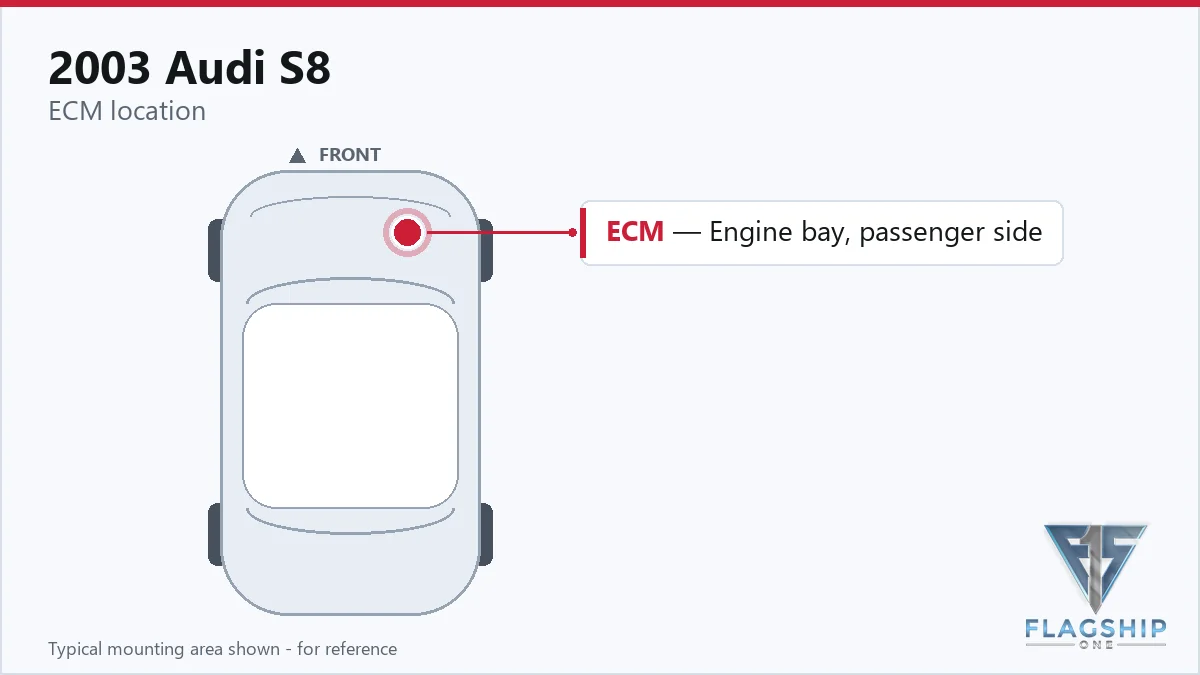
In the 2003 Audi S8, the engine control module is located inside the plenum chamber, which sits atop the engine. Accessing it requires removing the plenum cover, a process that typically involves disconnecting intake components and electrical connectors. According to factory labor estimates, replacing the module takes about 1.1 hours. This includes the time needed to carefully remove the old unit, install the new one, and reassemble the plenum. The location is designed for protection from moisture and heat, but it also means replacement isn’t a quick task. Torque specifications for fasteners are critical to prevent vacuum leaks or damage to the plenum. If you’re unfamiliar with the process, consulting a repair manual or professional technician is recommended to avoid missteps that could lead to further issues.
| Operation | Configuration | Book Time |
|---|---|---|
| Engine Control Module Relearn | A8 Quattro | 0.5 hr |
| Engine Control Module Relearn | S8 | 0.5 hr |
| Engine Control Module R&R | A8 Quattro | 1.1 hr |
| Engine Control Module R&R | S8 | 1.1 hr |
| Powertrain Control Module R&R | A8 Quattro | 1.1 hr |
| Powertrain Control Module R&R | S8 | 1.1 hr |
| Powertrain Control Module Relearn | A8 Quattro | 0.5 hr |
| Powertrain Control Module Relearn | S8 | 0.5 hr |
After replacing the engine control module in your 2003 Audi S8, the factory procedure requires a relearn process to synchronize the new unit with the vehicle’s sensors and systems. This typically takes 0.5 hours and involves using a diagnostic tool to reset adaptive values and ensure proper communication. However, if you opt for a VIN-programmed replacement unit from Flagship One, these steps are already completed before the module arrives. This means you can install the unit and drive your vehicle without additional programming, reducing labor time and potential complications. The pre-programmed unit is matched to your VIN, ensuring compatibility with your S8’s specific engine and transmission configurations. This approach eliminates the risk of errors during the relearn process and gets you back on the road faster.
A failing engine control module in your 2003 Audi S8 can manifest in several ways, often mimicking other mechanical or electrical issues. One of the most common signs is a no-start condition, where the engine cranks but refuses to fire due to incorrect fuel or spark delivery. You may also experience intermittent stalling, particularly at idle or during deceleration, as the module struggles to maintain stable engine operation. Misfires are another frequent symptom, often accompanied by a rough idle or hesitation under acceleration. These issues may trigger the check engine light, with codes like internal control module memory check sum error indicating a fault within the module itself. Additionally, you might notice poor fuel economy or a lack of response when pressing the accelerator pedal. In some cases, the vehicle may enter a “limp mode,” limiting power to prevent further damage. If your scan tool fails to communicate with the module, it could signal a complete failure, requiring immediate attention to avoid being stranded.
Intermittent stalling in your S8 may stem from a failing engine control module, particularly if the issue occurs without warning and is accompanied by rough idling. The module regulates fuel and ignition timing, so erratic behavior can disrupt engine stability. A diagnostic scan for trouble codes can help confirm whether the module is at fault or if another component, like a sensor or fuel pump, is responsible.
Distinguishing between a failing module and a sensor issue often requires a professional diagnostic scan. If multiple sensors report implausible values or the scan tool fails to communicate with the module, the module itself may be the problem. However, if only one sensor triggers a code, the issue is more likely isolated to that component. A thorough inspection of wiring and connectors can also help rule out electrical faults.
Driving with a failing engine control module is risky, as it can lead to unpredictable behavior like sudden stalling, misfires, or a complete loss of power. In some cases, the vehicle may enter a “limp mode,” severely limiting performance to prevent damage. If you suspect module failure, it’s best to address the issue promptly to avoid being stranded or causing further harm to the engine.
Replacing the module in your S8 requires basic hand tools, including sockets and wrenches for removing the plenum cover. A torque wrench is essential to ensure fasteners are tightened to specification. Additionally, a scan tool may be needed to clear codes or perform a relearn procedure after installation. If you’re not familiar with the process, consulting a repair manual or professional technician is advisable to avoid mistakes.
A used module from another S8 may physically fit, but it will likely require reprogramming to match your vehicle’s VIN and configuration. Without proper programming, the module may not communicate correctly with your engine’s sensors, leading to performance issues or a no-start condition. For reliable results, a new or pre-programmed replacement unit is recommended to ensure compatibility and avoid additional labor costs.
If your 2003 Audi S8 is showing signs of a failing engine control module, you have options beyond costly dealer repairs. A refurbished or new replacement unit can restore performance without the wait or expense of a factory part. Given the labor involved in accessing the module, choosing a pre-programmed unit can save time and reduce the risk of post-installation issues. Whether you’re tackling the job yourself or relying on a shop, understanding the process ensures you make the best choice for your vehicle’s needs.
Flagship One stocks a refurbished, VIN-programmed PCM for the 2003 Audi S8 with a lifetime warranty, free shipping and no core charge. The full Audi S8 module lineup covers other engine configurations as well.
The 2003 Audi S8 relies on its engine control module to maintain smooth, efficient operation. When this component fails, it can lead to frustrating symptoms like stalling, misfires, or a no-start condition. Replacing the module involves careful installation and, in some cases, additional programming to ensure proper function. By opting for a pre-programmed replacement, you can streamline the process and get your S8 back on the road with minimal downtime. Whether you choose to handle the job yourself or leave it to a professional, addressing the issue promptly will help preserve your vehicle’s performance and reliability.