
Last updated on August 25th, 2026 at 01:01 pm
In the 1999 Audi A8, the engine control module (ECM) and powertrain control module (PCM) act as the vehicle’s brain, interpreting sensor data to manage fuel, ignition, and transmission. Failure typically results in loss of driveability, diagnostic communication loss, and stored fault codes that prevent normal operation.
When a 1999 Audi A8 begins to exhibit no‑start conditions, intermittent stalling, or unexpected transmission behavior, the engine and powertrain control modules are often suspects. These electronic units coordinate fuel delivery, spark timing, and gear changes, so any disruption can quickly affect drivability. Understanding where the modules live, how long a shop typically spends on removal, installation, and relearn procedures, and what Flagship One can provide helps you make an informed decision about repair versus replacement. This guide walks you through the essential facts, typical symptoms, and practical steps to keep your A8 running as the manufacturer intended.
1999 Audi A8
OEM programmed ECM for your 1999 Audi A8 — plug & play, no dealer visit.
Free shipping · Lifetime warranty
The engine control module in the 1999 Audi A8 processes inputs from dozens of sensors to calculate the precise amount of fuel and spark needed for each cylinder. It also communicates with the powertrain control module, which oversees transmission shift timing and torque converter operation. Together, they ensure smooth acceleration, fuel efficiency, and emissions compliance. Because the A8 relies on coordinated electronic control, any fault in these units can cause rough idle, loss of power, or complete shutdown. The module’s role is critical, and a properly functioning replacement engine computer is essential for reliable performance. 1999 Audi A8 engine control module helps maintain the vehicle’s calibrated operation.
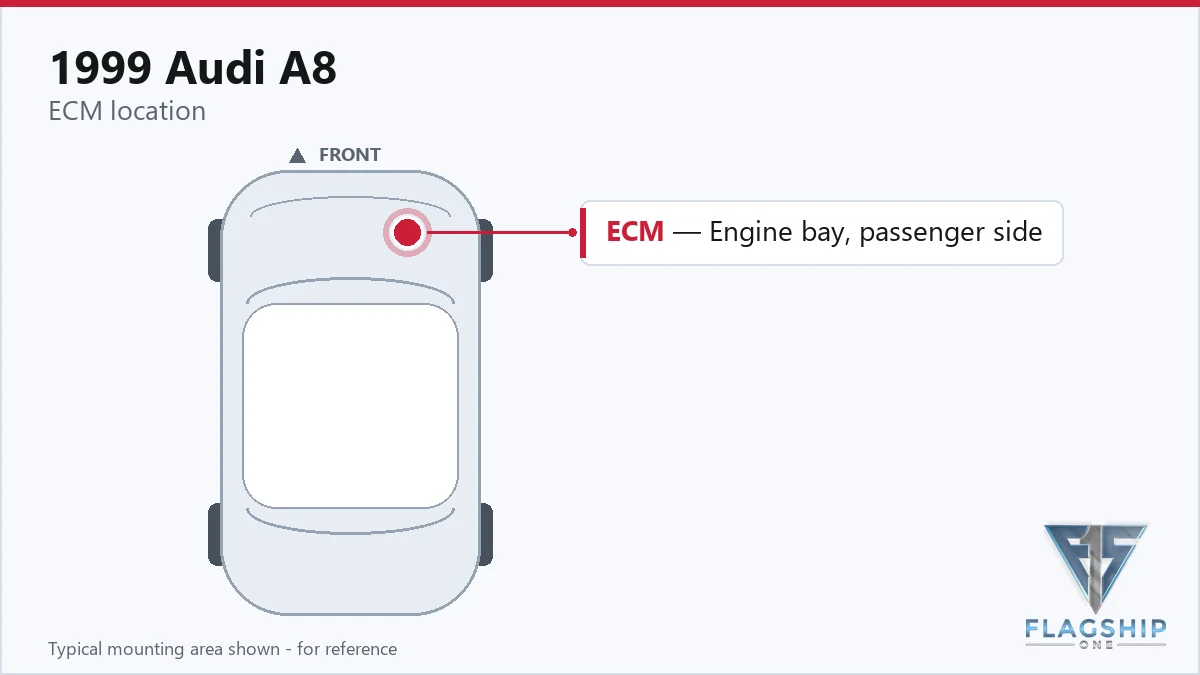
The factory layout places the engine control module inside the engine‑bay plenum, reachable through the fuel‑injection and ignition service area. Removing the unit typically follows the same steps used for the fuel‑injection and ignition components, allowing technicians to access the module without extensive disassembly. Labor times listed in the service guide indicate that a complete removal and reinstall of the ECM requires about 1.1 hours, while a simple relearn after replacement adds another 0.5 hours. The powertrain control module follows the same access path and timing, with identical removal, installation, and relearn durations. No torque specifications are provided in the available data.
| Operation | Configuration | Book Time |
|---|---|---|
| Engine Control Module Relearn | A8 | 0.5 hr |
| Engine Control Module Relearn | A8 Quattro | 0.5 hr |
| Engine Control Module R&R | A8 | 1.1 hr |
| Engine Control Module R&R | A8 Quattro | 1.1 hr |
| Powertrain Control Module R&R | A8 | 1.1 hr |
| Powertrain Control Module R&R | A8 Quattro | 1.1 hr |
| Powertrain Control Module Relearn | A8 | 0.5 hr |
| Powertrain Control Module Relearn | A8 Quattro | 0.5 hr |
After installing a new ECM or PCM in the 1999 Audi A8, the factory procedure calls for a relearn operation that takes roughly half an hour per module. This step restores the vehicle’s adaptive memory and ensures proper sensor calibration. Flagship One units arrive already VIN‑programmed, so the required relearn is effectively completed before the part reaches your shop. Using a a VIN‑programmed replacement unit means the technician can focus on mechanical installation and verification rather than extensive coding sessions.
When the ECM or PCM in a 1999 Audi A8 begins to fail, drivers may notice the engine refusing to start, sudden stalling at idle, or erratic transmission shifts that feel harsh or delayed. Diagnostic trouble codes often appear on a scan tool, and communication with the vehicle’s computer network can be lost, preventing further troubleshooting. Misfire patterns, reduced power, and unusual fuel consumption are also common clues that the control modules are not functioning correctly. Addressing these signs early can prevent more extensive damage to related systems.
The service guide lists about 1.1 hours for removal and installation, plus an additional 0.5 hours for the required relearn procedure.
While the module is accessible through the fuel‑injection area, the procedure involves precise electrical connections and a relearn step, so professional installation is recommended.
Flagship One provides units that are VIN‑programmed at the factory, eliminating the need for on‑site coding tools.
Unexpected transmission shifts, loss of torque converter control, and related diagnostic codes are common signs of PCM issues.
Flagship One offers a standard warranty on its refurbished units, covering defects and ensuring functional performance.
When the engine or powertrain control module in your 1999 Audi A8 needs attention, you can choose a factory‑refurbished replacement from Flagship One or have a qualified shop perform a repair. Both paths aim to restore reliable operation, but a VIN‑programmed unit simplifies the post‑install steps, letting you get back on the road faster.
Flagship One stocks a refurbished, VIN-programmed PCM for the 1999 Audi A8 with a lifetime warranty, free shipping and no core charge. The full Audi A8 module lineup covers other engine configurations as well.
The 1999 Audi A8 relies on its ECM and PCM for smooth performance; choosing a properly programmed replacement can save time and keep the vehicle running as intended. Consider your options and act promptly to maintain drivability.