
Last updated on August 25th, 2026 at 01:01 pm
The powertrain control module on the 1997 Audi A8 manages fuel injection timing, ignition advance, and transmission shift points. When this module fails, your vehicle may exhibit hard-starting, poor idle quality, or illumination of the check-engine light without an obvious cause.
Owning a 1997 Audi A8 means appreciating refined engineering, but it also means confronting aging electronics that may eventually require attention. The powertrain control module in your vehicle serves as the central nervous system for engine management, and when it malfunctions, the resulting driveability problems can be frustratingly difficult to diagnose. Many owners initially suspect simpler issues like ignition components or fuel delivery before considering that the computer itself may be at fault. This guide walks through what the module does, where it resides in your A8, how replacement and relearn procedures work according to factory specifications, and what symptoms typically accompany failure. By understanding these aspects, you can make an informed decision about repair versus replacement when facing electronic issues with your Audi. The information here helps you recognize when the control module deserves investigation and what to expect from the repair process.
The powertrain control module in your 1997 Audi A8 functions as the primary computer responsible for managing engine and transmission operation. This unit processes input from numerous sensors including the mass air flow sensor, oxygen sensors, throttle position sensor, and crankshaft position sensor to calculate ideal fuel delivery and ignition timing for current driving conditions. The module also controls automatic transmission shift points on models equipped with the Tiptronic automatic gearbox, coordinating clutch apply and release sequences for smooth gear changes.
When this module experiences internal failures, the consequences extend across multiple vehicle systems. The A8 may develop hesitation during acceleration, exhibit elevated idle speeds, or fail to start altogether. Some owners report that the check-engine light illuminates with trouble codes stored for random misfires or circuit malfunctions that persist even after addressing conventional ignition components. The module also monitors emissions control systems, and degradation may cause increased exhaust emissions that trigger inspection failure in areas with emissions testing requirements.
This computer operates within the harsh environment of the engine compartment, exposed to heat cycles, moisture, and vibration over years of service. Thermal stress gradually degrades internal circuit board connections and solder joints within the sealed module housing. Voltage irregularities from a weakening charging system accelerate this deterioration process. Understanding the module’s central role in your replacement engine computers for the Audi A8 helps clarify why symptoms can appear across seemingly unrelated systems when the control unit fails.
1997 Audi A8
OEM programmed ECM for your 1997 Audi A8 — plug & play, no dealer visit.
Free shipping · Lifetime warranty
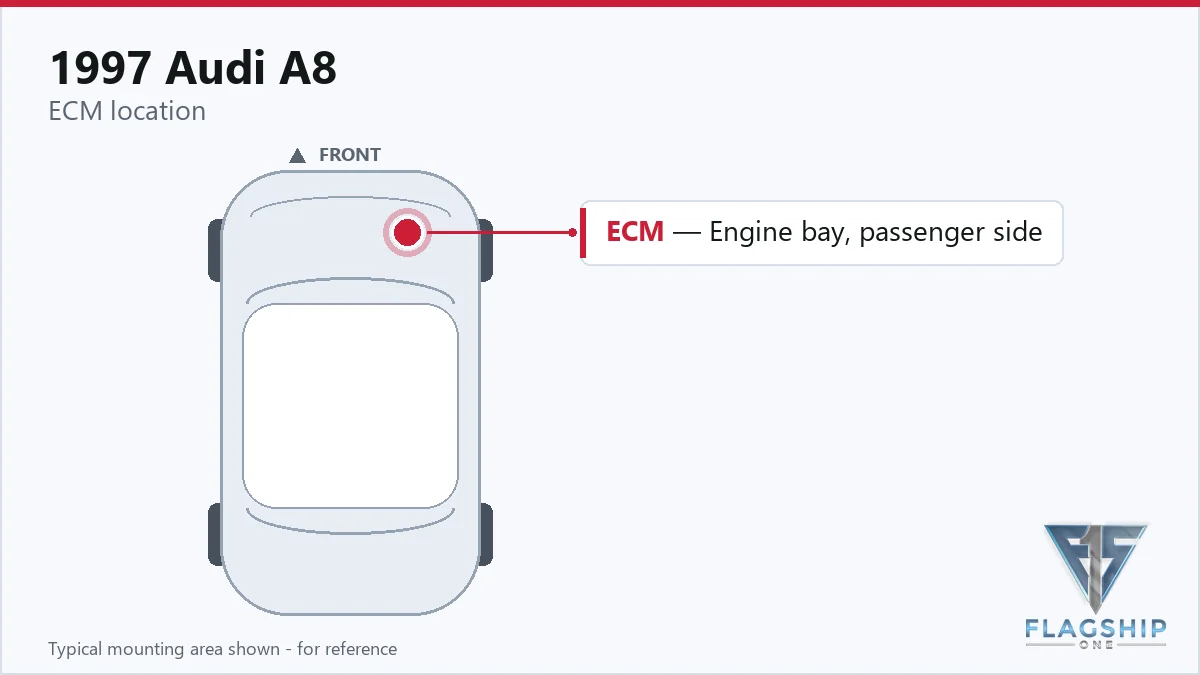
The factory component-location overview positions the engine control module inside the plenum area of the 1997 Audi A8. This location places the module above the engine, typically accessible from the passenger compartment near the firewall. Accessing this component requires careful disassembly to reach the plenum chamber where the unit resides.
Factory labor standards specify that removing and reinstalling the engine control module on the A8 requires one point one hours of work according to published repair times. The same removal and reinstallation interval applies to the A8 Quattro all-wheel-drive variant. These intervals reflect the time needed to access the module location, disconnect electrical connectors, remove mounting hardware, and complete the reverse installation procedure with the replacement unit.
Following module installation, a separate relearn procedure becomes necessary. The relearn operation for the A8 occupies point five hours of labor time, and the identical procedure for the Quattro model requires the same duration. This additional step programs the new module to recognize vehicle-specific sensor calibrations and establishes proper communication between the control unit and remaining vehicle systems. The total time investment when combining removal and reinstallation with relearn falls within predictable ranges that your repair facility can incorporate into the overall service estimate.
| Operation | Configuration | Book Time |
|---|---|---|
| Engine Control Module Relearn | A8 | 0.5 hr |
| Engine Control Module Relearn | A8 Quattro | 0.5 hr |
| Engine Control Module R&R | A8 | 1.1 hr |
| Engine Control Module R&R | A8 Quattro | 1.1 hr |
| Powertrain Control Module R&R | A8 | 1.1 hr |
| Powertrain Control Module R&R | A8 Quattro | 1.1 hr |
| Powertrain Control Module Relearn | A8 | 0.5 hr |
| Powertrain Control Module Relearn | A8 Quattro | 0.5 hr |
After installing a replacement powertrain control module in your 1997 Audi A8, the factory service procedure requires executing a relearn sequence to establish proper communication between the new unit and your vehicle. This procedure synchronizes the module with existing sensors and calibrates baseline values for fuel trims, idle speed control, and transmission adaptives. The relearn operation cannot be skipped, as an unprogrammed module will not properly manage engine operation without this configuration step.
The relearn process typically involves using factory-level diagnostic equipment to initiate the adaptation procedure while monitoring live data parameters. During this sequence, the module learns your vehicle’s specific characteristics including injector flow rates and vacuum leak severity. Once completed, the module stores these values and uses them for ongoing fuel and ignition calculations.
When purchasing a replacement module from Flagship One, you receive a VIN-programmed replacement unit that arrives configured with your specific vehicle identification number already written into the module memory. This pre-programming means the relearn procedure you would otherwise require at a dealership has already been performed at the factory. You still need to verify proper installation and clear any stored fault codes, but the time-consuming programming step that traditionally required dealer equipment has been completed before the module reaches your door.
Powertrain control module failures on the 1997 Audi A8 often announce themselves through symptoms that mimic other common problems, making diagnosis challenging without proper tooling. Hard-starting or no-start conditions frequently occur when the module fails to deliver proper injector pulse width or fails to activate the fuel pump relay. An owner may replace starter components, battery, and fuel system parts without resolving the underlying issue.
Intermittent stalling represents another characteristic symptom, particularly when the module loses communication with sensors momentarily before recovering. During these episodes, the engine may die at idle or under deceleration, then restart normally as if nothing occurred. This inconsistent behavior points toward internal module circuitry with marginal connections that expand with heat.
Stored trouble codes often accompany module failure and may include random misfire codes, circuit malfunctions for sensors that test good when checked manually, or complete loss of communication with the scan tool. Some owners encounter situations where the check-engine light remains illuminated despite replacing all related ignition components. When diagnostic efforts reveal no conventional causes for persistent codes, internal module health deserves investigation.
Automatic transmission shifting may also suffer when the control module degrades, producing harsh engagements, delayed shifts, or failure to shift into certain gears. The module coordinates clutch apply sequences through data received from input and output speed sensors, and corruption in these calculations produces noticeable drivability complaints. Addressing these symptoms early often prevents cascading damage to transmission components that result from abnormal shift patterns.
Technical skill and proper tooling determine whether a competent DIY mechanic can complete this job. You need access to the plenum area where the module resides, familiarity with electrical connector release procedures, and a method to clear fault codes afterward. The removal and reinstallation labor is straightforward for experienced shade-tree mechanics, but you still need to verify proper operation after installation.
If symptoms persist after module replacement, the problem likely involves wiring, connectors, or sensors rather than the module itself. Inspect the harness for damaged insulation, broken wires at connector pins, and signs of water intrusion in the connector housings. A thorough electrical diagnosis before replacement often saves frustration and unnecessary parts purchases.
Module failures typically result from heat cycling, moisture contamination, and voltage stress over extended service life. The engine compartment environment subjects electronics to temperatures that fluctuate with engine operation, gradually degrading solder joints and internal connections. A weak charging system that allows voltage spikes or prolonged low voltage accelerates this deterioration process considerably.
Used modules carry unknown service history and may already be experiencing the same degradation process that led to the original failure. A module from a salvage yard offers no programming history and typically requires the same relearn procedure as a new unit. Refurbished options from reputable suppliers often provide better value through inspection, repair, and warranty coverage that used parts cannot match.
Complete communication failure with the module or persistent internal fault codes despite sensor replacements points toward hardware failure requiring replacement. Intermittent issues that respond to battery disconnection may indicate programming corruption addressable through relearn. A professional diagnosis with factory-level scan tools typically clarifies whether replacement or reprogramming represents the appropriate repair path.
When facing powertrain control module issues with your 1997 Audi A8, you face a choice between repairing the existing module or installing a replacement unit. Professional repair services may address internal component-level failures, though success depends on specific fault types and available repair techniques. Replacement with a professionally refurbished unit provides a known-good baseline and typically includes warranty coverage. The location in the plenum and labor intervals for removal and reinstallation apply regardless of which repair path you select, so understanding total cost of ownership helps guide your decision.
Flagship One stocks a refurbished, VIN-programmed PCM for the 1997 Audi A8 with a lifetime warranty, free shipping and no core charge. The full Audi A8 module lineup covers other engine configurations as well.
The powertrain control module on your 1997 Audi A8 performs essential functions that directly affect drivability, emissions, and transmission operation. Recognizing the symptoms of module failure helps you pursue appropriate diagnosis rather than replacing unrelated components. Whether you ultimately choose professional repair or replacement with a quality refurbished unit, understanding the role this computer plays in your vehicle empowers you to make informed repair decisions. Flagship One provides VIN-programmed replacement modules that eliminate one step of the factory service procedure, simplifying your repair experience.