
Last updated on August 25th, 2026 at 01:19 pm
In the 2020 Hyundai Tucson the Engine Control Module and Powertrain Control Module manage engine timing, fuel delivery and transmission shift strategy. A failure in either unit can cause loss of power, stalling, or erratic gear changes, often triggering diagnostic codes and disabling normal operation.
When a 2020 Hyundai Tucson begins to exhibit no‑start conditions, unexpected stalling or erratic shifting, the engine and powertrain control modules are frequent suspects. Understanding how these computers operate, where they sit in the engine bay, and what steps are required after replacement can save you time and prevent costly re‑work. This guide walks you through the location of the ECM and PCM, the labor involved, the essential VIN programming step, and practical tips to keep the new unit functioning reliably. By the end, you will know what to expect from a proper replacement and how Flagship One’s pre‑programmed units simplify the process.
The Engine Control Module in the 2020 Hyundai Tucson acts as the brain for the gasoline engine, continuously monitoring sensor data to adjust fuel injection, ignition timing and emissions controls. It also communicates with the Powertrain Control Module, which oversees transmission shift logic and torque converter operation. Together, these computers ensure smooth acceleration, fuel efficiency and compliance with emissions standards. A malfunction can disrupt engine timing, cause misfires or prevent the transmission from engaging correctly, leading to drivability issues and diagnostic trouble codes. Proper operation is critical because the vehicle relies on precise coordination between engine output and gear selection. The 2020 Hyundai Tucson replacement engine computers are engineered to meet these timing and communication demands, and any deviation can affect overall performance.
2020 Hyundai Tucson
OEM programmed replacements — plug & play, no dealer visit.
Find yours by year, make & model →
Free shipping · Lifetime warranty
In the Tucson the control module is positioned next to the air cleaner assembly, making it accessible once the intake housing is removed. The factory removal procedure specifies that you reach the module by working around this air cleaner area. Labor times from the service book list 0.7 hours for removing and reinstalling the Engine Control Module and the same for the Powertrain Control Module. After the unit is seated, the installation nuts must be tightened to a torque range of 9.8 to 11.8 N·m. Once secured, the relearn steps require an additional 0.5 hours for each module, while a simple reset takes about 0.3 hours. These times reflect typical shop practice for a standard replacement without additional complications.
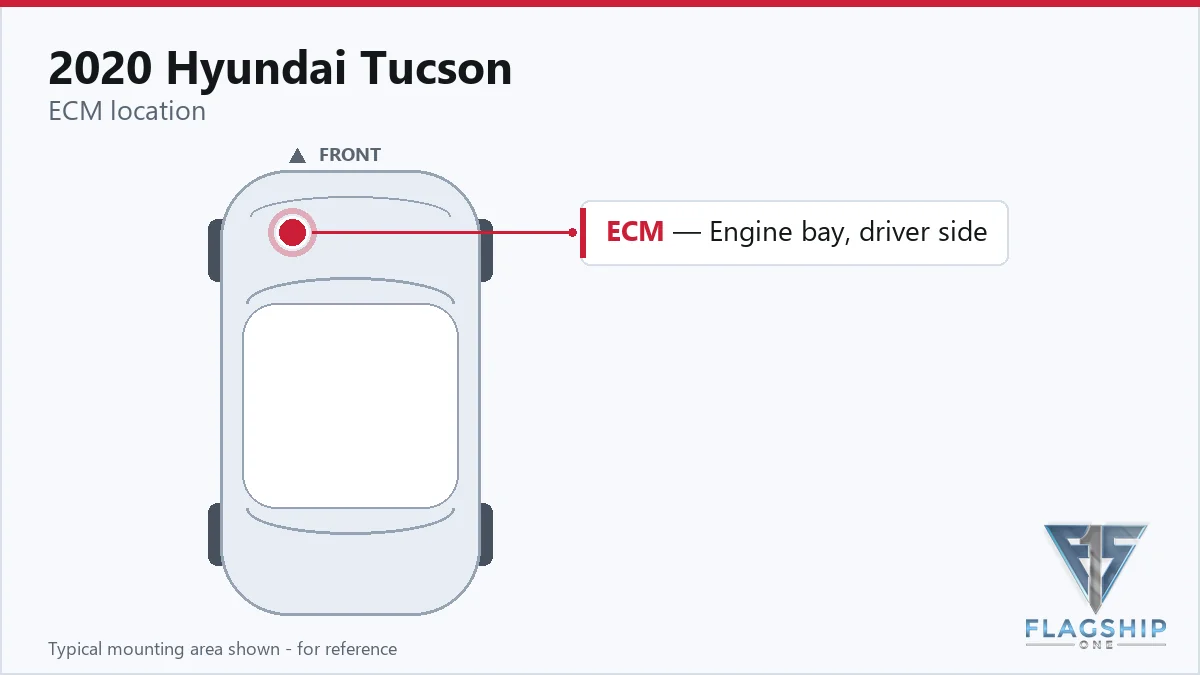
Work with the ignition off, and treat the module as static-sensitive: avoid touching the connector pins at any point.
| Operation | Configuration | Book Time |
|---|---|---|
| Engine Control Module R&R | All configurations | 0.7 hr |
| Engine Control Module Relearn | All configurations | 0.5 hr |
| Engine Control Module Reset | All configurations | 0.3 hr |
| Powertrain Control Module R&R | All configurations | 0.7 hr |
| Powertrain Control Module Relearn | All configurations | 0.5 hr |
After installing a new ECM in the 2020 Hyundai Tucson, the factory procedure mandates that the vehicle identification number be programmed into the module to ensure proper communication with the vehicle’s networks. Flagship One supplies units that arrive already VIN‑programmed, so the technician can skip this step and move directly to the relearn process. This eliminates the need for a separate programming session and reduces the chance of errors during VIN entry. The a VIN‑programmed replacement unit therefore streamlines the post‑install workflow and helps maintain compliance with Hyundai’s specifications.
When the ECM or PCM in a 2020 Hyundai Tucson begins to fail, you may notice a range of symptoms that affect drivability. Common signs include a complete no‑start condition where the engine cranks but does not fire, intermittent stalling while cruising, rough idle, or a loss of power during acceleration. Transmission‑related issues such as harsh shifting, delayed gear engagement, or the vehicle remaining in a single gear can also appear. Diagnostic trouble codes often accompany these symptoms; for example, a P0601 code indicating a internal control module memory checksum error may be logged. Additionally, you might experience dead communication with scan tools, making it difficult to retrieve data or clear codes. Recognizing these cues early can help you address the underlying module problem before it leads to broader system failures.
The service book lists about 0.7 hours for the removal and reinstall of the Engine Control Module, which reflects a typical shop scenario.
Yes, the factory procedure requires VIN programming for the Powertrain Control Module, but a Flagship One unit arrives pre‑programmed, eliminating that step.
The specified torque range for the ECM installation nuts is between 9.8 and 11.8 N·m.
Because the ECM communicates with the PCM, a malfunction can lead to erratic or harsh shifting, as the transmission relies on engine data for gear decisions.
Symptoms often include delayed gear engagement, unexpected gear lock‑up, and diagnostic codes related to powertrain control, which may also trigger engine performance issues.
When the ECM or PCM in your 2020 Hyundai Tucson needs attention, you can choose a professional repair or consider a refurbished replacement. Both paths require the same removal steps and post‑install verification, but a Flagship One unit arrives pre‑programmed, reducing shop time. Evaluate the condition of your existing module, the cost of labor, and the benefits of a tested, VIN‑ready replacement before deciding which route best fits your service schedule.
Flagship One stocks a refurbished, VIN-programmed PCM for the 2020 Hyundai Tucson with a lifetime warranty, free shipping and no core charge. The full Hyundai Tucson module lineup covers other engine configurations as well.
The Engine Control Module and Powertrain Control Module are essential to the reliable operation of your 2020 Hyundai Tucson. Proper removal, torque, and VIN programming ensure the vehicle returns to normal performance. If you need a replacement, consider a pre‑programmed unit to simplify the process and keep your Tucson running smoothly.