
Last updated on August 25th, 2026 at 01:19 pm
In the 2019 Hyundai Tucson, the Engine Control Module (ECM) and Powertrain Control Module (PCM) manage fuel delivery, ignition timing, emissions, and transmission shifting. A failure in either unit can cause loss of engine power, stalling, or communication loss with diagnostic tools, leading to drivability problems and potential emissions non‑compliance.
If your 2019 Hyundai Tucson is exhibiting no‑start conditions, rough shifting, or erratic engine behavior, the electronic control modules may be at fault. Understanding how the ECM and PCM function, where they reside, and what steps are required after a swap can help you resolve the issue efficiently. This guide walks you through the purpose of these modules, the exact location and removal process, the programming requirements, and practical tips to keep the new unit reliable. By the end, you’ll know what to expect in labor, torque specifications, and how Flagship One’s VIN‑programmed replacements simplify the post‑install steps, allowing you to get the Tucson back on the road with confidence.
The Engine Control Module in the 2019 Hyundai Tucson acts as the brain for the gasoline engine, constantly adjusting fuel injection, spark timing, and emissions controls based on sensor input. It also communicates with the Powertrain Control Module, which oversees transmission operation and overall drivetrain coordination. Together, these units ensure smooth acceleration, optimal fuel economy, and compliance with emission standards. When either module fails, the vehicle may lose power, stall, or refuse to start, and diagnostic tools may lose communication. Proper operation is critical because the modules manage safety‑related functions such as idle control and torque limiting. Understanding their role helps you appreciate why accurate VIN programming and correct torque are essential during replacement. For the Tucson, 2019 Hyundai Tucson engine control module replacement follows a defined factory procedure that positions the module next to the air cleaner assembly.
2019 Hyundai Tucson
OEM programmed ECM for your 2019 Hyundai Tucson — plug & play, no dealer visit.
Free shipping · Lifetime warranty
The factory removal procedure for the 2019 Hyundai Tucson places the control module beside the air cleaner assembly, giving direct access without extensive disassembly. Removing the ECM or PCM typically requires 0.7 hours of labor according to the service book. After the module is disengaged, the installation nuts must be tightened to a range of 9.8 to 11.8 N·m to ensure a secure fit without over‑stress. The same labor time applies to the PCM, which shares the same mounting location. Once the new unit is seated, the technician performs a relearn operation—0.5 hours for the ECM and 0.5 hours for the PCM—to synchronize the module with the vehicle’s existing sensors and actuators. A final reset, taking 0.3 hours for the ECM and 0.3 hours for the PCM, clears stored values and prepares the system for normal operation.
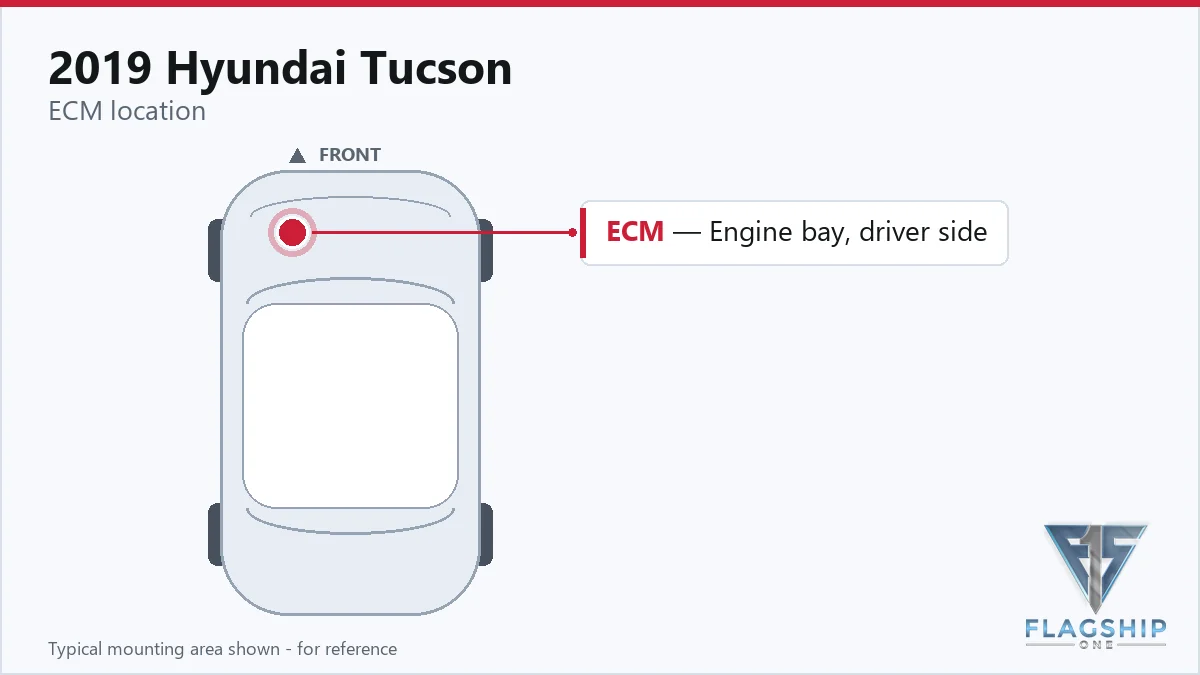
Work with the ignition off, and treat the module as static-sensitive: avoid touching the connector pins at any point.
| Operation | Configuration | Book Time |
|---|---|---|
| Engine Control Module R&R | All configurations | 0.7 hr |
| Engine Control Module Relearn | All configurations | 0.5 hr |
| Engine Control Module Reset | All configurations | 0.3 hr |
| Powertrain Control Module R&R | All configurations | 0.7 hr |
| Powertrain Control Module Relearn | All configurations | 0.5 hr |
After installing a new ECM or PCM in the 2019 Hyundai Tucson, the factory procedure requires the vehicle identification number to be programmed into the module before the engine will start. This step ensures the control unit matches the vehicle’s emissions certification and communication protocols. Flagship One units arrive already VIN‑coded, so the VIN programming step is completed at the factory. Consequently, when you install a a VIN-programmed replacement unit, you can skip the VIN entry and move directly to the relearn and reset processes, reducing shop time and the chance of programming errors.
When the ECM or PCM in a 2019 Hyundai Tucson begins to fail, owners often report a complete lack of engine start, intermittent stalling while driving, or unexpected loss of power during acceleration. Diagnostic scans may reveal communication errors, and the scan tool might lose link with the vehicle’s control network. Specific trouble codes such as P0601 communication error can appear, indicating internal module communication problems. Additional signs include erratic transmission shifting, rough idle, and occasional check‑engine lamp illumination with codes related to fuel trim or throttle position. These symptoms arise because the modules control critical engine and drivetrain functions, and any loss of their processing ability directly impacts vehicle performance.
You can physically replace the ECM, but the vehicle will not start until the VIN is programmed into the new unit, which typically requires a scan tool or a VIN‑programmed replacement.
The installation nuts should be tightened to a range of 9.8 to 11.8 N·m to ensure proper clamping without over‑torquing the fasteners.
The service book lists a relearn time of 0.5 hours for the ECM after installation, which aligns with the PCM relearn duration.
Yes, a VIN‑programmed unit from Flagship One comes pre‑coded, so the VIN entry step is already completed.
Codes such as P0601, which signals a communication error within the module, are typical indicators of ECM or PCM issues.
When the control module in your 2019 Hyundai Tucson needs attention, you can choose a factory‑refurbished unit or a new Flagship One replacement. Both options restore proper engine and transmission management, but the VIN‑programmed replacement reduces shop time by eliminating the programming step. Evaluate your budget and service schedule to decide which path best fits your repair plan.
Flagship One stocks a refurbished, VIN-programmed PCM for the 2019 Hyundai Tucson with a lifetime warranty, free shipping and no core charge. The full Hyundai Tucson module lineup covers other engine configurations as well.
The 2019 Hyundai Tucson relies on its ECM and PCM for reliable performance. Proper removal, torque, and VIN programming are essential to restore functionality. Consider a Flagship One VIN‑programmed replacement to streamline the repair and get your Tucson back on the road.