
Last updated on August 25th, 2026 at 12:14 pm
The engine control module in the 2018 Hyundai Sonata Plug-In Hybrid manages the 2.0L hybrid powertrain, coordinating fuel delivery, ignition timing, and electric motor integration; failure can cause no-start, stalling, or communication loss with scan tools.
When a 2018 Hyundai Sonata Plug-In Hybrid develops a sudden no-start condition, unexplained stalling, or a scan tool that simply will not communicate, the engine control module or powertrain control module often becomes the focus of diagnosis. These two computers share responsibility for the 2.0L hybrid powertrain, blending conventional fuel management with high-voltage electric motor control in a way that leaves little margin for error. A module that loses its internal memory or suffers a communication bus fault can mimic sensor failures, transmission problems, or even a dead high-voltage battery, sending a technician down a long path of unnecessary parts replacement. This guide walks through the factory location, labor allowances, torque values, and programming requirements so you can confirm whether the module itself is at fault and understand what a proper repair entails. You will also learn which service bulletins Hyundai has issued for VIN writing and ECU update procedures, and how a replacement unit that arrives already programmed to your vehicle identification number can eliminate several steps from the shop workflow. The goal is to give you the factual foundation needed to decide between bench repair, dealer reprogramming, or a plug-and-play replacement without guessing.
In the 2018 Hyundai Sonata Plug-In Hybrid the engine control module acts as the central processor for the 2.0L gasoline direct-injection engine while the powertrain control module coordinates the hybrid system, including the integrated starter-generator, high-voltage battery management, and the seamless transition between electric and combined propulsion modes. Because the two modules share sensor inputs — crankshaft position, throttle angle, coolant temperature, and battery state-of-charge — a fault in either one can produce symptoms that appear to originate in the other. The ECM stores the vehicle identification number, immobilizer data, and adaptive fuel trims that are learned over thousands of drive cycles; losing that data means the engine may idle roughly, hesitate on acceleration, or fail to start until a full relearn is completed. The PCM, meanwhile, governs the high-voltage contactors and regenerative braking logic, so a communication loss there can disable electric-only driving and trigger a fallback limp mode that limits speed and disables the plug-in charging function. When either module develops an internal memory error or a corrupted flash block, the factory scan tool will often report a module-internal code rather than a sensor code, and the only reliable fix is replacement followed by VIN programming and a structured relearn sequence. Technicians who understand this architecture can avoid misdiagnosing a perfectly good mass-airflow sensor or throttle body when the real culprit is the computer itself, and they can plan the job around the specific replacement engine computers for the Sonata Plug-In Hybrid that match the vehicle’s calibration.
2018 Hyundai Sonata Plug-In Hybrid
OEM programmed replacements — plug & play, no dealer visit.
Find yours by year, make & model →
Free shipping · Lifetime warranty
The factory removal procedure reaches the control module next to the air cleaner assembly, placing both the ECM and PCM in the engine compartment where they are accessible without removing major subframes or the high-voltage battery pack. Book time for engine control module removal and installation is 0.5 hours, with an additional 0.5 hours allocated for the relearn procedure and 0.3 hours for a simple reset if only adaptive values need clearing. The powertrain control module carries the same 0.5-hour R&R allowance and a separate 0.5-hour relearn slot. When reinstalling, the ECM mounting bolts must be torqued to 9.8 ~ 11.8 N·m and the nuts to the same 9.8 ~ 11.8 N·m range; using a calibrated torque wrench prevents distortion of the module housing and ensures a reliable ground path through the case. The air cleaner housing and inlet duct must be removed first, which adds a few minutes of practical time beyond the book allowance, but no special tools are required beyond standard metric sockets and a torque wrench. After physical installation, the factory scan tool must be connected to perform the VIN write, immobilizer synchronization, and the hybrid system initialization that the relearn hours cover.
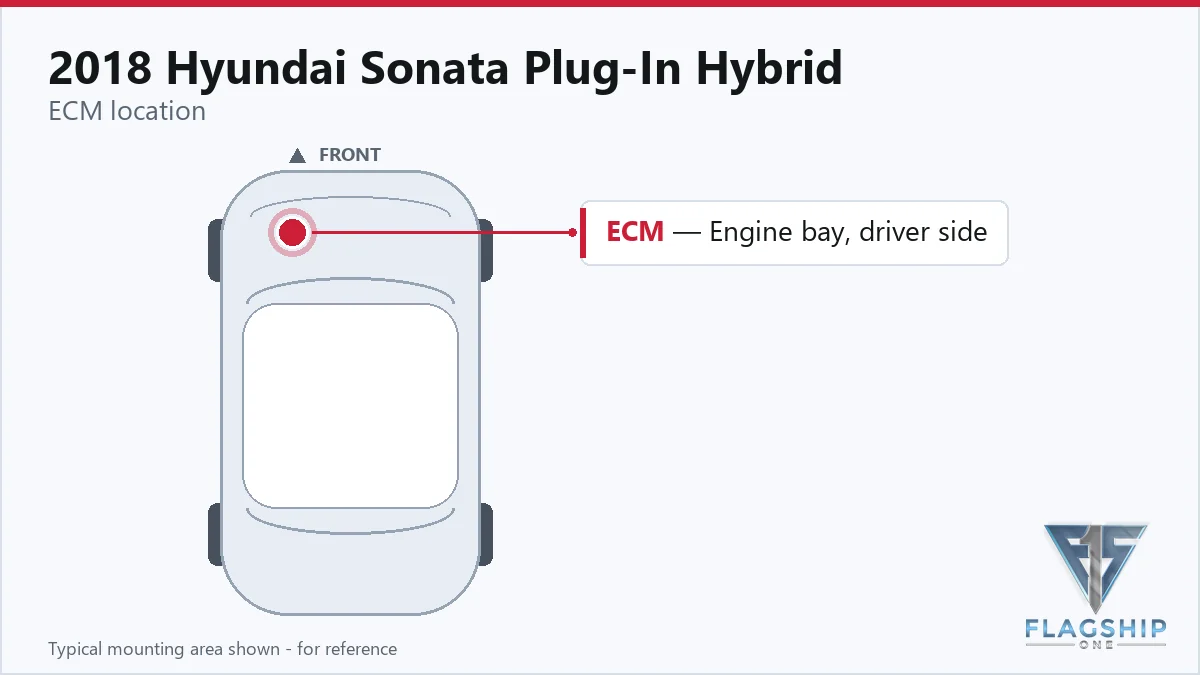
Work with the ignition off, and treat the module as static-sensitive: avoid touching the connector pins at any point.
| Operation | Configuration | Book Time |
|---|---|---|
| Engine Control Module R&R | All configurations | 0.5 hr |
| Engine Control Module Relearn | All configurations | 0.5 hr |
| Engine Control Module Reset | All configurations | 0.3 hr |
| Powertrain Control Module R&R | All configurations | 0.5 hr |
| Powertrain Control Module Relearn | All configurations | 0.5 hr |
Hyundai service information states that when replacing an ECM the VIN must be programmed in the ECM before the vehicle will exit shipping mode and allow normal engine operation; the same requirement applies to the PCM for hybrid system activation. The dealer workflow uses the GDS Mobile tablet interface to write the VIN, synchronize the immobilizer, and then run the ECU update procedure outlined in the general information bulletin for tablet-based GDS Mobile. After the VIN write, the technician must execute the relearn routines for idle adaptation, throttle position, and hybrid contactor calibration, which together consume the 0.5-hour relearn labor allowance for each module. A replacement unit that arrives with the correct VIN already burned into its flash memory eliminates the VIN-write step and the immobilizer synchronization, leaving only the adaptive relearns to be performed in the bay. This can reduce total shop time by roughly half for the programming portion of the job. Flagship One supplies a VIN-programmed replacement unit that matches the exact calibration for your 2018 Sonata Plug-In Hybrid, so the technician can proceed directly to the relearn sequence after physical installation without waiting for dealer network access or subscription software.
The module-internal trouble code documented for this vehicle is P0605, which indicates an internal read-only memory error within the control module processor. This code cannot be resolved by clearing or by repairing external wiring; it requires module replacement or specialized bench repair.
| Code | Meaning | Full Guide |
|---|---|---|
| P0605 | Internal ROM error | Full P0605 guide → |
| Bulletin | Subject | What It Addresses |
|---|---|---|
| 04-36-019 | TSB • Fuel System • [04-36-019] 2005MY ECM AND PCM VIN WRITING DURING CONTROL MODULE REPLACEMEN | — |
| — | TSB • General Information • [15-GI-001] ECU UPDATE PROCEDURE FOR TABLET-BASED GDS MOBILE | — |
No. The VIN and immobilizer data are unique to each vehicle; a module from another car will not communicate with your keys or pass the hybrid system self-test until the VIN is rewritten.
Yes. The powertrain control module maintains its own VIN record and must be programmed independently; the factory procedure writes both modules in sequence during a replacement.
The factory labor allowance for the ECM relearn is 0.5 hours, which typically includes idle adaptation, throttle position learning, and hybrid contactor calibration in one continuous session.
No. P0605 indicates an internal processor memory fault; the code is stored in non-volatile memory inside the module and will return immediately on key-on after any battery disconnect.
Yes. Both the installation bolts and the nuts are specified at 9.8 to 11.8 N·m, so a single torque setting covers all mounting hardware.
When the diagnosis points to a failed ECM or PCM, you have three paths: send the original module to a specialist for bench repair, schedule a dealer visit for a new module and full programming, or install a refurbished unit that arrives already matched to your VIN. The bench repair route preserves your original adaptive data but adds shipping time and requires a shop capable of BGA rework. The dealer route guarantees the latest calibration but involves the highest parts cost and a programming appointment. A VIN-preprogrammed replacement splits the difference — it eliminates the VIN-write step, carries a warranty, and lets your technician finish the job in a single bay visit after the relearn.
Flagship One stocks a refurbished, VIN-programmed PCM for the 2018 Hyundai Sonata Plug-In Hybrid with a lifetime warranty, free shipping and no core charge. The full Hyundai Sonata Plug-In Hybrid module lineup covers other engine configurations as well.
The 2018 Hyundai Sonata Plug-In Hybrid depends on precise communication between its engine and powertrain control modules to deliver the seamless hybrid experience owners expect. When either module fails, the symptoms can mimic a dozen other faults, but the factory labor times, torque values, and programming requirements are well documented. Armed with the correct location, the proper torque specification, and an understanding of the mandatory VIN write, you can approach the repair with confidence. If a replacement module that arrives ready for your vehicle simplifies the workflow, that option is available; otherwise, the dealer toolset and the bulletins cited here will guide a complete factory restoration.