
Last updated on August 25th, 2026 at 01:21 pm
In the 2011 Hyundai Sonata, the Engine Control Module manages fuel injection, ignition timing, and emission controls. A failure typically disrupts communication with the powertrain, leading to a malfunction indicator lamp and loss of engine performance. The module also stores diagnostic trouble codes that help pinpoint internal faults.
When a 2011 Hyundai Sonata begins to illuminate the malfunction indicator lamp and registers diagnostic codes, the engine control module often becomes a focal point of investigation. Understanding how the ECM functions, where it resides, and what steps are required for a correct replacement can save you time and unnecessary parts. This guide walks you through the module’s role in your Sonata, outlines the practical steps for removal and installation, explains the programming requirements, and highlights the symptoms that typically point to an ECM problem. Armed with this information, you’ll know what to expect from a repair shop or a DIY approach and how to protect the module from future issues.
The Engine Control Module in the 2011 Hyundai Sonata acts as the brain of the powertrain, interpreting sensor data to control fuel delivery, spark timing, and emission systems. It continuously monitors engine parameters and adjusts operation to meet performance and efficiency targets. When the module cannot process inputs correctly, it may trigger a malfunction indicator lamp and store fault codes. The ECM also communicates with the Powertrain Control Module to coordinate shifting and torque converter lock‑up. Proper operation is essential for smooth acceleration, fuel economy, and emissions compliance. For owners seeking a direct replacement, replacement engine control modules for the 2011 Hyundai Sonata provide a proven path to restore full functionality.
2011 Hyundai Sonata
OEM programmed ECM for your 2011 Hyundai Sonata — plug & play, no dealer visit.
Free shipping · Lifetime warranty
The factory removal procedure places the ECM beside the air cleaner assembly, making it accessible without extensive disassembly. Labor estimates list 0.4 hours for removal and another 0.4 hours for reinstalling the module. When installing, both the mounting bolts and nuts must be tightened to a torque range of 9.8 to 11.8 N·m. After the hardware is secured, the technician proceeds with any required relearn or reset procedures, each typically taking 0.3 to 0.5 hours according to the service manual. The proximity to the air intake means you should verify that the intake hose remains clear and that the module’s connector is free of debris before final torque.
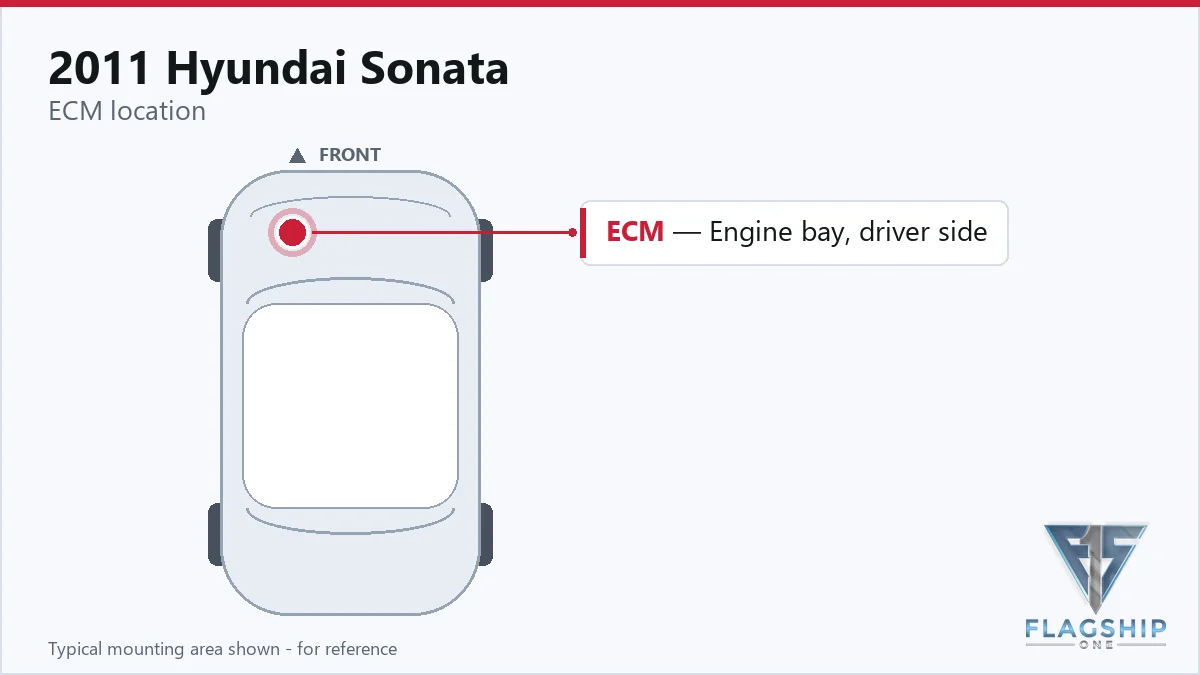
Work with the ignition off, and treat the module as static-sensitive: avoid touching the connector pins at any point.
| Operation | Configuration | Book Time |
|---|---|---|
| Engine Control Module R&R | All configurations | 0.4 hr |
| Engine Control Module Relearn | All configurations | 0.5 hr |
| Engine Control Module Reset | All configurations | 0.3 hr |
| Powertrain Control Module R&R | All configurations | 0.4 hr |
| Powertrain Control Module Relearn | All configurations | 0.5 hr |
Once the ECM is physically installed, the factory process requires programming the vehicle identification number into the new unit to ensure proper communication with other control modules. Flagship One supplies units that arrive already VIN‑programmed, which eliminates the need for that step on the shop floor. After the module is seated and torqued, a brief reset of the ECM may be performed, but the critical VIN write is already completed, allowing the technician to move directly to any required relearn cycles.
Every VIN-programmed replacement unit from Flagship One arrives with these steps already completed.
Typical signs of a failing ECM in a 2011 Hyundai Sonata include a persistent check engine light, loss of power during acceleration, rough idle, and occasional stalling. Drivers may also notice erratic transmission shifting or a complete loss of engine start capability if the module loses communication with the powertrain. Diagnostic scans frequently reveal internal fault codes, and one common code for this model is ECM internal memory error which indicates a problem within the module’s processing hardware. Addressing these symptoms promptly can prevent further drivetrain damage.
The following diagnostic trouble codes are commonly associated with ECM failures in the 2011 Hyundai Sonata:
| Code | Meaning | Full Guide |
|---|---|---|
| P0605 | Internal ROM error | Full P0605 guide → |
Two service bulletins address ECM concerns for this vehicle. TSB 10-FL-005 covers situations where the MIL is illuminated with codes P0605, P2105, or P2110 and outlines an update procedure. TSB 04-36-019 provides guidance for VIN writing during control module replacement, ensuring the new ECM is correctly identified by the vehicle’s systems.
| Bulletin | Subject | What It Addresses |
|---|---|---|
| — | TSB • Fuel System • [10-FL-005] ECM UPDATE – MIL ON WITH DTC P0605 & P2105 OR P2110 | — |
| 04-36-019 | TSB • Fuel System • [04-36-019] 2005MY ECM AND PCM VIN WRITING DURING CONTROL MODULE REPLACEMEN | — |
The code P0605 is commonly logged when the ECM experiences an internal memory or processing error, prompting a check engine light.
Labor guides suggest about 0.4 hours for removal and another 0.4 hours for installation, not including any relearn or reset steps.
Yes, the factory procedure requires the VIN to be written into the new module, but Flagship One units arrive pre‑programmed, removing that requirement.
Both the bolts and nuts should be tightened to a range of 9.8 to 11.8 N·m according to the service manual.
Because the ECM communicates with the Powertrain Control Module, a malfunction can lead to erratic or delayed shifting, especially under load.
When the ECM in your 2011 Hyundai Sonata fails, you have the option of a professional repair or installing a refurbished replacement. Both approaches aim to restore engine control and clear diagnostic codes, but a refurbished unit from Flagship One arrives VIN‑programmed and tested to meet factory specifications, simplifying the reinstall process.
Flagship One stocks a refurbished, VIN-programmed PCM for the 2011 Hyundai Sonata with a lifetime warranty, free shipping and no core charge. The full Hyundai Sonata module lineup covers other engine configurations as well.
If your 2011 Hyundai Sonata shows ECM‑related symptoms, consider a qualified replacement that respects the factory torque and programming requirements. Flagship One offers solutions that align with the vehicle’s design, helping you get back on the road with confidence.