
Last updated on August 25th, 2026 at 01:22 pm
The powertrain control module (PCM) or engine control module (ECM) in a 2010 Hyundai Sonata 2.4L is the computer that manages fuel delivery, ignition timing, and emissions. Failure can cause no-start, stalling, misfire codes, and poor cold performance.
If your 2010 Hyundai Sonata with the 2.4L engine is experiencing hard starting, rough idle when cold, or an illuminated check engine light with misfire codes, the powertrain control module (PCM) or engine control module (ECM) may be at fault. This guide explains what the module does in your Sonata, where it is located, what replacement involves, and what factory service bulletins apply. You will learn the symptoms of a failing module, the programming steps required after replacement, and how a pre-programmed unit can save time. The information here is based on documented labor times, torque specifications, and official TSBs for this specific vehicle.
In the 2010 Hyundai Sonata 2.4L, the powertrain control module (PCM) — also referred to as the engine control module (ECM) — is the central computer that controls fuel injection, ignition timing, idle speed, and emissions systems. It receives data from sensors like the crankshaft position sensor, oxygen sensors, and throttle position sensor, then adjusts actuator commands to keep the engine running efficiently. When this module fails, the engine may not start, may stall unpredictably, or may run poorly with misfire codes. For this Sonata, the PCM also communicates with the transmission control unit and manages the vehicle’s OBD-II diagnostics. A failing module often triggers internal trouble codes like P0605. If you need a replacement, you can find replacement engine computers for the 2010 Sonata that are pre-programmed to match your vehicle’s VIN and calibration.
2010 Hyundai Sonata 2.4L
OEM programmed ECM for your 2010 Hyundai Sonata 2.4L — plug & play, no dealer visit.
Free shipping · Lifetime warranty
The factory removal procedure for the 2010 Hyundai Sonata 2.4L PCM/ECM places the module next to the air cleaner assembly. To access it, you typically remove the air cleaner housing and disconnect the electrical connectors. The module is secured with bolts that must be tightened to 9.8 to 11.8 N·m during installation. According to published labor times, removing and replacing the PCM or ECM takes 0.5 hours, and performing the required relearn procedure adds another 0.5 hours. The relearn ensures the module adapts to the engine’s idle and fuel trim values. No special tools are needed beyond a socket set and a scan tool capable of the relearn. The location is convenient, making the swap a straightforward job for a competent DIYer or shop.
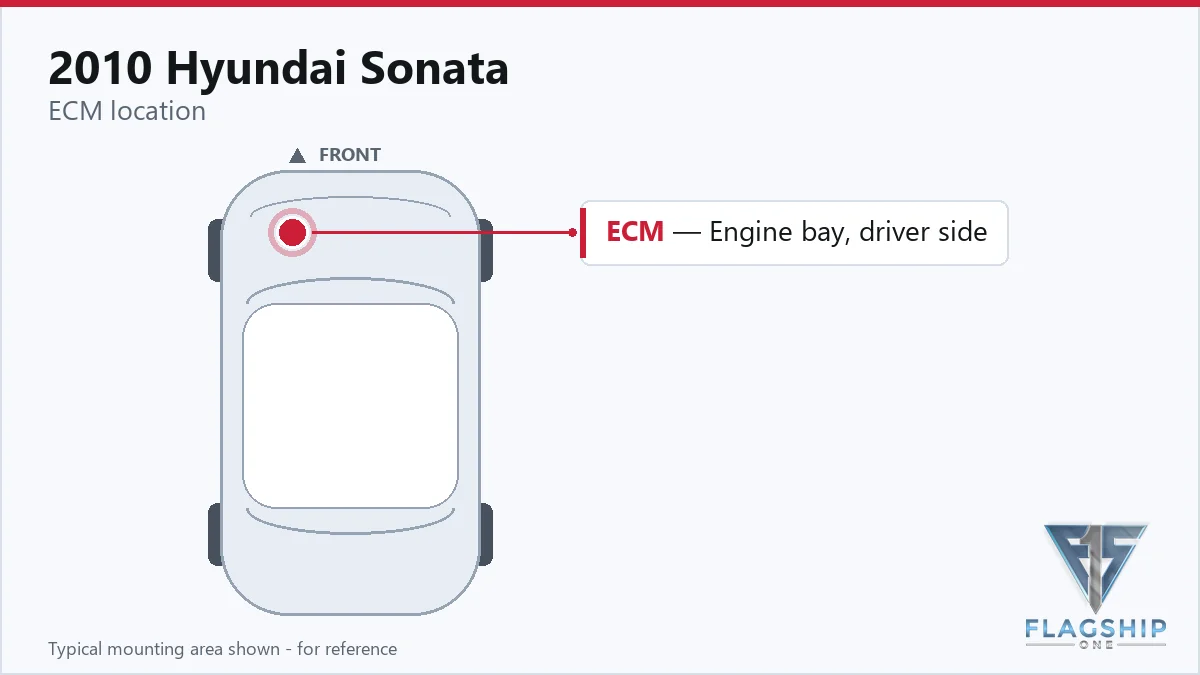
Work with the ignition off, and treat the module as static-sensitive: avoid touching the connector pins at any point.
| Operation | Configuration | Book Time |
|---|---|---|
| Powertrain Control Module R&R | All configurations | 0.5 hr |
| Powertrain Control Module Relearn | All configurations | 0.5 hr |
| Engine Control Module R&R | All configurations | 0.5 hr |
| Engine Control Module Relearn | All configurations | 0.5 hr |
After installing a new PCM in the 2010 Hyundai Sonata 2.4L, the factory procedure requires that the vehicle identification number (VIN) be programmed into the module. This is done using the cursor, function, and number keys on a factory scan tool. The VIN programming is essential for the module to communicate with other vehicle systems and to match the correct calibration. If you purchase a VIN-programmed replacement unit from Flagship One, that step is already completed before shipping. The module arrives ready to install, and you only need to perform the 0.5-hour relearn procedure to finalize the installation. This eliminates the need for a dealer visit or specialized programming equipment.
A failing PCM or ECM in the 2010 Hyundai Sonata 2.4L can produce a range of symptoms. The engine may crank but not start, or it may start and stall shortly after. You might notice a rough idle, especially when the engine is cold, or hesitation during acceleration. The check engine light often illuminates with misfire codes (P0300-P0306) or a module-internal fault. Scan tool communication may be lost entirely, preventing diagnosis. Shifting issues can also occur if the PCM controls transmission functions. One documented internal trouble code for this vehicle is P0605 internal control module fault, which points directly to a problem inside the PCM itself. If you experience any of these issues, the module should be tested or replaced.
The 2010 Hyundai Sonata 2.4L PCM/ECM can store internal trouble codes that indicate a fault within the module itself. The following code is documented for this vehicle:
| Code | Meaning | Full Guide |
|---|---|---|
| P0605 | Internal ROM error | Full P0605 guide → |
Two factory service bulletins apply to the 2010 Hyundai Sonata 2.4L PCM/ECM. TSB 10-FL-002 addresses an ECM update for a hard start and rough idle when cold, with the check engine light on and diagnostic trouble code P161B. TSB 09-FL-004 covers an ECM update for the 2.7L and 3.3L engines (note: the 2.4L may be included in related updates) that addresses misfire codes P0300 through P0306 or code P0110 with the MIL on. Both bulletins recommend updating the ECM software to resolve these drivability concerns. If your Sonata exhibits these symptoms, a software update may be the first step before considering module replacement.
| Bulletin | Subject | What It Addresses |
|---|---|---|
| — | TSB • Fuel System • [10-FL-002] ECM UPDATE – MIL ON DTC P161B – HARD START/ROUGH IDLE COLD | — |
| — | TSB • Fuel System • [09-FL-004] ECM UPDATE – CM 2.7L EN TG NF 3.3L MIL ON DTC P0300-P0306 OR P0 | — |
Common signs include a no-start condition, stalling, rough idle when cold, misfire codes, and loss of communication with a scan tool. If you have trouble code P0605, it indicates an internal PCM fault. A professional diagnosis can confirm the module is the cause.
Yes, the module is located next to the air cleaner assembly and is accessible with basic hand tools. The factory labor time is 0.5 hours for removal and installation. However, you will need a scan tool to perform the 0.5-hour relearn procedure after installation.
Yes, the factory procedure requires programming the VIN into the new PCM using cursor, function, and number keys. If you buy a pre-programmed unit from Flagship One, the VIN is already set, so you only need to do the relearn.
If your 2010 Hyundai Sonata 2.4L needs a PCM or ECM, you have two options: have a shop repair the original module (if possible) or replace it with a new or refurbished unit. A refurbished module that is pre-programmed to your VIN can save the cost and hassle of dealer programming. Flagship One offers such units specifically for the Sonata, with the VIN already written so you can install and relearn without a trip to the dealership.
Flagship One stocks a refurbished, VIN-programmed PCM for the 2010 Hyundai Sonata with a lifetime warranty, free shipping and no core charge. The full Hyundai Sonata module lineup covers other engine configurations as well.
The PCM/ECM in your 2010 Hyundai Sonata 2.4L is a critical component that controls engine operation. When it fails, symptoms like hard starting, rough idle, and misfire codes can appear. Replacement is straightforward with the module located near the air cleaner, and a pre-programmed unit from Flagship One eliminates the need for VIN programming, leaving only a quick relearn to get you back on the road.