
Last updated on August 25th, 2026 at 01:22 pm
The Engine Control Module in a 2010 Hyundai Accent manages fuel injection, ignition timing, and emissions controls. Failure typically results from internal circuitry problems, leading to loss of engine control and diagnostic trouble codes.
When the engine control module in your 2010 Hyundai Accent shows persistent misfire codes or the engine refuses to start, you may need to replace the unit. Understanding the module’s role, where it sits, and the steps required after installation can help you avoid common pitfalls. This guide walks through the location, removal time, torque requirements, and programming details so you can approach the job with confidence and know what to expect from a professional repair shop or a DIY effort.
In the 2010 Hyundai Accent, the Engine Control Module collects sensor data and directs fuel delivery, spark timing, and emissions functions. It acts as the brain that synchronizes engine operation, ensuring smooth acceleration and compliance with emissions standards. Because the module directly influences powertrain performance, any malfunction can trigger a range of drivability problems. The module’s reliability is essential for maintaining fuel efficiency and meeting regulatory requirements. For those needing a new unit, the market offers engine computer replacement for Accent that match the vehicle’s specifications.
2010 Hyundai Accent
OEM programmed ECM for your 2010 Hyundai Accent — plug & play, no dealer visit.
Free shipping · Lifetime warranty
The factory procedure shows that the ECM is positioned next to the air cleaner assembly, making it accessible once the intake components are removed. The labor guide assigns half an hour for both removal and reinstall, reflecting the relatively straightforward access. When reinstalling, the two mounting bolts must be tightened to a torque range of 9.8 to 11.8 N·m to secure the module without over‑compressing the housing. Following these steps helps ensure proper mechanical fit before any electrical programming begins.
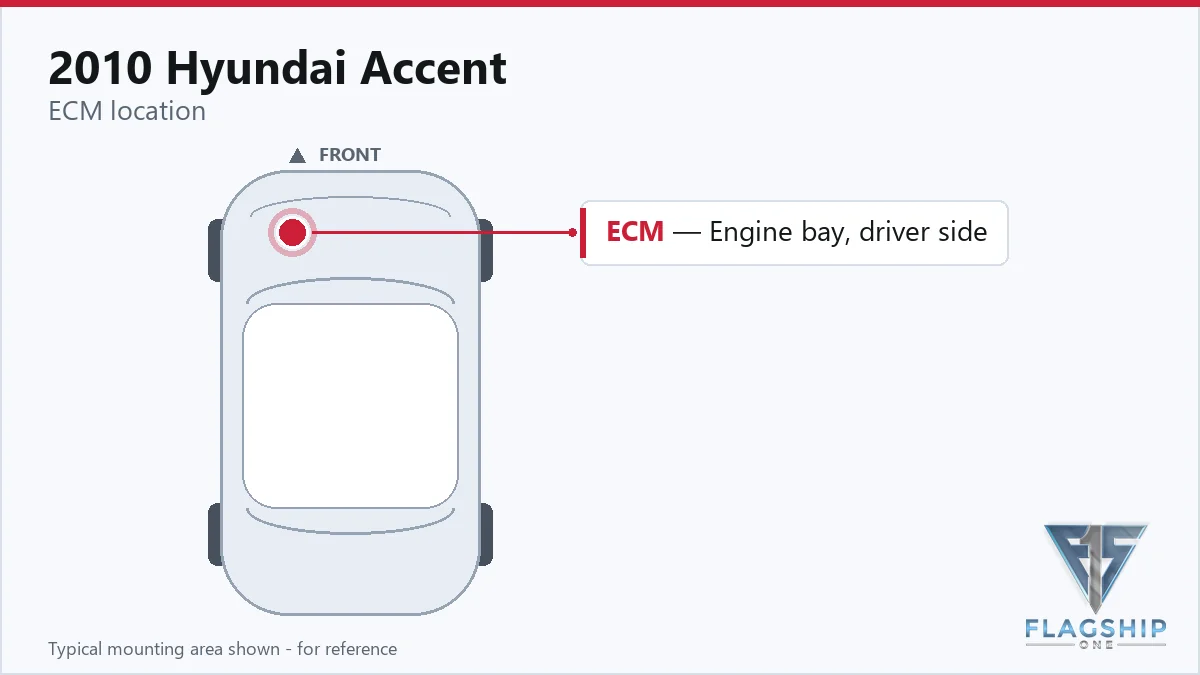
Work with the ignition off, and treat the module as static-sensitive: avoid touching the connector pins at any point.
| Operation | Configuration | Book Time |
|---|---|---|
| Powertrain Control Module R&R | All configurations | 0.5 hr |
| Engine Control Module R&R | All configurations | 0.5 hr |
| Engine Control Module Relearn | All configurations | 0.5 hr |
After the ECM is installed, the factory process requires the vehicle identification number to be entered into the module using the cursor, function, and number keys. Flagship One supplies a a VIN-programmed replacement unit that already contains the correct VIN, eliminating the need for this manual entry and reducing the chance of error during the post‑install phase.
A failing ECM in a 2010 Hyundai Accent often leads to no‑start conditions, rough idle, or intermittent stalling, especially when the engine is under load. You may also see misfire‑related codes such as P0300 through P0304, and in some cases the module reports a communication fault that prevents the scan tool from reading live data. These symptoms typically appear gradually, giving you a window to address the issue before it escalates to complete loss of power.
The following trouble code is documented for the 2010 Hyundai Accent and relates directly to the ECM:
| Code | Meaning | Full Guide |
|---|---|---|
| P0605 | Internal ROM error | Full P0605 guide → |
A Technical Service Bulletin titled Fuel System • [13-FL-012] ECM UPDATE addresses MIL illumination with codes P0300‑P0304, P0128, and P0461, indicating that an ECM update may resolve these conditions.
| Bulletin | Subject | What It Addresses |
|---|---|---|
| — | TSB • Fuel System • [13-FL-012] ECM UPDATE – MIL ON DTC P0300-P0304, P0128, P0461 | — |
The module is reachable without major disassembly, and the labor guide lists 0.5 hours for removal and reinstall. However, you must still program the VIN, which Flagship One units handle automatically.
The specification calls for a torque between 9.8 and 11.8 N·m. Using a calibrated torque wrench helps achieve the correct clamping force.
The bulletin recommends an ECM software update for those specific codes. A Flagship One unit with the latest firmware may already include the necessary fixes.
If multiple unrelated codes appear, especially communication‑related ones like P0605, the ECM itself is a likely source. Sensor failures usually trigger isolated codes.
Refurbished units that have been tested and reprogrammed to match your VIN can perform comparably to new modules, provided they meet the torque and installation specifications.
When the ECM needs attention, you can choose a repair that follows the factory removal steps or opt for a Flagship One refurbished unit that arrives VIN‑programmed. Both approaches address the underlying issue, but a pre‑programmed replacement can reduce shop time and simplify the post‑install process for your 2010 Hyundai Accent.
Flagship One stocks a refurbished, VIN-programmed PCM for the 2010 Hyundai Accent with a lifetime warranty, free shipping and no core charge. The full Hyundai Accent module lineup covers other engine configurations as well.
Replacing the Engine Control Module in a 2010 Hyundai Accent restores proper engine management and helps clear related trouble codes. Consider a VIN‑programmed replacement to streamline the job and keep your vehicle running smoothly.