
Last updated on August 25th, 2026 at 01:23 pm
The engine control module on the 2006 Hyundai Sonata manages fuel delivery, ignition timing, and emissions systems. Internal processor faults may trigger check engine lights and driveability complaints.
When a 2006 Hyundai Sonata develops starting problems, stalling, or an illuminated check engine light that refuses to clear, the engine control module often falls under suspicion. The ECM serves as the central nervous system of the 2.4L powertrain, processing data from dozens of sensors and commanding the actuators that keep the engine running smoothly. This guide walks through what the module does, where it sits on your vehicle, what the replacement process involves, and what you need to know about programming requirements. Understanding these steps before you commit to a repair or replacement helps you ask the right questions and avoid unnecessary expenses.
The engine computer in your Sonata translates sensor readings into real-time adjustments to fuel injection, variable valve timing, and emissions control components. On the 2.4L four-cylinder engine found in this model year, the module monitors mass airflow, crankshaft position, oxygen sensors, and the evaporative emissions system to maintain efficient combustion across a wide range of conditions. When the controller fails internally, the engine may run rough, stall at idle, or fail to start at all. Many replacement engine computers for the Sonata arrive as pre-programmed units, which means the Vehicle Identification Number is already written into the controller before installation replacement engine computers for the Sonata and eliminates a step that would otherwise require dealer-level equipment.
2006 Hyundai Sonata
OEM programmed ECM for your 2006 Hyundai Sonata — plug & play, no dealer visit.
Free shipping · Lifetime warranty
The factory service procedure directs technicians to the area adjacent to the air cleaner assembly when reaching the control module on the 2006 Sonata. The removal process involves disconnecting the battery, extracting the unit from its mounting location, and transferring the connectors. Book time for powertrain control module removal and installation is listed at 0.5 hours, while the subsequent relearn procedure also carries a 0.5-hour book time. Together these represent the labor estimates your shop or technician will typically reference when quoting the work. After the new module is installed, the vehicle may need to complete an adaptation cycle before all driveability concerns resolve.
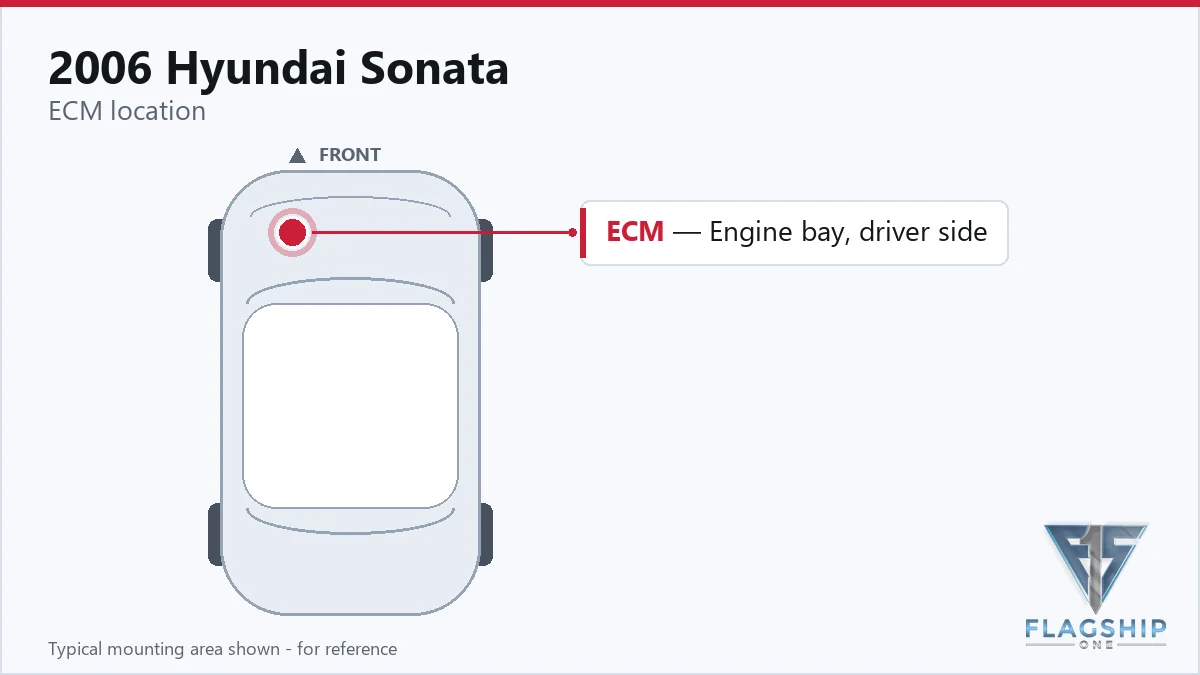
Work with the ignition off, and treat the module as static-sensitive: avoid touching the connector pins at any point.
| Operation | Configuration | Book Time |
|---|---|---|
| Powertrain Control Module R&R | All configurations | 0.5 hr |
| Powertrain Control Module Relearn | All configurations | 0.5 hr |
| Engine Control Module R&R | All configurations | 0.5 hr |
| Engine Control Module Relearn | All configurations | 0.5 hr |
The manufacturer requires that the Vehicle Identification Number be written into a replacement ECM following the procedure outlined in FL-43. This step uses the cursor, function, and numeric keypad to input the VIN into the module. Without this programming, the engine will not operate correctly. If your replacement unit arrives from Flagship One already VIN-programmed, the in-vehicle programming step is completed before the module ships to you. You or your technician will still need to verify communication and may need to perform any remaining relearn procedures a VIN-programmed replacement unit once the controller is installed and the battery is reconnected.
A failing ECM on this vehicle commonly produces a no-start condition, intermittent stalling, or a persistent check engine light. Misfire codes such as P0300 through P0304 appear frequently when the controller loses its ability to properly fire the injectors or ignition coils. Some vehicles lose communication with scan tools entirely, making diagnosis more challenging. Transmission shifting may become harsh or erratic because the transmission control module depends on the ECM for certain data. The P0605 internal fault is one specific code associated with ECM failures on this model and indicates a read-only memory problem within the controller itself internal memory fault, though the check engine light may illuminate before the code sets depending on driving conditions.
The 2006 Hyundai Sonata covered by this guide has documented module-internal trouble codes. These codes originate inside the controller rather than from external sensors and typically indicate hardware-level problems that repair or replacement of external components will not resolve.
| Code | Meaning | Full Guide |
|---|---|---|
| P0605 | Internal ROM error | Full P0605 guide → |
Factory bulletin 09-FL-008 addresses an ECM update for the Sonata related to the malfunction indicator lamp illuminating with DTC P0441. This diagnostic trouble code indicates an evaporative emissions system performance concern. The bulletin applies to certain vehicles in this model year range and outlines a software recalibration or update to address the condition. If your vehicle displays P0441 without other apparent causes such as a loose gas cap, the service bulletin may be relevant to your repair path.
| Bulletin | Subject | What It Addresses |
|---|---|---|
| — | TSB • Fuel System • [09-FL-008] ECM UPDATE – MIL ON WITH DTC P0441 | — |
A used unit may physically fit, but it will likely need to be programmed with your Vehicle Identification Number. Additionally, you inherit whatever faults caused the original unit to fail, and there is no way to verify the used controller’s condition.
The mechanical removal is straightforward for an experienced DIY technician, but you will need access to programming capability for the VIN write-in step. If your replacement unit does not arrive pre-programmed, a dealer or specialty shop will be required.
The engine will likely crank but not start, or it may run very poorly. The controller requires the Vehicle Identification Number to be written into its memory before it will command fuel and spark properly on this model year.
If diagnostics confirm the ECM at fault, you face two main paths. A dealer replacement typically orders a fresh unit and performs the in-vehicle programming on-site. A professionally refurbished replacement from Flagship One offers a pre-programmed unit matched to your Vehicle Identification Number, often reducing turnaround time and eliminating the need for a separate programming visit. Both approaches can restore normal operation when the diagnosis supports ECM replacement.
Flagship One stocks a refurbished, VIN-programmed PCM for the 2006 Hyundai Sonata with a lifetime warranty, free shipping and no core charge. The full Hyundai Sonata module lineup covers other engine configurations as well.
The 2006 Hyundai Sonata benefits from a well-documented ECM design, and the replacement process is straightforward once the module is accessed near the air cleaner assembly. Confirming the diagnosis through live data and trouble codes before purchasing a replacement saves both time and money. Whether you choose a factory-fresh unit or a professionally refurbished replacement, ensuring the Vehicle Identification Number is correctly programmed is the critical final step.