
Last updated on August 25th, 2026 at 01:30 pm
The Powertrain Control Module (PCM) in your 2020 Ford Edge 2.0L engine acts as the brain, managing fuel, ignition, and emissions. Failures may cause no-start conditions, poor drivability, or stored trouble codes related to internal processor faults.
If your 2020 Ford Edge 2.0L has been stalling, refusing to start, or logging cryptic engine codes, the Powertrain Control Module (PCM) may be at fault. This compact computer oversees everything from fuel delivery to transmission shifts, and when it fails, your vehicle’s performance can suffer in noticeable ways. Replacing it isn’t just about swapping a part—it involves precise labor, programming, and relearn steps to ensure everything communicates correctly. Understanding the process helps you make informed decisions, whether you’re diagnosing symptoms or weighing repair options. This guide covers what the PCM does, where it’s located, the labor involved, and how a pre-programmed replacement unit can streamline the job.
The Powertrain Control Module (PCM) in your 2020 Ford Edge 2.0L engine is the central hub for engine and transmission management. It processes data from sensors to optimize fuel injection, ignition timing, and emissions control, ensuring smooth operation and compliance with regulations. Without a functioning PCM, your vehicle may struggle to start, run erratically, or even enter a fail-safe mode that limits performance. Because it integrates engine and transmission control, a faulty PCM can also affect shifting behavior, leading to rough or delayed gear changes. When replacement becomes necessary, replacement engine computers for the Edge are designed to restore full functionality, but proper installation and programming are critical to avoid recurring issues.
The PCM in your 2020 Ford Edge is typically mounted in the engine bay, often near the firewall or strut tower for protection from heat and moisture. Accessing it requires removing a few bolts and disconnecting the wiring harness, a process that usually takes about 0.7 hours of labor. Once the old unit is removed, the new PCM is installed in the same location, with care taken to ensure the connectors are securely fastened. No specialized tools are required beyond basic hand tools, but proper torque specifications should be followed to avoid damaging the mounting points. After installation, a relearn procedure of 0.5 hours is often necessary to synchronize the PCM with the vehicle’s other systems.
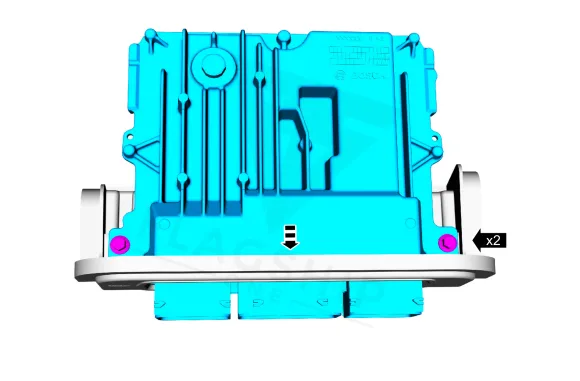
Work with the ignition off, and treat the module as static-sensitive: avoid touching the connector pins at any point.
| Operation | Configuration | Book Time |
|---|---|---|
| Powertrain Control Module R&R | All configurations | 0.7 hr |
| Powertrain Control Module Relearn | All configurations | 0.5 hr |
| Engine Control Module Relearn | All configurations | 0.5 hr |
| Engine Control Module R&R | All configurations | 0.7 hr |
| Engine Control Module Reset | All configurations | 0.3 hr |
2020 Ford Edge 2.0L: When the
OEM programmed replacements — plug & play, no dealer visit.
Find yours by year, make & model →
Free shipping · Lifetime warranty
After replacing the PCM in your 2020 Ford Edge, the factory procedure requires reprogramming the Passive Anti-Theft System (PATS) to ensure the vehicle starts and runs correctly. This step is critical because the PCM must recognize the vehicle’s security credentials to prevent immobilization. Additionally, a relearn process of 0.5 hours is typically needed to recalibrate the module with the engine and transmission. However, when you use a VIN-programmed replacement unit, these steps are already completed, saving you time and reducing the risk of programming errors. This means your vehicle can be back on the road faster, with fewer opportunities for post-installation issues.
A failing PCM in your 2020 Ford Edge 2.0L engine may exhibit a range of symptoms, often starting with intermittent issues that worsen over time. One of the most common signs is a no-start condition, where the engine cranks but refuses to fire, sometimes accompanied by a security warning light on the dashboard. Stalling or rough idling may also occur, particularly when the vehicle is warm, as the PCM struggles to maintain consistent fuel and ignition timing. Misfires or hesitation under acceleration can indicate the module is unable to process sensor data correctly, leading to poor engine performance. Another telltale sign is the illumination of the check engine light, often with codes like an internal control module read-only memory error, which point directly to PCM faults. In some cases, the transmission may shift erratically or fail to engage gears properly, as the PCM also governs transmission control. If your scan tool fails to communicate with the PCM, that’s another strong indicator of a module failure, as the unit may no longer respond to diagnostic requests.
Your 2020 Ford Edge 2.0L engine may log specific trouble codes when the PCM begins to fail. These codes are stored internally and can help pinpoint the source of drivability issues. Below are the documented module-internal trouble codes for this vehicle.
| Code | Meaning | Full Guide |
|---|---|---|
| P0605 | Internal ROM error | Full P0605 guide → |
| P0606 | Module processor failure | Full P0606 guide → |
| P0607 | Module performance fault | Full P0607 guide → |
| P164E | Module-internal fault | — |
| P166B | Module-internal fault | — |
| U0100 | Module-internal fault | Full U0100 guide → |
| U0121 | Module-internal fault | Full U0121 guide → |
| U0140 | Module-internal fault | Full U0140 guide → |
| U0155 | Module-internal fault | Full U0155 guide → |
Common signs include a no-start condition, stalling, rough idling, or the check engine light illuminating with internal PCM codes. If your scan tool can’t communicate with the module, that’s another strong indicator of failure.
While the physical replacement is straightforward, the process requires a relearn procedure and PATS reprogramming. Without the proper tools and software, you may encounter issues with starting or drivability. A pre-programmed unit simplifies the process.
The vehicle may not start, as the PCM won’t recognize the security credentials. This is why factory procedures include PATS reprogramming, though a VIN-programmed replacement unit eliminates this step.
Stalling can occur if the relearn procedure isn’t completed, as the PCM may not be properly synchronized with the engine and transmission. This step is essential for restoring smooth operation.
Ignoring codes like P0605 or P166B can lead to worsening drivability issues, including misfires, poor fuel economy, or even transmission problems. Addressing them promptly helps prevent further damage.
If your 2020 Ford Edge 2.0L is experiencing PCM-related issues, you have options. A repair may be possible if the fault is minor, but for internal failures or persistent codes, replacement is often the most reliable solution. A pre-programmed unit ensures compatibility and eliminates the need for additional programming steps, making the process smoother and reducing downtime. Whether you choose a new or refurbished module, proper installation and relearn procedures are key to restoring your vehicle’s performance.
Flagship One stocks a refurbished, VIN-programmed PCM for the 2020 Ford Edge with a lifetime warranty, free shipping and no core charge. The full Ford Edge module lineup covers other engine configurations as well.
The PCM in your 2020 Ford Edge 2.0L engine plays a critical role in managing engine and transmission functions. When it fails, symptoms like stalling, no-start conditions, or internal trouble codes can disrupt your driving experience. Understanding the replacement process, labor times, and programming requirements helps you make informed decisions. With the right approach, your Edge can return to reliable operation, whether you opt for a repair or a pre-programmed replacement unit.