
Last updated on August 25th, 2026 at 01:54 pm
The Powertrain Control Module (PCM) in your 2002 Mitsubishi Montero Sport manages engine performance and transmission behavior. Failures may cause erratic idling, stalling, or a no-start condition, often linked to electrical faults or internal corruption.
If your 2002 Mitsubishi Montero Sport has been acting unpredictably—stalling at stops, refusing to start, or throwing cryptic warning lights—it may point to a failing Powertrain Control Module (PCM). This small but critical computer oversees everything from fuel injection to transmission shifts, and when it malfunctions, your SUV’s performance suffers. Replacing it isn’t just about swapping a part; it involves precise access, proper installation, and often a relearn process to restore normal operation. Understanding these steps helps you weigh whether to tackle the job yourself or rely on a shop. Either way, knowing what’s involved demystifies the process and ensures you’re prepared for the work ahead. A properly functioning PCM keeps your Montero Sport running smoothly, so addressing issues promptly can prevent further complications down the road.
2002 Mitsubishi Montero Sport
OEM programmed replacements — plug & play, no dealer visit.
Find yours by year, make & model →
Free shipping · Lifetime warranty
The Powertrain Control Module (PCM) in your 2002 Mitsubishi Montero Sport serves as the brain of the engine and transmission systems. It continuously monitors sensors for data like engine speed, throttle position, and oxygen levels, then adjusts fuel delivery, ignition timing, and shift points to optimize performance. Without a functional PCM, your vehicle may struggle to start, idle roughly, or shift erratically. Over time, electrical surges, moisture intrusion, or internal wear can corrupt the module’s programming or damage its circuitry. When this happens, the PCM may send incorrect signals or fail to communicate with other systems, leading to a range of drivability issues. Replacing it with replacement engine computers for the Montero Sport ensures compatibility and restores proper function, but the process requires careful handling to avoid damaging surrounding components or triggering additional faults.
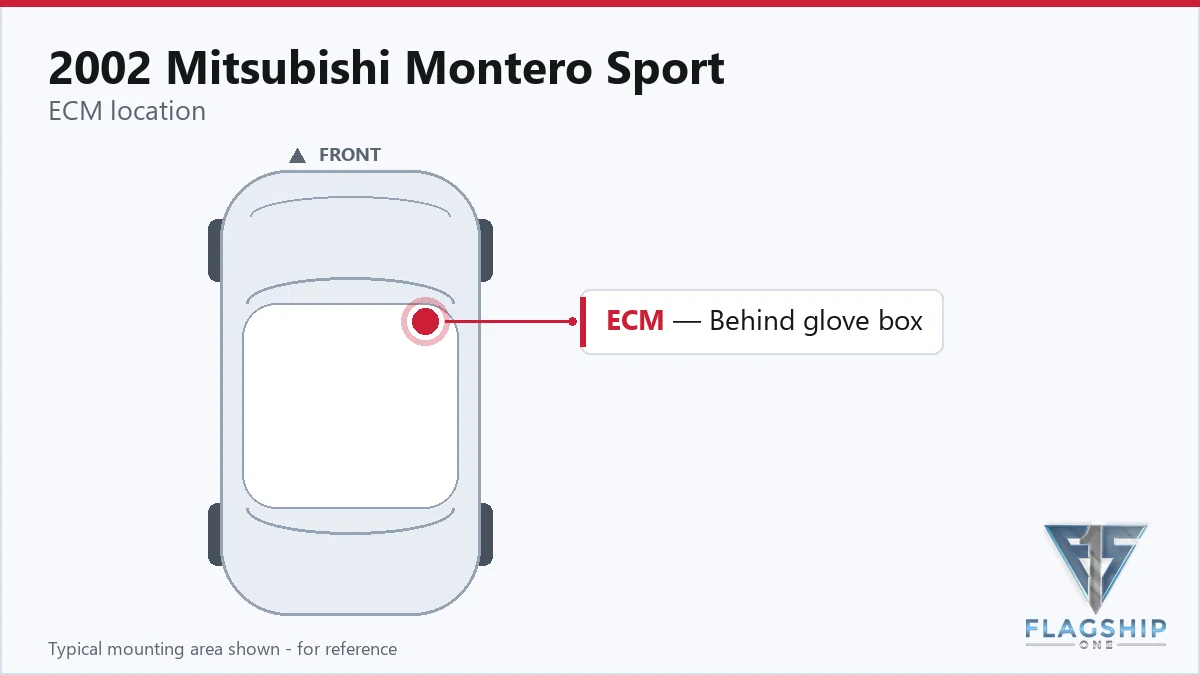
The PCM in your 2002 Mitsubishi Montero Sport is tucked behind the glove box and cowl side trim on the passenger side. To reach it, you’ll first remove the glove box assembly, which typically involves releasing a few screws or clips. Next, the cowl side trim panel must be detached to expose the module’s mounting location. The factory procedure accounts for 0.7 hours of labor for removal and reinstallation of the Powertrain Control Module, while the Engine Control Module (ECM) variant takes 0.6 hours. These times reflect the straightforward access but don’t include additional steps like relearning or programming, which may add to the total time if required. Proper reinstallation ensures the module’s connectors seat securely, preventing intermittent electrical issues that could mimic a faulty PCM.
| Operation | Configuration | Book Time |
|---|---|---|
| Powertrain Control Module R&R | All configurations | 0.7 hr |
| Powertrain Control Module Relearn | All configurations | 0.5 hr |
| Engine Control Module Relearn | All configurations | 0.5 hr |
| Engine Control Module R&R | All configurations | 0.6 hr |
After installing a new PCM in your 2002 Mitsubishi Montero Sport, the factory procedure mandates a relearn process to synchronize the module with the vehicle’s sensors and transmission. This step, which typically takes 0.5 hours, ensures the PCM recognizes engine parameters and shift patterns correctly. Without it, you may experience rough idling, delayed shifts, or even a no-start condition. However, opting for a VIN-programmed replacement unit from Flagship One eliminates this requirement, as the module arrives pre-configured to match your Montero Sport’s specifications. This not only saves time but also reduces the risk of programming errors that could complicate the repair. If you’re handling the installation yourself, confirm the unit’s compatibility with your VIN to avoid additional setup steps.
A failing PCM in your 2002 Mitsubishi Montero Sport often announces itself through a mix of drivability issues and warning lights. Common signs include intermittent stalling, especially at idle or during deceleration, as the module struggles to maintain stable engine operation. You might also notice the engine cranking but not starting, or it may fire up only to die moments later. Erratic shifting, such as harsh or delayed gear changes, can indicate the PCM is miscommunicating with the transmission. Onboard diagnostics may log faults like internal control module memory checksum error, which suggests the module’s internal programming has been corrupted. Other symptoms include poor fuel economy, rough idling, or the check engine light illuminating without an obvious cause. In some cases, the vehicle may enter a “limp mode,” limiting engine power to prevent further damage. If you’re experiencing these issues, a scan tool can help confirm whether the PCM is the root cause or if another system is at fault.
Common signs include stalling, no-start conditions, erratic shifting, or a check engine light with no clear cause. A scan tool can reveal PCM-related trouble codes, such as P0601, which often indicate internal faults. If these symptoms persist after checking other systems, the PCM may be the culprit.
Driving with a failing PCM can lead to unpredictable behavior, such as sudden stalling or transmission issues. In some cases, the vehicle may enter limp mode, limiting power to prevent damage. If you suspect PCM failure, it’s best to address it promptly to avoid further complications.
Replacing the PCM is possible if you’re comfortable with basic mechanical work. The module is located behind the glove box and cowl side trim, requiring removal of these components. However, a relearn procedure is typically needed afterward to ensure proper function, unless you use a pre-programmed unit.
The relearn process allows the new PCM to synchronize with the vehicle’s sensors and transmission. Without it, the module may not recognize engine parameters correctly, leading to rough idling, poor shifting, or other drivability issues. This step is critical for restoring normal operation.
In the 2002 Montero Sport, the PCM (Powertrain Control Module) and ECM (Engine Control Module) refer to the same component, though some vehicles separate engine and transmission control. The PCM manages both systems, while an ECM would focus solely on engine functions. Labor times for replacement may vary slightly depending on the terminology used.
If your 2002 Mitsubishi Montero Sport is showing signs of PCM failure, you have options. A repair shop can diagnose and replace the module, but labor and programming costs can add up quickly. Alternatively, a VIN-programmed replacement unit ensures compatibility and eliminates the need for additional setup, saving time and hassle. Whether you choose a new or refurbished module, addressing the issue promptly can restore your SUV’s performance and reliability.
Flagship One stocks a refurbished, VIN-programmed PCM for the 2002 Mitsubishi Montero Sport with a lifetime warranty, free shipping and no core charge. The full Mitsubishi Montero Sport module lineup covers other engine configurations as well.
The 2002 Mitsubishi Montero Sport relies on its PCM to keep the engine and transmission working smoothly. When this module fails, it can lead to frustrating drivability issues, from stalling to erratic shifting. Replacing it involves careful access and, in most cases, a relearn procedure to ensure proper function. By understanding the symptoms and steps involved, you can make an informed decision about repairs and get your Montero Sport back on the road with confidence.