
Last updated on August 25th, 2026 at 01:54 pm
The powertrain control module (PCM) in your 2001 Mitsubishi Montero manages fuel delivery, ignition timing, and transmission shifts. When it fails, you may experience no-start conditions, erratic idling, or warning lights tied to engine performance or emissions systems.
If your 2001 Mitsubishi Montero is acting up—stalling unexpectedly, refusing to start, or throwing cryptic engine codes—the powertrain control module (PCM) may be the culprit. This small but critical computer oversees everything from fuel injection to transmission shifts, and when it malfunctions, your vehicle’s performance can suffer dramatically. Replacing it isn’t just about swapping a part; it requires careful access, proper installation, and often a relearn procedure to ensure everything syncs correctly. Understanding the process helps you avoid unnecessary labor costs and ensures your Montero runs as smoothly as it did when it left the factory. Whether you’re diagnosing a persistent issue or preparing for a replacement, knowing what to expect puts you in control of the repair.
The powertrain control module (PCM) in your 2001 Mitsubishi Montero serves as the brain of the engine and transmission systems. It continuously monitors sensors for data like air intake, throttle position, and engine temperature, then adjusts fuel delivery, ignition timing, and shift points in real time. Without a functioning PCM, your Montero may struggle to start, idle roughly, or even enter a fail-safe mode that limits performance. This module also plays a key role in emissions control, ensuring the vehicle meets regulatory standards. When it fails, you might notice symptoms like hesitation under acceleration, unexplained stalling, or a check engine light that won’t clear. Replacing it with replacement engine computers for the Montero ensures compatibility and restores proper operation, but the process requires precision to avoid introducing new issues. The PCM’s location behind the cowl side trim means access isn’t straightforward, and improper handling can lead to electrical gremlins or connector damage.
2001 Mitsubishi Montero
OEM programmed replacements — plug & play, no dealer visit.
Find yours by year, make & model →
Free shipping · Lifetime warranty
The PCM in your 2001 Mitsubishi Montero is tucked behind the cowl side trim, near the firewall on the driver’s side. To access it, you’ll need to remove the trim panel, which may involve disconnecting clips or fasteners without breaking them. Once the panel is off, the module is visible and secured with a few bolts or screws. Factory labor time for removal and reinstallation is listed at 0.6 hours, though this doesn’t account for potential complications like corroded connectors or tight spaces. After installing the new unit, the electrical connections must be checked for cleanliness and proper seating to avoid intermittent faults. While the physical swap is straightforward, the location demands patience to avoid damaging surrounding components or the module itself during removal.
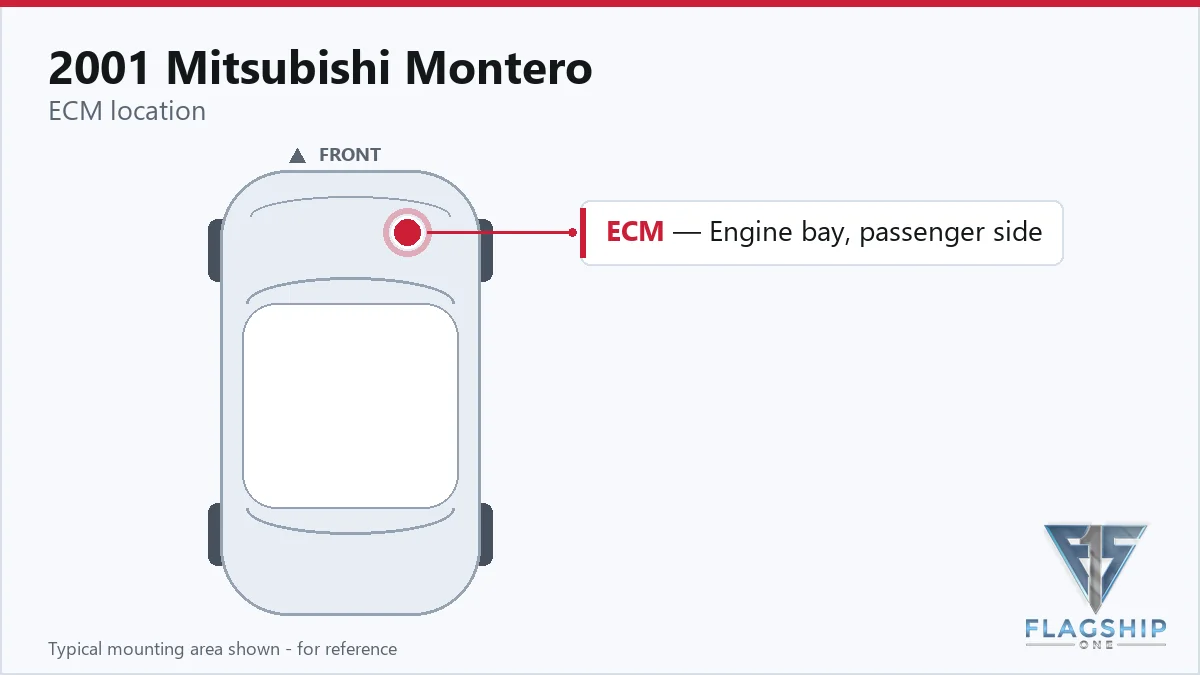
Work with the ignition off, and treat the module as static-sensitive: avoid touching the connector pins at any point.
| Operation | Configuration | Book Time |
|---|---|---|
| Powertrain Control Module R&R | All configurations | 0.6 hr |
| Powertrain Control Module Relearn | All configurations | 0.5 hr |
| Engine Control Module Relearn | All configurations | 0.5 hr |
| Engine Control Module R&R | All configurations | 0.6 hr |
After replacing the PCM in your 2001 Mitsubishi Montero, the factory procedure requires a relearn process to synchronize the module with the vehicle’s sensors and transmission. This step, which typically takes 0.5 hours, ensures the engine and transmission communicate correctly, preventing issues like rough shifting or poor fuel economy. However, if you install a VIN-programmed replacement unit, this relearn step is already completed, saving you time and potential frustration. The pre-programmed unit arrives ready to plug in and drive, eliminating the need for specialized scan tools or dealer visits to initialize the module. This convenience is particularly valuable if you’re working in a home garage or with limited diagnostic equipment. Still, it’s wise to verify that all electrical connections are secure and that no additional codes appear after installation, as these could indicate unrelated issues that need attention.
When the PCM in your 2001 Mitsubishi Montero begins to fail, the symptoms can range from subtle to severe. You might notice the engine stalling unexpectedly, especially at idle or during deceleration, or the vehicle may hesitate or jerk during acceleration. A common sign is the check engine light illuminating, often accompanied by codes related to fuel trim, misfires, or sensor malfunctions. In some cases, the Montero may crank but refuse to start, leaving you stranded until the issue is resolved. Another telltale sign is poor communication with a scan tool—if the tool can’t establish a connection or retrieves incomplete data, the PCM may be the root cause. Transmission shifting issues, such as delayed or harsh gear changes, can also point to a failing module. One specific fault code you might encounter is an internal control module memory check sum error, which indicates the PCM’s memory has been corrupted and may need replacement. Ignoring these symptoms can lead to further damage, so addressing them promptly is key to keeping your Montero running reliably.
If your Montero cranks but won’t start after a PCM replacement, the module may not have been properly programmed or synchronized with the vehicle’s sensors. A relearn procedure is typically required to establish communication between the PCM and the engine. If the unit wasn’t pre-programmed, you may need to use a scan tool to complete this step or verify that all electrical connections are secure.
Driving with a failing PCM is risky, as it can lead to unpredictable behavior like stalling, poor fuel economy, or even transmission damage. In some cases, the vehicle may enter a fail-safe mode that limits performance to prevent further issues. If you suspect the PCM is failing, it’s best to address the problem promptly to avoid being stranded or causing additional damage.
Diagnosing a failing PCM involves checking for symptoms like no-start conditions, stalling, or communication errors with a scan tool. If the scan tool can’t connect to the PCM or retrieves codes related to internal module faults, the PCM is likely the issue. However, other problems, like a bad crankshaft position sensor or fuel pump, can mimic PCM failure, so a thorough diagnosis is essential.
Replacing the PCM in your Montero requires basic hand tools to remove the cowl side trim, such as a trim panel removal tool, screwdrivers, and possibly a socket set. You’ll also need a scan tool to perform the relearn procedure unless you’re using a pre-programmed unit. A multimeter can help verify electrical connections, but it’s not strictly necessary for the replacement itself.
Refurbished PCMs are often a cost-effective alternative to new units, especially for older vehicles like the 2001 Montero. A reputable supplier will test and pre-program the module to match your vehicle’s VIN, ensuring compatibility and saving you the hassle of a relearn procedure. New units may offer peace of mind but are typically more expensive and may not provide additional benefits for an older vehicle.
If your 2001 Mitsubishi Montero is showing signs of PCM failure, you have a few options to consider. A dealership or repair shop can perform the replacement and relearn procedure, but this often comes with higher labor costs. Alternatively, a refurbished replacement unit pre-programmed to your Montero’s VIN can simplify the process, allowing you to complete the job in your own garage with minimal tools. This approach not only saves time but also ensures the module is ready to go right out of the box, reducing the risk of post-installation issues.
Flagship One stocks a refurbished, VIN-programmed PCM for the 2001 Mitsubishi Montero with a lifetime warranty, free shipping and no core charge. The full Mitsubishi Montero module lineup covers other engine configurations as well.
Replacing the PCM in your 2001 Mitsubishi Montero doesn’t have to be a daunting task, especially if you’re prepared with the right information and tools. Whether you opt for a dealership repair or a DIY approach with a pre-programmed unit, understanding the symptoms, location, and installation process helps you make an informed decision. Addressing PCM issues promptly can restore your Montero’s performance and reliability, keeping you on the road with confidence.