
Last updated on August 25th, 2026 at 01:55 pm
The powertrain control module (PCM) in the 1995 Mitsubishi Mirage manages fuel delivery, ignition timing, and emissions systems. Failure may cause erratic engine behavior, stalling, or a no-start condition without clear mechanical causes.
If your 1995 Mitsubishi Mirage is experiencing unexplained stalling, rough idling, or difficulty starting, the powertrain control module (PCM) may be the culprit. This small but critical component acts as the brain of your vehicle’s engine and transmission, regulating fuel, ignition, and emissions systems. When it fails, symptoms can mimic mechanical issues, making diagnosis tricky. Understanding how the PCM functions, where it’s located, and what replacement involves can help you decide whether to tackle the job yourself or leave it to a professional. With the right replacement unit, you can restore reliable performance without unnecessary downtime.
1995 Mitsubishi Mirage
OEM programmed replacements — plug & play, no dealer visit.
Find yours by year, make & model →
Free shipping · Lifetime warranty
In the 1995 Mitsubishi Mirage, the powertrain control module (PCM) coordinates engine and transmission operations to ensure smooth performance. It adjusts fuel injection, ignition timing, and idle speed based on inputs from sensors throughout the vehicle. A faulty PCM may disrupt these processes, leading to poor drivability or even a no-start condition. Since this vehicle predates OBD-II, diagnosing issues relies more on symptom observation than trouble codes. If replacement becomes necessary, opting for replacement engine computers for the Mirage ensures compatibility and avoids the need for additional programming steps.
The PCM in the 1995 Mitsubishi Mirage is mounted inside the vehicle, though the exact location isn’t specified beyond the model designation. Replacement involves disconnecting the battery, removing the module’s electrical connectors, and unbolting the unit from its mount. Labor time for removal and reinstallation (R&R) is typically 0.8 hours. After installation, a relearn procedure is required, which adds another 0.5 hours to the process. No special tools are mentioned, but care should be taken to avoid damaging connectors or mounting points during the swap.
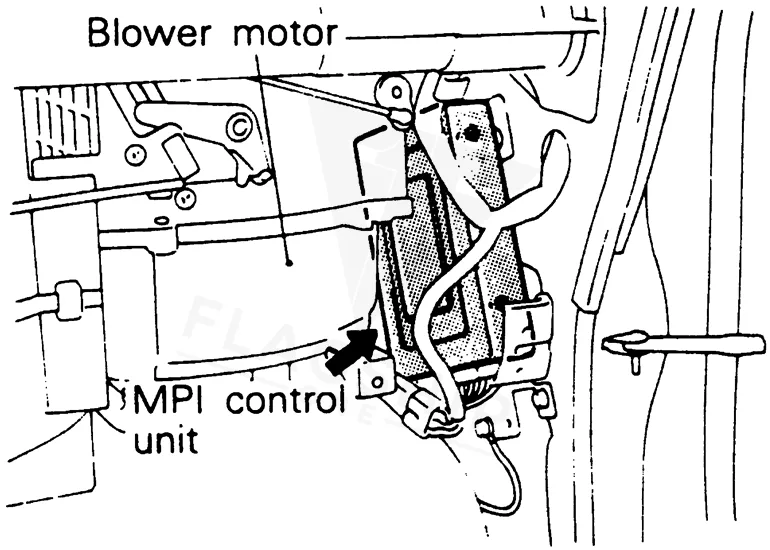
Work with the ignition off, and treat the module as static-sensitive: avoid touching the connector pins at any point.
| Operation | Configuration | Book Time |
|---|---|---|
| Powertrain Control Module R&R | All configurations | 0.8 hr |
| Powertrain Control Module Relearn | All configurations | 0.5 hr |
| Engine Control Module Relearn | All configurations | 0.5 hr |
| Engine Control Module R&R | All configurations | 0.8 hr |
After replacing the PCM in a 1995 Mitsubishi Mirage, the vehicle requires a relearn procedure to synchronize the new module with the engine and transmission. This process typically takes 0.5 hours and ensures proper operation. However, if you install a VIN-programmed replacement unit, these steps are already completed, saving time and reducing the risk of calibration errors. This eliminates the need for additional programming tools or dealer visits, allowing your vehicle to return to service more quickly.
A failing PCM in the 1995 Mitsubishi Mirage may cause a range of symptoms, including intermittent stalling, rough idling, or hesitation during acceleration. You might also experience a no-start condition, where the engine cranks but fails to fire. In some cases, the vehicle may run poorly at certain speeds or temperatures. Since this model lacks OBD-II diagnostics, issues like internal control module memory checksum error won’t appear, so diagnosis relies on observing these behaviors. If symptoms persist after checking for mechanical or electrical problems, the PCM may need replacement.
Replacing the PCM is straightforward if you’re comfortable working with electrical components. The process involves disconnecting the battery, removing the old module, and installing the new one. However, a relearn procedure is required afterward, which may require professional tools or assistance.
If the PCM wasn’t properly relearned after installation, the engine may run poorly or stall. This procedure ensures the module synchronizes with the vehicle’s sensors and systems. A VIN-programmed replacement unit eliminates this step, reducing the chance of calibration issues.
Common signs include stalling, rough idling, or a no-start condition. Since this model lacks OBD-II diagnostics, symptoms are the primary indicator. If mechanical or electrical issues are ruled out, the PCM may be the cause.
If your 1995 Mitsubishi Mirage is experiencing PCM-related issues, you have options. A repair may be possible if the problem is minor, but replacement is often more reliable. Opting for a pre-programmed unit simplifies the process, eliminating the need for additional programming steps. Whether you choose a new or refurbished module, ensure it’s designed for your vehicle to avoid compatibility issues.
Flagship One stocks a refurbished, VIN-programmed PCM for the 1995 Mitsubishi Mirage with a lifetime warranty, free shipping and no core charge. The full Mitsubishi Mirage module lineup covers other engine configurations as well.
The 1995 Mitsubishi Mirage relies on its PCM to manage critical engine and transmission functions. If yours is failing, replacement is a practical solution to restore performance. With a VIN-programmed unit, you can avoid the hassle of additional programming and get back on the road quickly. Addressing symptoms early can prevent further drivability issues down the line.