
Last updated on August 25th, 2026 at 01:56 pm
The Powertrain Control Module (PCM) in the 2018 Mazda CX-5 manages engine and transmission functions. A faulty PCM may cause drivability issues, warning lights, or communication errors with diagnostic tools.
If your 2018 Mazda CX-5 is experiencing unexplained drivability issues—like stalling, rough shifting, or warning lights—your Powertrain Control Module (PCM) may be the culprit. This critical component oversees engine and transmission functions, and when it fails, it can disrupt communication between systems. Understanding the role of the PCM, how to identify potential problems, and what replacement involves can help you make informed decisions. Whether you’re diagnosing a persistent check engine light or preparing for a repair, knowing the steps and requirements ensures a smoother process and avoids unnecessary delays.
The Powertrain Control Module in your 2018 Mazda CX-5 acts as the brain for both engine and transmission operations. It processes data from sensors to optimize fuel delivery, ignition timing, and shift points, ensuring smooth performance and efficiency. A malfunctioning PCM can lead to poor drivability, reduced fuel economy, or even a vehicle that won’t start. When replacement becomes necessary, choosing the correct replacement engine computers for the CX-5 is critical to avoid compatibility issues. The module’s location and programming requirements make professional installation advisable, though pre-programmed units simplify the process.
2018 Mazda CX-5
OEM programmed ECM for your 2018 Mazda CX-5 — plug & play, no dealer visit.
Free shipping · Lifetime warranty
In the 2018 Mazda CX-5, the PCM is typically mounted near the engine bay or inside the cabin, depending on the specific configuration. Replacing it involves disconnecting the battery, removing the module’s electrical connectors, and unbolting the unit from its mount. The labor time for Powertrain Control Module removal and reinstallation is 0.9 hours. After installation, a relearn procedure is required, which adds another 0.5 hours to the process. If an incorrect PCM is installed, it may interfere with engine control, leading to further issues. Always ensure the replacement unit matches the vehicle’s specifications.
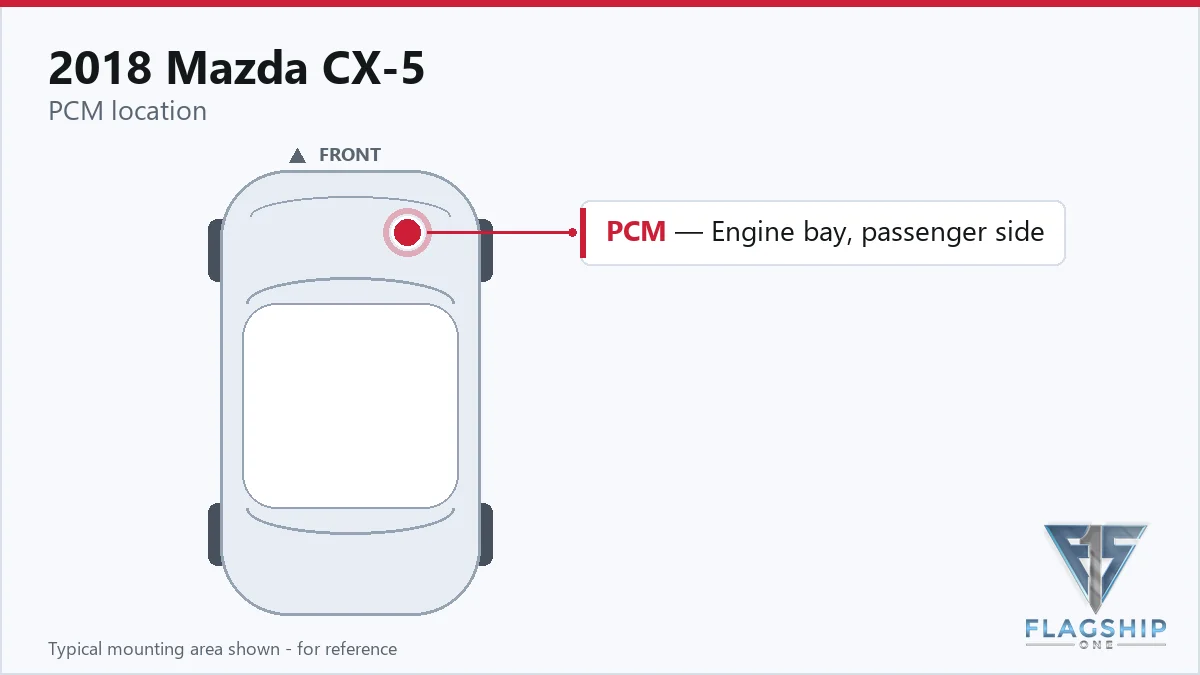
Work with the ignition off, and treat the module as static-sensitive: avoid touching the connector pins at any point.
| Operation | Configuration | Book Time |
|---|---|---|
| Powertrain Control Module R&R | All configurations | 0.9 hr |
| Powertrain Control Module Relearn | All configurations | 0.5 hr |
| Engine Control Module Reset | All configurations | 0.3 hr |
| Engine Control Module R&R | All configurations | 0.9 hr |
| Engine Control Module Relearn | All configurations | 0.5 hr |
After installing a new PCM in your 2018 Mazda CX-5, the factory procedure requires a reprogramming step to synchronize the module with the vehicle’s systems. This process typically takes 0.5 hours and ensures proper communication between the PCM and other components. However, if you opt for a VIN-programmed replacement unit, these steps are already completed, saving time and reducing the risk of programming errors. Reprogramming may also be necessary if no immediate repair solution is found and a later calibration is available.
A failing PCM in the 2018 Mazda CX-5 may cause a range of symptoms, including intermittent stalling, rough idling, or a no-start condition. You might also notice warning lights on the dashboard, such as the check engine or transmission warning light. Diagnostic trouble codes like an internal control module memory check sum error may appear, indicating a potential fault within the module itself. In some cases, the vehicle may exhibit poor shifting behavior or fail to communicate with a scan tool. Addressing these symptoms promptly can prevent further drivability issues.
The 2018 Mazda CX-5 may store specific trouble codes when the PCM experiences internal faults. These codes help identify the source of the problem and guide the diagnostic process.
| Code | Meaning | Full Guide |
|---|---|---|
| P0601 | Internal memory checksum error | Full P0601 guide → |
Mazda issued a Technical Service Bulletin addressing check engine and automatic transmission warning lights in the 2018 CX-5. The bulletin, 05-004/19, covers scenarios where one or more diagnostic trouble codes—such as P0842, P0847, P0872, P0877, P0780, or P1738—are stored in the Transmission Control Module (TCM) memory. These codes may indicate issues related to the transmission or its sensors, which could indirectly involve PCM communication or control.
| Bulletin | Subject | What It Addresses |
|---|---|---|
| — | Technical Service Bulletin > Transmission/Transaxle > On-Board Diagnostics > 05-004/19 – Check | — |
Installing an incorrect PCM may cause interference with engine control, leading to drivability issues or communication errors. The vehicle may not start, or warning lights could appear on the dashboard. Always verify compatibility before installation.
While the vehicle may still run, a P0601 code indicates a potential internal PCM fault. Driving with this issue may lead to poor performance, stalling, or further damage. It’s advisable to diagnose and address the problem promptly.
Replacing the PCM typically requires 0.9 hours for removal and reinstallation. An additional 0.5 hours is needed for the relearn procedure to ensure proper functionality. Total labor time may vary based on shop efficiency.
When your 2018 Mazda CX-5 requires a new PCM, you have options. A dealership may offer a new unit with factory programming, but this often comes at a higher cost. Refurbished or remanufactured units, particularly those pre-programmed to your vehicle’s VIN, provide a reliable alternative. These units eliminate the need for additional programming steps, saving time and reducing the risk of errors during installation.
Flagship One stocks a refurbished, VIN-programmed PCM for the 2018 Mazda CX-5 with a lifetime warranty, free shipping and no core charge. The full Mazda CX-5 module lineup covers other engine configurations as well.
The 2018 Mazda CX-5 relies on its PCM to manage critical engine and transmission functions. If you’re experiencing warning lights, stalling, or other drivability issues, the PCM may be the source. Replacing it with a compatible, pre-programmed unit ensures a smoother repair process and restores your vehicle’s performance. Addressing the problem early can prevent more extensive issues down the road.