
Last updated on August 25th, 2026 at 02:13 pm
The powertrain control module in the 1995 Kia Sephia manages fuel delivery, ignition timing, and transmission shifting for the 1.6L engine. When it fails, the engine may not start, run roughly, or shift erratically because the controller can no longer process sensor data or command actuators correctly.
If your 1995 Kia Sephia cranks but will not fire, stalls at idle, or shows no communication with a scan tool, the powertrain control module may be the culprit. This module governs fuel injection, spark timing, and automatic transmission functions for the 1.6L engine, so a failure can mimic many other problems. Understanding where the unit lives, what the factory service procedure requires, and how a pre-programmed replacement changes the repair timeline helps you decide the next step. The following sections break down the module’s role, location, factory reprogramming details, typical failure signs, and the relevant service bulletin so you can approach the job with confidence.
1995 Kia Sephia
OEM programmed ECM for your 1995 Kia Sephia — plug & play, no dealer visit.
Free shipping · Lifetime warranty
The powertrain control module in the 1995 Kia Sephia acts as the central brain for the 1.6L engine and automatic transmission, processing inputs from sensors such as the crankshaft position, throttle position, and coolant temperature to calculate precise fuel injector pulse width and ignition timing. It also controls shift solenoids, idle air bypass, and the fuel pump relay, meaning a fault can produce a wide range of drivability issues. Because this vehicle predates OBD-II, the module does not store standardized P-codes; instead, it relies on proprietary self-diagnostics that a factory scan tool reads through the data link connector. When the internal processor or driver circuits degrade, you may lose injector pulse, spark, or shift control entirely. Replacing the unit with replacement engine computers for the Sephia restores the factory logic maps and communication protocols needed for proper operation.
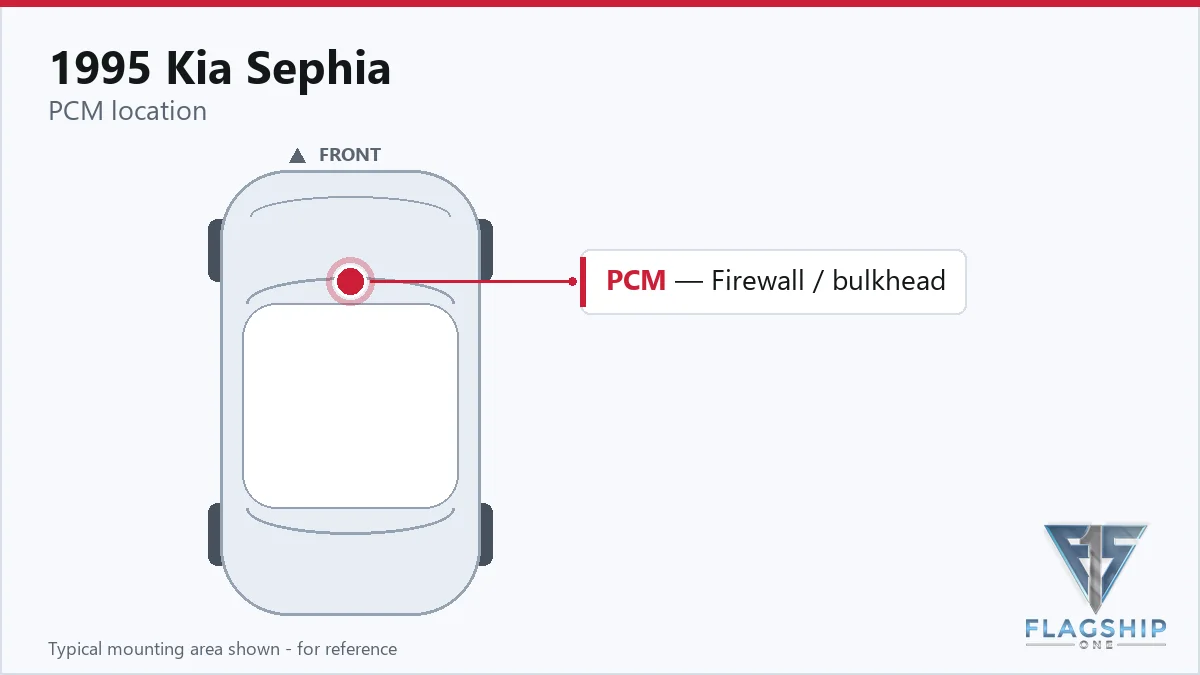
The PCM is located under the dash center, on the floor, against the engine compartment bulkhead. Access typically requires removing the lower dash trim panels and possibly the carpet to reach the mounting bracket. Book time for removal and installation is 0.4 hours. After the physical swap, the factory relearn procedure adds 0.5 hours and involves cycling the ignition through specific key-on and key-off intervals to re-establish idle baseline and transmission adaptive values. No torque specifications are provided for the mounting hardware, so hand-snug the fasteners to avoid cracking the module housing.
| Operation | Configuration | Book Time |
|---|---|---|
| Engine Control Module R&R | All configurations | 0.4 hr |
| Engine Control Module Relearn | All configurations | 0.5 hr |
| Powertrain Control Module R&R | All configurations | 0.4 hr |
| Powertrain Control Module Relearn | All configurations | 0.5 hr |
The factory service bulletin SST037r1 describes the Standard KDS Reflash Procedure, which a dealer uses to load the latest calibration software into a new or replacement module using the Kia Diagnostic System. This step ensures the unit matches the vehicle’s exact configuration, including transmission type and emissions calibration. Flagship One units arrive with a VIN-programmed replacement unit so the KDS reflash and the associated 0.5-hour relearn are already complete, letting you install and drive without a dealer visit.
Typical signs of a failing PCM in the 1995 Kia Sephia include a crank-no-start condition where the engine turns over but never fires, sudden stalling at idle or low speed that may not restart immediately, and a complete lack of communication with a scan tool plugged into the data link connector. You might also notice erratic shifting, harsh engagement, or the transmission locked in a single gear because the shift solenoids are not receiving commands. Intermittent misfires or a dead fuel pump relay can also point to driver circuit failure inside the module. Because this is a pre-OBD-II vehicle, the check engine light may not illuminate even when the module is malfunctioning.
Technical Service Bulletin SST037r1 covers the Standard KDS Reflash Procedure (Revision 1). This bulletin provides the step-by-step process for connecting the Kia Diagnostic System, selecting the correct calibration file, and programming the module to the vehicle identification number. It applies whenever a module is replaced or when a software update is required to address drivability concerns.
| Bulletin | Subject | What It Addresses |
|---|---|---|
| — | TSB • General Information • [SST037r1] Standard KDS Reflash Procedure (SST037) (Rev 1) | — |
The factory procedure calls for a KDS reflash and a 0.5-hour relearn. A VIN-programmed unit from Flagship One arrives with that work already done, so no dealer visit is needed.
It sits under the center of the dash, on the floor, against the engine compartment bulkhead. Lower dash panels and carpet usually must be removed for access.
Yes. The module controls the shift solenoids directly. If the driver circuits fail, the transmission may default to a single gear or shift erratically.
When the PCM in your 1995 Kia Sephia fails, you can either source a used unit and pay for dealer programming plus the 0.5-hour relearn, or install a refurbished module that arrives calibrated to your VIN. The latter eliminates the reprogramming appointment and gets the car back on the road faster, which matters when the vehicle is your daily driver.
Flagship One stocks a refurbished, VIN-programmed PCM for the 1995 Kia Sephia with a lifetime warranty, free shipping and no core charge. The full Kia Sephia module lineup covers other engine configurations as well.
The 1995 Kia Sephia relies on a single powertrain control module to run the 1.6L engine and automatic transmission. Knowing its location, the factory book times, and the reprogramming requirement lets you plan the repair efficiently. A pre-programmed replacement removes the dealer step from the equation and restores factory performance with minimal downtime.