
Last updated on August 25th, 2026 at 02:14 pm
The ECM (engine control module) in your 1991 Isuzu Amigo 2.3L manages fuel injection and ignition timing. When it fails, it can cause no-start, stalling, poor performance, or erratic behavior. Because this is a pre-OBD-II vehicle, diagnosis relies on symptoms rather than diagnostic trouble codes.
If you own a 1991 Isuzu Amigo with the 2.3L engine, you may have encountered frustrating driveability issues like sudden stalling, hard starting, or a complete no-start condition. These symptoms often point to a failing engine control module (ECM), the computer that manages fuel delivery and ignition timing. Because this vehicle is pre-OBD-II, it does not generate standard diagnostic trouble codes, making symptom-based diagnosis essential. This article explains what the ECM does in your Amigo, where it is located, how to recognize failure signs, and what replacement involves. You will also learn how a pre-programmed replacement unit can simplify the repair, saving you time and guesswork. Whether you are a DIY owner or working with a mechanic, understanding the ECM’s role helps you make informed decisions about repair or replacement.
1991 Isuzu Amigo 2.3L
OEM programmed ECM for your 1991 Isuzu Amigo 2.3L — plug & play, no dealer visit.
Free shipping · Lifetime warranty
The ECM in your 1991 Isuzu Amigo 2.3L is the brain of the engine management system. It receives signals from sensors such as the throttle position sensor, coolant temperature sensor, and oxygen sensor, then adjusts fuel injector pulse width and ignition timing to maintain proper air-fuel mixture and engine performance. In this pre-OBD-II vehicle, the ECM operates without a standardized diagnostic link; instead, it relies on internal logic and basic sensor inputs. When the ECM fails, it can disrupt these critical functions, leading to poor drivability or a non-running engine. Because the Amigo is a compact SUV often used for off-road or daily driving, a reliable ECM is essential for both performance and safety. When you need a new unit, look for replacement ECMs for the Isuzu Amigo that are pre-programmed to match your vehicle’s specifications, ensuring plug-and-play installation without the need for dealer programming.
The ECM in your 1991 Isuzu Amigo 2.3L can usually be found in front of the center console, under the dash. It is typically mounted on a bracket or tucked behind a trim panel. To access it, you may need to remove a lower dash panel or kick panel on the passenger side. The module is a rectangular metal box with one or two multi-pin connectors. Replacement involves disconnecting the battery, unbolting the ECM from its bracket, carefully releasing the connector latches, and removing the unit. Installation is the reverse: position the new ECM, secure it, reconnect the connectors, and reattach any trim. Because the connectors can be fragile, take care not to bend pins or damage the locking tabs. No special tools are required, but a small socket set and a trim tool may help. The entire process typically takes about an hour for a careful DIYer.
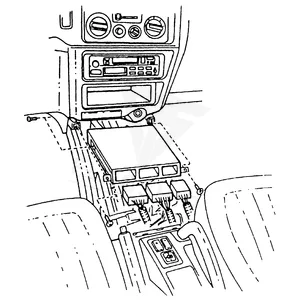
Work with the ignition off, and treat the module as static-sensitive: avoid touching the connector pins at any point.
After replacing the ECM in a 1991 Isuzu Amigo 2.3L, the factory procedure typically requires programming the module with vehicle-specific data such as injector flow rates, ignition timing maps, and VIN information. This step often involves a dealer-level scan tool or specialized equipment that may not be available to independent shops or owners. Without proper programming, the engine may run poorly or not start at all. Instead of going through that process, you can order a VIN-programmed replacement unit from Flagship One that arrives ready to install. The unit is pre-loaded with the correct calibration for your Amigo’s 2.3L engine, so you simply plug it in and reconnect the battery. This eliminates the need for a separate programming visit and gets your vehicle back on the road faster.
A failing ECM in your 1991 Isuzu Amigo 2.3L can produce a range of symptoms that may mimic other issues. The most common sign is a no-start condition where the engine cranks but does not fire. You may also experience intermittent stalling, especially when the engine is warm, or a sudden loss of power during acceleration. Poor fuel economy and rough idle are frequent complaints. Because the ECM controls ignition timing, a failing module can cause misfires or backfiring. In some cases, the check engine light may illuminate, but since this is a pre-OBD-II vehicle, the light does not provide a specific code. Another clue is that the scan tool cannot communicate with the ECM when attempting diagnosis. If you notice these symptoms and have ruled out basic causes like fuel pressure, spark, and sensor faults, the ECM should be a prime suspect.
You can perform basic electrical tests: check for power and ground at the ECM connector with the ignition on, and verify that sensors like the coolant temperature sensor and throttle position sensor provide correct voltage signals. A multimeter and a service manual with pinout diagrams are essential. If all inputs and outputs appear normal but the engine still won’t run, a known-good replacement ECM is often the most reliable diagnostic step.
A used ECM may work if it comes from an identical vehicle with the same engine and transmission, but it will still need to be programmed with your vehicle’s VIN and calibration data. Without proper programming, it may not function correctly. Additionally, used modules carry unknown failure risk. A pre-programmed replacement from Flagship One eliminates these uncertainties.
Common causes include voltage spikes from a faulty alternator or battery, corrosion at the connectors or ground points, moisture intrusion into the module, and age-related component degradation. Heat and vibration can also stress internal solder joints over time. Preventive maintenance of the charging system and electrical connections can reduce failure risk.
The ECM primarily controls the engine, but in some vehicles it also communicates with the transmission control module. In the Amigo, a failing ECM may send incorrect signals that affect shift timing or torque converter lockup, leading to harsh or erratic shifting. However, transmission issues are more often due to the transmission itself or its sensors.
It is not recommended. A failing ECM can cause sudden stalling or loss of power, which may lead to an accident, especially in traffic or off-road conditions. Additionally, continued operation with a faulty module can damage other components like the catalytic converter or oxygen sensor. Have the issue diagnosed and repaired promptly.
When your 1991 Isuzu Amigo 2.3L experiences ECM-related issues, you have two main options: attempt to repair the original module or replace it with a refurbished unit. Repairing a failed ECM is often impractical due to the complexity of surface-mount components and the lack of available schematics. A refurbished replacement from Flagship One offers a reliable, cost-effective solution that is pre-programmed for your specific vehicle, ensuring a straightforward installation and restored performance.
Flagship One stocks a refurbished, VIN-programmed ECM for the 1991 Isuzu Amigo with a lifetime warranty, free shipping and no core charge. The full Isuzu Amigo module lineup covers other engine configurations as well.
The ECM in your 1991 Isuzu Amigo 2.3L is a critical component that directly affects engine performance and reliability. Recognizing the symptoms of failure and knowing where the module is located can help you diagnose problems efficiently. If replacement becomes necessary, choosing a pre-programmed unit from Flagship One simplifies the process and gets your Amigo back on the road with minimal downtime.