
Last updated on August 25th, 2026 at 02:41 pm
The powertrain control module (PCM) in your 1994 Buick Century manages engine and transmission functions. Failure may cause stalling, poor performance, or a no-start condition due to corrupted calibration data or internal faults.
If your 1994 Buick Century is experiencing erratic engine behavior, stalling, or a no-start condition, the powertrain control module (PCM) may be the culprit. This critical component acts as the brain for your engine and transmission, managing everything from fuel delivery to shift timing. When it fails, symptoms can range from subtle performance issues to complete immobilization. Understanding the role of the PCM, where it’s located, and what replacement involves can help you make informed decisions. Whether you’re diagnosing an existing problem or preparing for potential repairs, knowing the facts about this module will save you time and uncertainty.
1994 Buick Century
OEM programmed ECM for your 1994 Buick Century — plug & play, no dealer visit.
Free shipping · Lifetime warranty
In your 1994 Buick Century, the powertrain control module (PCM) integrates engine and transmission control into a single unit. It processes inputs from sensors to adjust fuel injection, ignition timing, and shift points, ensuring optimal performance and efficiency. The module also contains a programmable read-only memory (PROM) chip, which holds vehicle-specific data like weight, axle ratio, and transmission type. If the PCM fails, your vehicle may experience drivability issues or fail to start altogether. When replacement becomes necessary, opting for replacement powertrain control modules for the Buick Century ensures compatibility and restores proper function without the guesswork of generic parts.
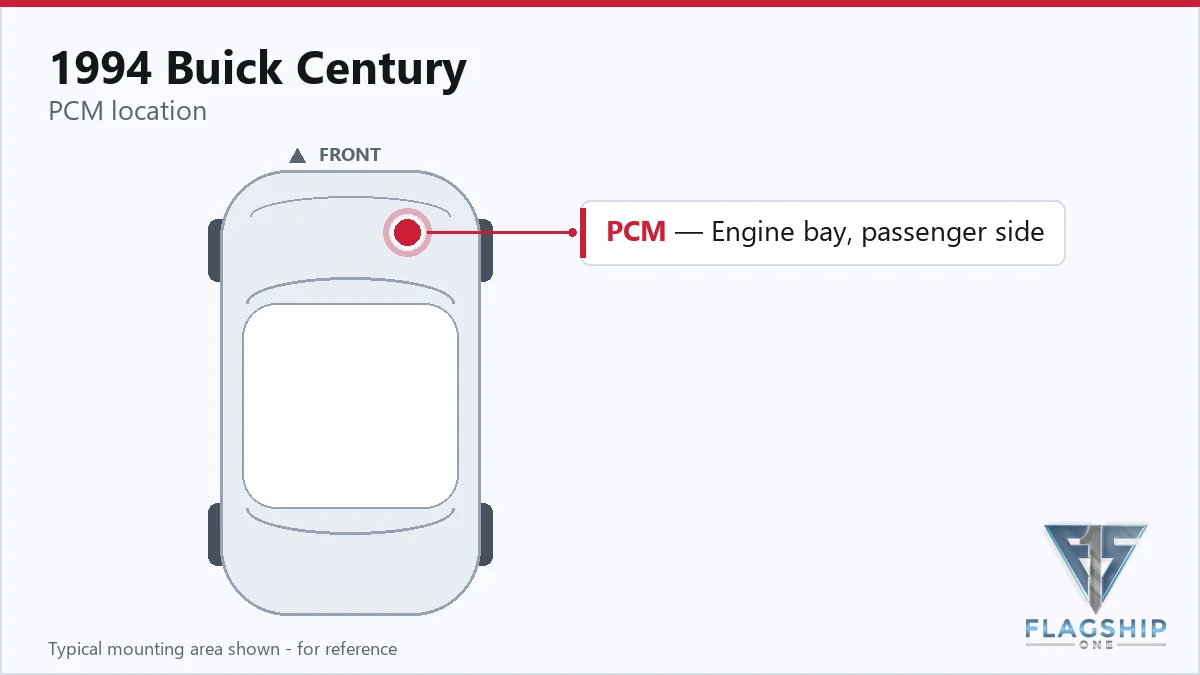
The PCM in your 1994 Buick Century is mounted inside the vehicle, typically beneath the dashboard or behind the glove compartment. Accessing it requires removing interior panels, but no major disassembly is needed. Replacing the module involves disconnecting the battery, unplugging the wiring harness, and removing the mounting bolts. Labor time for PCM replacement is typically 0.5 hours, according to factory estimates. After installation, a relearn procedure is required to synchronize the new module with your vehicle’s systems, which adds another 0.5 hours of labor. Torque specifications for mounting bolts are critical to prevent damage to the module or its housing.
| Operation | Configuration | Book Time |
|---|---|---|
| Engine Control Module R&R | All configurations | 1.4 hr |
| Powertrain Control Module Relearn | All configurations | 0.5 hr |
| Powertrain Control Module R&R | All configurations | 0.5 hr |
After replacing the PCM in your 1994 Buick Century, the factory procedure requires a relearn process to ensure the module communicates correctly with the engine and transmission. This step typically takes 0.5 hours and involves resetting learned values for fuel trim, idle speed, and shift patterns. However, when you install a VIN-programmed replacement unit, these steps are already completed. The module arrives pre-configured with your vehicle’s specific calibration data, eliminating the need for manual programming and reducing downtime. This ensures your Century starts and drives as expected immediately after installation.
A failing PCM in your 1994 Buick Century may cause a variety of symptoms. Common issues include intermittent stalling, rough idle, or hesitation during acceleration. You might also notice the transmission shifting erratically or the engine failing to start altogether. In some cases, the vehicle may enter a limp-home mode, limiting performance to prevent further damage. If the module loses communication with the scan tool, diagnostics become difficult. While these symptoms can stem from other issues, persistent problems often point to PCM failure, especially if they occur alongside electrical or sensor-related faults.
Intermittent stalling in your Century may stem from a failing PCM, especially if the issue occurs alongside other symptoms like rough idle or erratic shifting. The module controls critical engine functions, and corruption in its memory or circuitry can disrupt these processes. A diagnostic scan can help confirm whether the PCM is the root cause.
If your Century exhibits persistent drivability issues like stalling, no-start conditions, or transmission problems, and diagnostics point to the PCM, replacement is often the most reliable solution. Internal faults or corrupted calibration data typically cannot be repaired, making a new or refurbished module the practical choice.
Replacing the PCM is a straightforward process involving basic hand tools and about 0.5 hours of labor. However, if you’re unfamiliar with electrical systems or the relearn procedure, a professional can ensure the job is done correctly. Using a pre-programmed unit simplifies the process by eliminating the need for manual programming.
If your 1994 Buick Century is showing signs of PCM failure, you have options. Repairing the existing module is rarely feasible, so replacement is typically the best course. A new or refurbished unit, pre-programmed with your vehicle’s VIN, ensures compatibility and saves time on post-installation procedures. This approach minimizes downtime and restores your Century’s performance without the hassle of manual programming.
Flagship One stocks a refurbished, VIN-programmed PCM for the 1994 Buick Century with a lifetime warranty, free shipping and no core charge. The full Buick Century module lineup covers other engine configurations as well.
The powertrain control module in your 1994 Buick Century plays a vital role in keeping your vehicle running smoothly. If you’re experiencing stalling, no-start conditions, or other drivability issues, the PCM may be the cause. Replacing it with a pre-programmed unit can resolve these problems efficiently, getting you back on the road with minimal disruption. Consider your options carefully to ensure a reliable repair.