
Last updated on August 25th, 2026 at 02:43 pm
In the 2010 BMW X6M, the Powertrain Control Module (PCM) and Engine Control Module (ECM) manage engine timing, fuel delivery, and transmission shifting. A failure typically triggers a check engine light and can halt engine operation or cause erratic shifting. These modules reside in the electronic box within the engine compartment and require precise removal and programming procedures.
When a 2010 BMW X6M begins to illuminate the check engine light, owners often discover that the heart of the vehicle’s electronic control system—its PCM or ECM—may be at fault. Understanding how these modules function, where they sit, and what the repair process entails can save time and prevent unnecessary complications. This guide walks you through the essential facts about the control modules in your X6M, outlines the steps required for removal and replacement, and explains how Flagship One’s VIN‑programmed units simplify the process. By the end, you’ll know what to expect from labor, how the factory re‑learn procedure works, and why a properly programmed replacement matters for reliable performance.
The Powertrain Control Module and Engine Control Module in the 2010 BMW X6M serve as the central processors for engine and transmission management. They continuously monitor sensor data, adjust fuel injection, control ignition timing, and coordinate shift points to deliver smooth power delivery. When these units malfunction, the vehicle may experience loss of power, rough idle, or transmission hesitation, compromising drivability and emissions compliance. Because the X6M relies on precise electronic coordination, any fault in the PCM or ECM can trigger diagnostic trouble codes and illuminate the check engine light. Proper operation of these modules is essential for maintaining performance and meeting regulatory standards. For owners seeking a direct swap, replacement control modules for the 2010 BMW X6M provide a tested solution that matches factory specifications.
2010 BMW X6M
OEM programmed ECM for your 2010 BMW X6M — plug & play, no dealer visit.
Free shipping · Lifetime warranty
The PCM and ECM are housed inside the electronics box, commonly referred to as the E‑box, located in the engine compartment of the 2010 BMW X6M. Accessing the modules requires opening the engine bay, removing the cover to expose the E‑box, and disconnecting the wiring harnesses. The factory removal procedure outlines that the control module can be reached without additional body work. Labor times listed in the service guide indicate that removing and reinstalling each module takes between 0.8 and 1.0 hours, depending on whether the gasoline‑specific procedure is used. After the unit is seated, a relearn step is required, adding another 0.5 hours to ensure the vehicle’s control strategies are correctly calibrated.
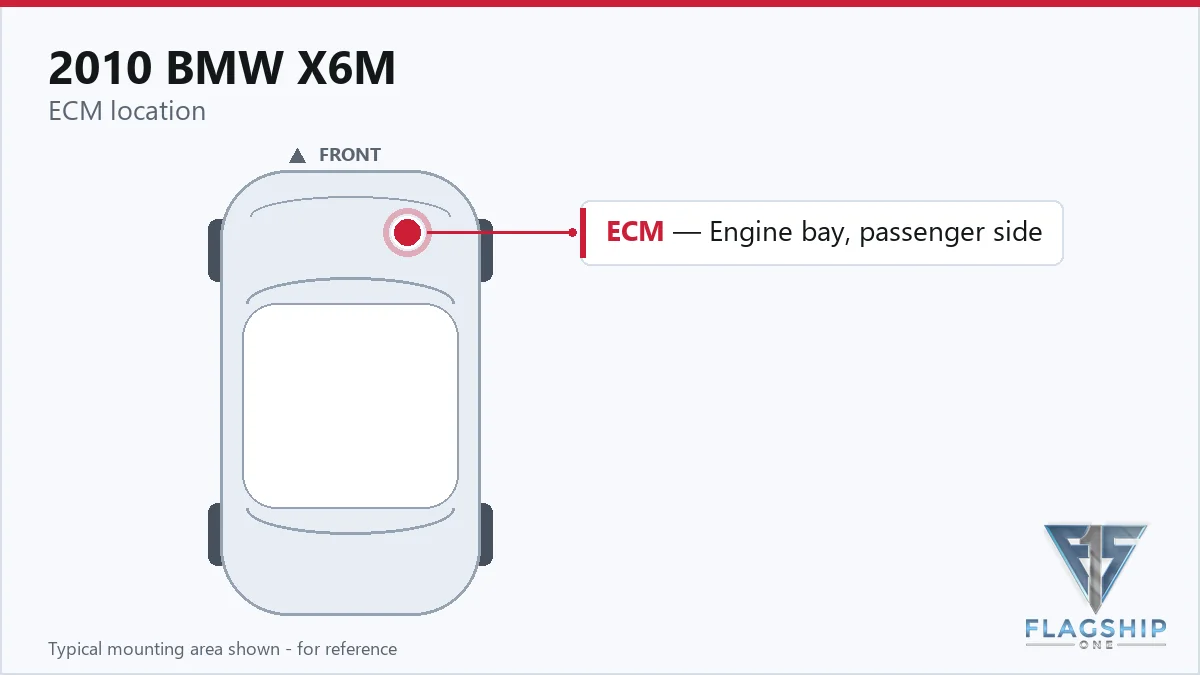
Work with the ignition off, and treat the module as static-sensitive: avoid touching the connector pins at any point.
| Operation | Configuration | Book Time |
|---|---|---|
| Engine Control Module R&R | GAS | 0.8 hr |
| Engine Control Module R&R | All configurations | 1.0 hr |
| Engine Control Module Relearn | All configurations | 0.5 hr |
| Powertrain Control Module R&R | GAS | 0.8 hr |
| Powertrain Control Module R&R | All configurations | 1.0 hr |
| Powertrain Control Module Relearn | All configurations | 0.5 hr |
Following the physical replacement of the PCM or ECM in the 2010 BMW X6M, the factory protocol calls for a module relearn operation lasting about half an hour. This step re-establishes communication with the vehicle’s sensors and ensures proper adaptation of fuel and transmission parameters. Flagship One units arrive pre‑programmed to the vehicle’s VIN, so the relearn process is already completed when the part is installed. This eliminates the need for additional programming steps and reduces the risk of post‑install errors. The VIN‑programmed replacement unit streamlines the repair, allowing you to focus on the mechanical aspects of the swap. a VIN-programmed replacement unit handles the necessary software configuration out of the box.
Owners of a 2010 BMW X6M may notice a range of symptoms when the PCM or ECM begins to fail. Common signs include a persistent check engine light, engine stalling during idle, rough acceleration, or unexpected transmission shifting delays. In some cases, the vehicle may refuse to start or exhibit intermittent loss of power as the control unit loses communication with critical sensors. Diagnostic trouble codes related to internal module faults often appear, prompting a scan‑tool readout that points to the control module as the source of the issue. These symptoms typically warrant a thorough inspection of the PCM and ECM to confirm whether replacement is necessary.
| Bulletin | Subject | What It Addresses |
|---|---|---|
| — | Check Engine Light Illuminated, Faults Stored in DME/ECM | — |
Yes, the PCM controls shift timing and fuel delivery. A malfunction can lead to delayed or harsh shifting, especially under load.
The factory removal procedure only requires standard hand tools to access the E‑box and disconnect the wiring harnesses.
The service guide specifies a 0.5‑hour relearn step to calibrate the new module with the vehicle’s sensors.
A VIN‑programmed unit from Flagship One includes the necessary software, so additional coding is typically unnecessary.
Warranty details are provided with each purchase and cover defects in materials and workmanship for the specified period.
When the PCM or ECM in your 2010 BMW X6M needs attention, you have the option of a brand‑new factory‑spec unit or a refurbished replacement that meets the same performance standards. Both approaches restore the vehicle’s electronic control functions, but a refurbished module from Flagship One may offer cost savings while still delivering the required VIN programming and reliability.
Flagship One stocks a refurbished, VIN-programmed PCM for the 2010 BMW X6M with a lifetime warranty, free shipping and no core charge. The full BMW X6M module lineup covers other engine configurations as well.
If your 2010 BMW X6M shows signs of PCM or ECM failure, addressing the issue promptly can restore proper engine and transmission operation. Consider a VIN‑programmed replacement to simplify the repair and keep your vehicle performing as intended.