
Last updated on August 25th, 2026 at 02:43 pm
The Engine Control Module (ECM) in your 2010 BMW 7 Series manages fuel injection, ignition timing, and emissions systems. Failures may cause poor performance, stalling, or stored fault codes related to engine operation.
If your 2010 BMW 7 Series is experiencing unexplained drivability issues, a faulty Engine Control Module (ECM) could be the cause. This critical component oversees engine performance, fuel delivery, and emissions systems. Replacing it involves specific steps to access the module and ensure proper calibration. Understanding the process, labor requirements, and symptoms of failure can help you make informed decisions about repairs. This guide covers what the ECM does, where it’s located, and what to expect during replacement.
The ECM in your 2010 BMW 7 Series acts as the brain of the engine, continuously adjusting fuel injection, ignition timing, and emissions controls for optimal performance. It processes data from sensors throughout the engine bay to maintain efficiency and power. When it fails, you may notice poor acceleration, stalling, or a check engine light. Replacing it requires replacement engine computers for the 7 Series to restore proper function. Without a fully operational ECM, your vehicle may struggle to meet emissions standards or deliver expected power.
2010 BMW 7 Series
OEM programmed ECM for your 2010 BMW 7 Series — plug & play, no dealer visit.
Free shipping · Lifetime warranty
The ECM in your 2010 BMW 7 Series is housed in the electronics box (E-box) in the engine compartment. To access it, the factory procedure requires switching off the ignition, disconnecting the battery’s earth lead, and draining coolant for the charge air cooler. Additional steps include removing the right intake pipe and right tension strut. Labor time for removal and reinstallation is typically 2.2 hours. Always follow electrostatic discharge (ESD) protection guidelines to avoid damaging sensitive electronics during handling.
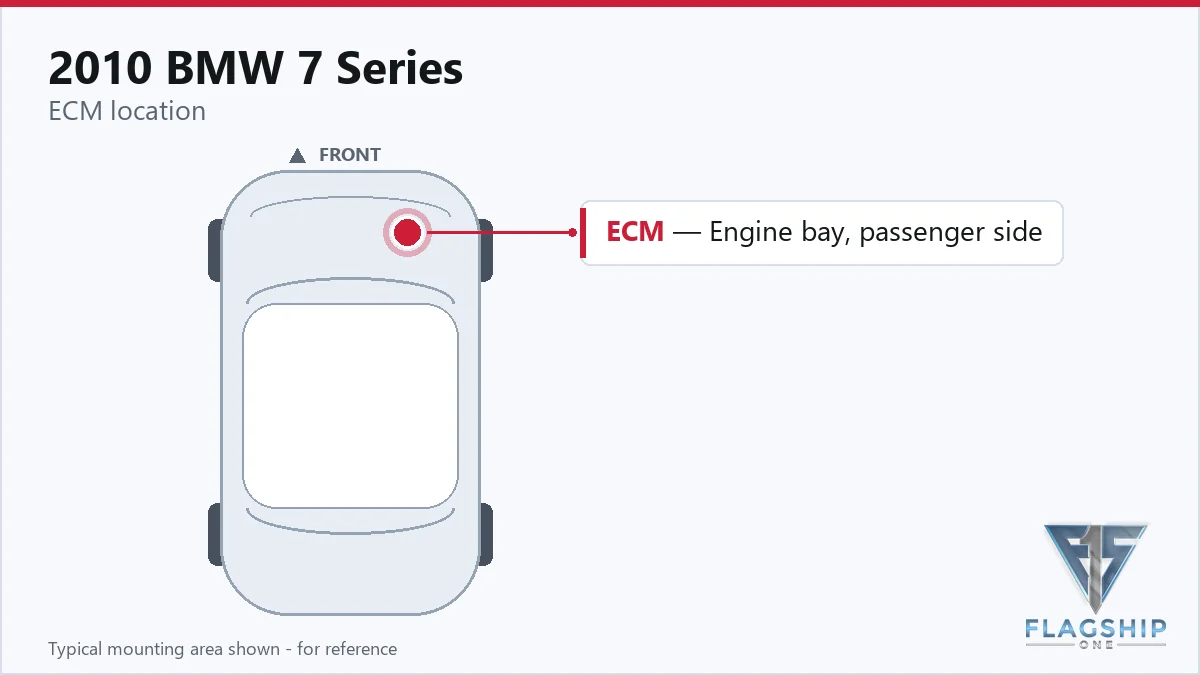
Work with the ignition off, and treat the module as static-sensitive: avoid touching the connector pins at any point.
| Operation | Configuration | Book Time |
|---|---|---|
| Powertrain Control Module R&R | All configurations | 2.2 hr |
| Engine Control Module R&R | All configurations | 2.2 hr |
| Engine Control Module Relearn | All configurations | 0.5 hr |
After replacing the ECM in your 2010 BMW 7 Series, the factory procedure requires a 0.5-hour relearn process to synchronize the module with the vehicle’s systems. However, a VIN-programmed replacement unit from Flagship One arrives pre-configured, eliminating the need for additional programming. This ensures your vehicle’s engine controls are immediately calibrated to factory specifications, reducing downtime and potential calibration errors.
A failing ECM in your 2010 BMW 7 Series may cause a range of symptoms, including rough idling, stalling, or poor acceleration. You might also notice the check engine light illuminating, often accompanied by fault codes like internal control module memory check sum error. In some cases, the vehicle may fail to start or exhibit erratic shifting behavior. If your scan tool shows no communication with the ECM, the module itself could be the issue. Addressing these symptoms promptly can prevent further drivability problems.
Factory service bulletins for the 2010 BMW 7 Series address instances where the check engine light illuminates and faults are stored in the ECM. These bulletins provide diagnostic steps to confirm ECM-related issues and outline recommended repair procedures. Following these guidelines can help ensure accurate diagnosis and proper resolution of drivability concerns.
| Bulletin | Subject | What It Addresses |
|---|---|---|
| — | Check Engine Light Illuminated, Faults Stored in DME/ECM | — |
Common signs include a check engine light, poor engine performance, stalling, or no-start conditions. A scan tool may reveal fault codes related to the ECM or communication errors. If the vehicle exhibits these symptoms, the ECM should be inspected as a potential cause.
While technically possible, ECM replacement requires specific steps, including disconnecting the battery, draining coolant, and removing intake components. Electrostatic discharge precautions are also critical. If you lack experience with these procedures, professional installation is recommended.
Skipping the relearn procedure may result in poor engine performance, erratic shifting, or stored fault codes. The ECM must synchronize with the vehicle’s systems to ensure proper operation. Using a pre-programmed unit eliminates this step.
If your 2010 BMW 7 Series requires an ECM replacement, you have options. A new OEM module may involve additional programming steps, while a refurbished unit can offer a cost-effective alternative. Flagship One provides VIN-programmed replacements that arrive ready to install, reducing labor time and ensuring immediate compatibility with your vehicle’s systems.
Flagship One stocks a refurbished, VIN-programmed PCM for the 2010 BMW 7 Series with a lifetime warranty, free shipping and no core charge. The full BMW 7 Series module lineup covers other engine configurations as well.
Replacing the ECM in your 2010 BMW 7 Series can resolve drivability issues and restore engine performance. Whether you opt for a new or refurbished unit, understanding the process and symptoms of failure helps you make an informed decision. Addressing ECM-related problems promptly ensures your vehicle remains reliable and efficient.