
Last updated on August 25th, 2026 at 02:46 pm
The Powertrain Control Module on the 1995 Acura Legend (3.2L) manages fuel delivery, ignition timing, and emissions systems. When this processor fails, the engine may refuse to start, run roughly, stall, or trigger multiple trouble codes without scanner communication.
A no-start condition on your 1995 Acura Legend (3.2L) can stem from several sources, but when the engine cranking sounds normal yet the vehicle refuses to fire, the Powertrain Control Module often warrants investigation. This guide explains how the module functions, where it resides, what replacement involves, and why a remanufactured unit may resolve multiple driveability complaints simultaneously. You will learn the factory-recommended safety precautions, the standard labor time, and what programming steps the procedure normally requires. By the end, you will understand whether replacement is appropriate for your situation and how to proceed with confidence.
The Powertrain Control Module on the 1995 Acura Legend (3.2L) serves as the central nervous system for the engine management strategy. This processor continuously adjusts fuel injector pulse width, spark timing, and idle air control based on input from multiple sensors including the mass airflow sensor, coolant temperature sensor, and throttle position sensor. For the Legend owner, this translates directly to driveability: smooth acceleration, correct fuel economy, and proper emissions compliance. Without reliable communication from these sensors, the module defaults to predetermined values that rarely match actual engine demands, resulting in poor performance across the board. Replacement engine computers for the 1995 Acura Legend often come from suppliers who pre-program the unit with your specific vehicle identification number, which means the module arrives ready to communicate with your drivetrain without additional dealer configuration steps. The module also monitors its own internal memory and sensor reference voltages, setting trouble codes internally when values fall outside acceptable ranges.
Flagship One keeps Acura Legend replacement engine computers in stock for exactly this failure pattern.
1995 Acura Legend
OEM programmed replacements — plug & play, no dealer visit.
Find yours by year, make & model →
Free shipping · Lifetime warranty
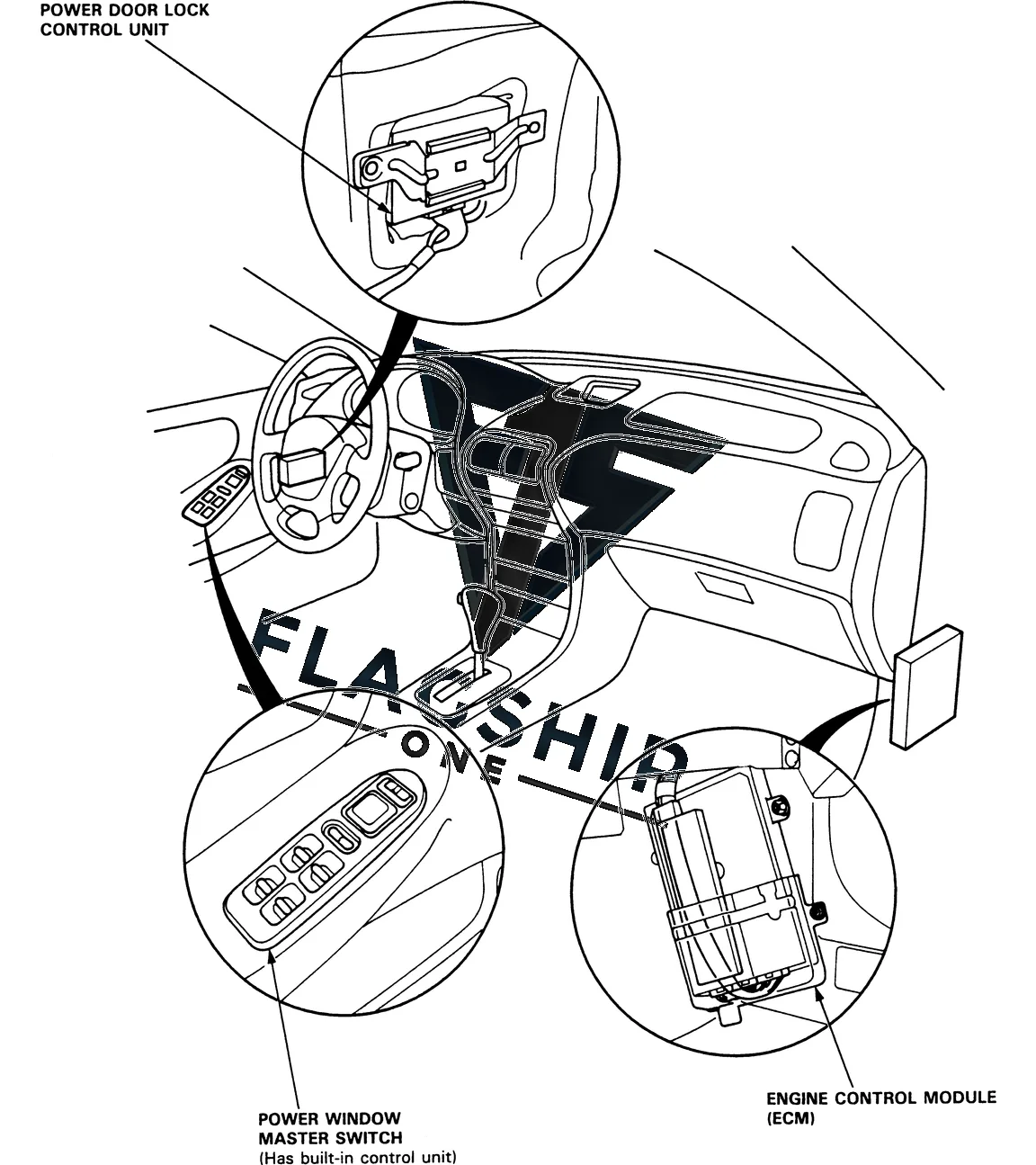
Work with the ignition off, and treat the module as static-sensitive: avoid touching the connector pins at any point.
| Operation | Configuration | Book Time |
|---|---|---|
| Powertrain Control Module R&R | All configurations | 0.6 hr |
| Powertrain Control Module Relearn | All configurations | 0.5 hr |
| Engine Control Module R&R | All configurations | 0.6 hr |
After installing a replacement module on the 1995 Acura Legend (3.2L), the factory service procedure requires a relearn session during which the new module adapts to your specific engine characteristics. This process typically takes 0.5 hour as a separate book operation and involves the technician driving the vehicle through predetermined RPM and load ranges while monitoring live data. The module learns sensor baseline values and adjusts compensation factors accordingly. However, units from Flagship One arrive already configured with your vehicle identification number, which means the adaptation steps are substantially completed before the module ever reaches your mechanic. Your technician still performs a verification procedure to confirm all systems communicate properly, but the time-consuming relearn process is effectively bypassed. This pre-configuration represents a meaningful advantage over blank replacement units that require full initialization through the factory procedure.
Every VIN-programmed replacement unit from Flagship One arrives with these steps already completed.
When the Powertrain Control Module on the 1995 Acura Legend (3.2L) begins failing, symptoms often emerge in stages rather than all at once. Early signs may include intermittent check engine illumination, subtle hesitation during acceleration, or slight rough idle that worsens with electrical load. More advanced failure typically produces a hard no-start condition where the engine cranks at normal speed but receives no fuel or spark command from the module. Misfire codes affecting individual cylinders frequently appear when the module cannot properly calculate fuel requirements, and these codes may persist even after replacing spark plugs or ignition components. Complete communication failure leaves your scan tool unable to establish a data link, which itself confirms the module has stopped processing sensor inputs. In automatic transmission models, harsh or delayed shifting may accompany PCM failure since the module shares data with the transmission control system.
Factory service bulletins for the 1995 Acura Legend and related vehicles address several PCM-related concerns. Technical service information recommends measuring voltage drops at ground circuits as a diagnostic technique for intermittent electrical complaints that may otherwise suggest module failure. Specific bulletin guidance covers troubleshooting with voltage drop methods to isolate circuit problems from actual component failures. Additional bulletins address DTC P0171 and DTC P0172 with emphasis on voltage drop testing to identify fuel system issues that could trigger module fault codes. Connector terminal service procedures and diagnostic approaches for multiple indicator conditions, including misfire codes, appear in related technical documents. When diagnosing your Legend, voltage drop testing at ECU grounds often reveals problematic connections before concluding the module itself has failed.
| Bulletin | Subject | What It Addresses |
|---|---|---|
| — | Use Voltage Drops to Check ECU Grounds | — |
| — | DTC P0171 and DTC P0172 Troubleshooting Tips • Measure Voltage Drops to Pinpoint Problem | — |
| — | ECU Connector Terminals Removal • More No Spark, Use Your Dwell Meter | — |
Used modules typically require VIN programming to match your specific vehicle identification number, and many are already compromised by the same failure mode that affected the original. Remanufactured units from a reputable supplier arrive pre-programmed and tested to specification.
When the battery was disconnected with the ignition powered, the module may have lost critical calibration data or set internal fault codes. Voltage drop testing at ground circuits can determine whether poor connections caused the original battery drain or whether the module itself sustained damage.
Yes, an alternator producing excessive voltage or unstable output stresses the module power supply circuits over time. Symptoms of charging system malfunction often appear before the module fails completely, so diagnosing and repairing the alternator first may prevent repeat module failure after replacement.
If your 1995 Acura Legend (3.2L) exhibits no-start conditions, intermittent stalling, multiple sensor codes, or complete loss of scan tool communication, the Powertrain Control Module may be the root cause. Repairs involving module replacement can be costly when performed at a dealership, but remanufactured units from Flagship One arrive VIN-programmed and ready to install, significantly reducing your total repair investment. Have a qualified technician verify the module and associated circuits before ordering replacement to ensure the diagnosis is correct and no secondary damage exists.
Flagship One stocks a refurbished, VIN-programmed PCM for the 1995 Acura Legend with a lifetime warranty, free shipping and no core charge. The full Acura Legend module lineup covers other engine configurations as well.
The 1995 Acura Legend (3.2L) Powertrain Control Module plays an irreplaceable role in engine operation, and failure produces a wide range of driveability symptoms that often confuse the diagnostic process. By following factory safety precautions, using voltage drop methods for circuit verification, and selecting a pre-programmed replacement unit, you can restore reliable operation without unnecessary delay. Flagship One offers replacement modules configured specifically for your vehicle identification number, eliminating the hassle of separate programming appointments.