
Last updated on August 25th, 2026 at 02:46 pm
The powertrain control module (PCM) in your 1994 Acura Legend manages fuel injection, ignition timing, and emissions systems. A failing PCM may cause erratic idling, stalling, or a complete no-start condition, often mimicking fuel pump or sensor issues.
If your 1994 Acura Legend is stalling unexpectedly or refusing to start, the powertrain control module (PCM) may be the culprit. This small but critical computer oversees engine performance, fuel delivery, and emissions systems. When it fails, symptoms can range from subtle drivability issues to a complete loss of power. Replacing the PCM involves locating the unit, safely disconnecting it, and ensuring proper programming to avoid further complications. Understanding the process helps you assess whether a DIY approach is feasible or if a pre-programmed replacement is the smarter choice.
The PCM in your 1994 Acura Legend acts as the brain of the engine, continuously adjusting fuel injection and ignition timing based on sensor inputs. Without it, your vehicle may run poorly or not at all. Over time, heat, vibration, or voltage spikes can degrade internal components, leading to intermittent or permanent failure. If replacement becomes necessary, sourcing replacement engine computers for the Legend ensures compatibility and avoids the hassle of manual programming. A properly functioning PCM is essential for smooth operation and passing emissions tests, making it a key component to address if issues arise.
1994 Acura Legend
OEM programmed replacements — plug & play, no dealer visit.
Find yours by year, make & model →
Free shipping · Lifetime warranty
In the 1994 Acura Legend sedan, the PCM is typically mounted below the left side of the glove box, though some configurations place it near the right front footrest or under the blower unit. Accessing the module requires removing interior panels or trim, depending on its exact location. The factory labor guide estimates 0.6 hours for removal and reinstallation. Once exposed, the PCM is secured with a connector that must be carefully unplugged. Always ensure the ignition is off before disconnecting power to prevent damage. Reinstallation follows the reverse process, with no additional torque specifications provided for this vehicle.
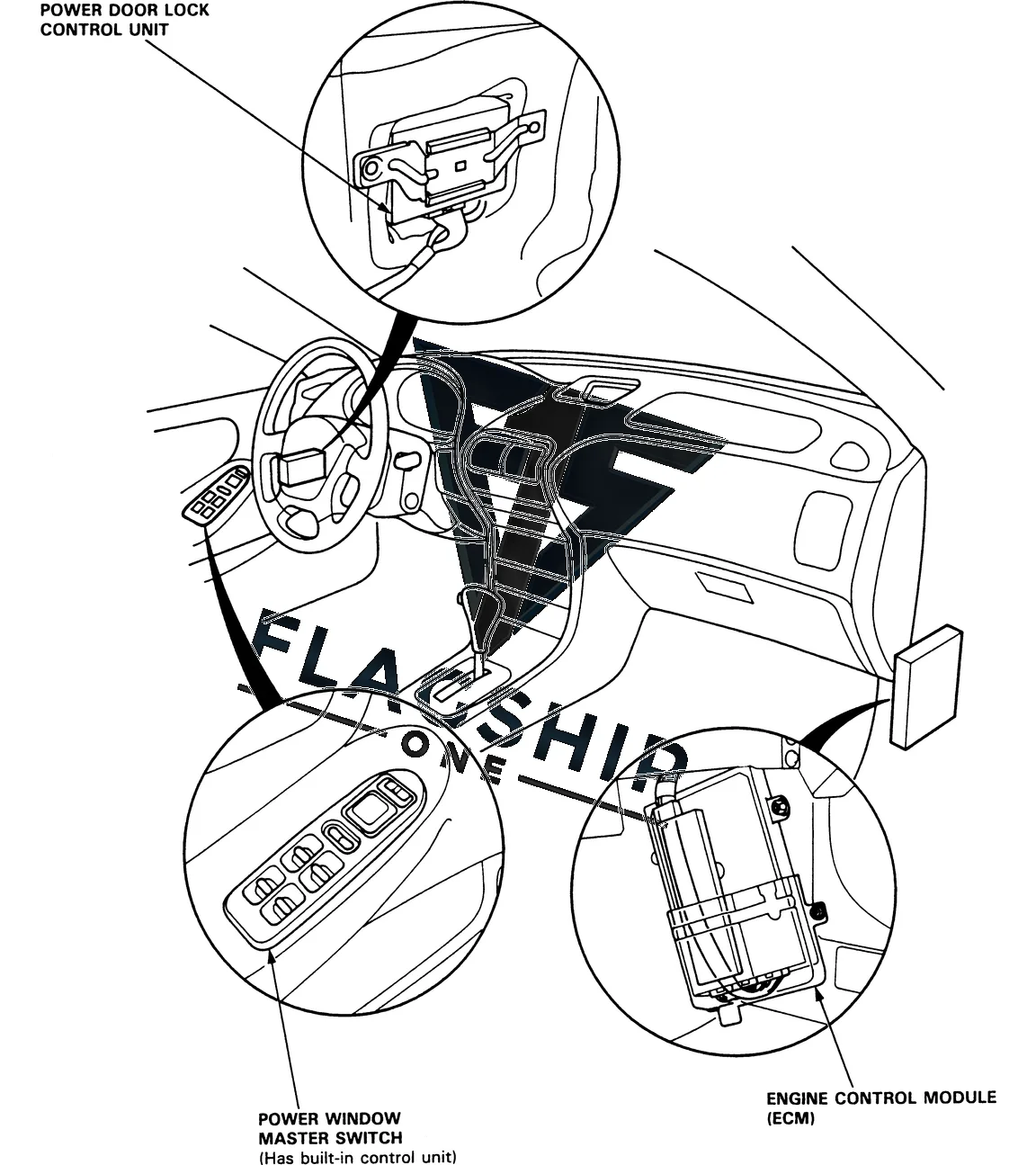
Work with the ignition off, and treat the module as static-sensitive: avoid touching the connector pins at any point.
| Operation | Configuration | Book Time |
|---|---|---|
| Powertrain Control Module R&R | All configurations | 0.6 hr |
| Powertrain Control Module Relearn | All configurations | 0.5 hr |
| Engine Control Module R&R | All configurations | 0.6 hr |
After installing a new PCM in your 1994 Acura Legend, the factory requires a 0.5-hour relearn procedure to synchronize the module with the engine and transmission. This step ensures proper fuel mapping and ignition timing. However, a VIN-programmed replacement unit from Flagship One arrives pre-configured, eliminating the need for this additional labor. Simply install the unit, reconnect the battery, and start the vehicle—no further steps are necessary. This saves time and reduces the risk of programming errors that could lead to drivability issues.
A failing PCM in your 1994 Acura Legend may cause a range of symptoms, including stalling at idle, rough acceleration, or a no-start condition. You might also notice poor fuel economy or erratic shifting if the transmission is affected. In some cases, the vehicle may enter a limp-home mode, limiting power to prevent further damage. If the PCM loses communication with the scan tool, it could indicate internal failure. For example, a lean condition detected may appear if the module fails to adjust fuel trim properly, though this can also stem from vacuum leaks or faulty sensors.
Factory service bulletins for the 1994 Acura Legend highlight several PCM-related troubleshooting tips. One bulletin recommends using voltage drop tests to verify proper ECU grounding, which can resolve intermittent electrical issues. Another covers DTC P0171 and P0172, advising technicians to measure voltage drops to isolate problems. Additional bulletins address misfire codes (P0301–P0306) and provide guidance on removing ECU connector terminals without damaging them. A software update (SN211) for the PGM tester is also noted to improve diagnostic accuracy for multiple indicator faults.
| Bulletin | Subject | What It Addresses |
|---|---|---|
| — | Use Voltage Drops to Check ECU Grounds | — |
| — | DTC P0171 and DTC P0172 Troubleshooting Tips • Measure Voltage Drops to Pinpoint Problem | — |
| — | ECU Connector Terminals Removal • More No Spark, Use Your Dwell Meter | — |
Stalling after PCM replacement often occurs if the module isn’t properly programmed or if the relearn procedure isn’t completed. A VIN-programmed unit eliminates this step, ensuring immediate compatibility. If the issue persists, check for loose connectors or faulty sensors that may need recalibration.
Driving with a failing PCM may lead to poor performance, stalling, or even a no-start condition. In some cases, the vehicle may enter limp mode, limiting power to prevent damage. If you suspect PCM issues, address them promptly to avoid further complications.
A bad PCM often causes multiple symptoms at once, such as stalling, misfires, and poor throttle response. If only one sensor-related code appears, the issue may lie with the sensor itself. However, if the PCM fails to communicate with the scan tool or stores internal fault codes, the module is likely the problem.
If your 1994 Acura Legend is experiencing PCM-related issues, you have two main options: attempt a repair or opt for a replacement. Given the labor involved in programming and relearn procedures, a pre-programmed unit may be the more efficient choice. Refurbished replacements offer a cost-effective alternative to new parts while ensuring compatibility with your vehicle’s systems.
Flagship One stocks a refurbished, VIN-programmed PCM for the 1994 Acura Legend with a lifetime warranty, free shipping and no core charge. The full Acura Legend module lineup covers other engine configurations as well.
The PCM in your 1994 Acura Legend plays a critical role in engine performance and drivability. If you’re facing stalling, no-start conditions, or erratic behavior, a failing module could be the cause. Whether you choose to replace it yourself or opt for a pre-programmed unit, addressing the issue promptly will restore reliable operation to your vehicle.