
Last updated on August 25th, 2026 at 12:09 pm
The powertrain control module in the 2020 Nissan Murano manages engine timing, fuel delivery, and transmission shift logic; a loss of internal memory or corrupted software can cause erratic performance, unexpected stalls, or a complete no‑start condition under certain driving conditions.
Owners of a 2020 Nissan Murano who experience sudden stalling, a persistent no‑start, or unexplained transmission behavior often trace the problem to the powertrain control module or the engine control module. These computers coordinate fuel injection, ignition timing, and shift scheduling, so a fault can affect drivability across the entire power‑train. This guide explains how the modules function in this specific model, what symptoms typically appear when they begin to fail, and which factory service procedures are required after a replacement. It also outlines the labor times published for removal, installation, reset, and relearn operations, giving you a realistic picture of the shop effort involved. By understanding the diagnostic code P0605 and the associated relearn steps, you can decide whether a professional repair, a refurbished unit, or a new VIN‑programmed replacement best fits your situation. The information that follows is organized to help you evaluate the problem, communicate effectively with a technician, and avoid unnecessary expense. It also highlights preventive habits that protect the modules from voltage spikes and connector corrosion, which are common contributors to early failure.
The powertrain control module in the 2020 Nissan Murano acts as the central processor for engine management, governing fuel injector pulse width, ignition coil timing, and the electronic throttle position. It also communicates with the transmission control unit to select shift points that match driver demand and engine load. The engine control module, while sometimes integrated, handles the core combustion calculations and monitors sensor inputs such as crankshaft position, camshaft position, and mass airflow. When either module loses its internal calibration — often due to a corrupted flash memory block — the vehicle may exhibit rough idle, hesitation under acceleration, or an outright refusal to start. Because the two computers share a high‑speed data bus, a fault in one can propagate error codes to the other, complicating diagnosis. Technicians typically verify power and ground integrity, then scan for the specific internal fault code that indicates a memory checksum failure. If replacement is required, the new hardware must be matched to the vehicle identification number so that immobilizer and emissions strategies align; this is why many shops order replacement engine computers for the Murano that arrive pre‑configured. Proper installation also demands that the mounting brackets, connector seals, and torque specifications be observed to prevent future water ingress or vibration‑induced solder cracks. The module housing is sealed against moisture, and the connector pins are gold‑plated to reduce resistance, yet prolonged exposure to road salt can still degrade the interface over time.
2020 Nissan Murano
OEM programmed ECM for your 2020 Nissan Murano — plug & play, no dealer visit.
Free shipping · Lifetime warranty
The service manual lists a removal and installation time of 1.2 hours for the powertrain control module and the same 1.2 hours for the engine control module. After the hardware is swapped, a powertrain control module relearn requires an additional 0.5 hours, while the engine control module needs a reset of 0.3 hours followed by a relearn of 0.5 hours. These book times assume the technician has clear access to the mounting bolts and the electrical connectors, and that the necessary scan tool is available for the relearn procedures. No special torque values are published for the module brackets, but the standard fastener torque for the engine bay should be observed. Because the modules sit behind the dashboard and under the hood in close proximity to the battery, the technician must disconnect the negative cable before beginning work to avoid voltage spikes. The total shop effort will depend on how quickly the connectors release and whether any corrosion must be cleaned before the new unit is seated.
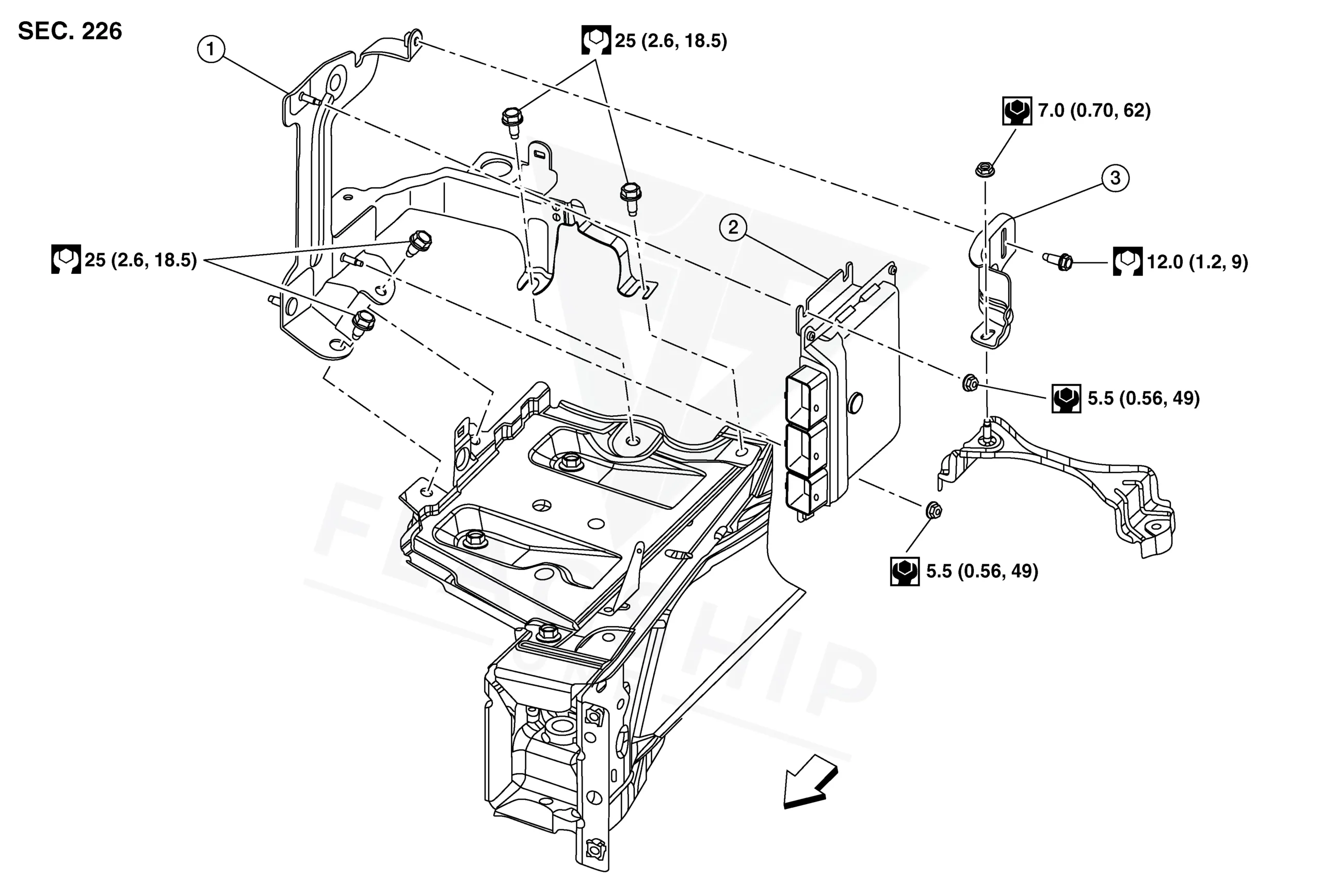
Work with the ignition off, and treat the module as static-sensitive: avoid touching the connector pins at any point.
| Operation | Configuration | Book Time |
|---|---|---|
| Powertrain Control Module R&R | All configurations | 1.2 hr |
| Powertrain Control Module Relearn | All configurations | 0.5 hr |
| Engine Control Module R&R | All configurations | 1.2 hr |
| Engine Control Module Reset | All configurations | 0.3 hr |
| Engine Control Module Relearn | All configurations | 0.5 hr |
After a module is installed, the factory service procedure calls for a powertrain control module relearn that takes roughly 0.5 hours and an engine control module reset of 0.3 hours followed by a relearn of 0.5 hours. The scan tool must be connected to the vehicle data link connector, and the technician initiates the relearn sequence so the new computer can learn the current sensor calibrations and transmission adaptives. If the replacement hardware arrives already matched to the vehicle identification number, the relearn steps are still required but the immobilizer and emissions parameters are already synchronized, reducing the chance of a post‑install fault code. Flagship One ships a VIN‑programmed replacement unit that has been flashed with the correct VIN data, so the technician can proceed directly to the relearn without first performing a full flash. This approach shortens shop time and eliminates the risk of loading an incorrect calibration file, which could otherwise cause drivability complaints or a check‑engine light.
Drivers of the 2020 Nissan Murano may notice a sudden loss of power while cruising, an engine that cranks but refuses to fire, or a transmission that holds a gear longer than expected. Intermittent stalling at idle, rough idle with fluctuating RPM, and a check‑engine light that appears without a clear pattern are also common when the powertrain control module or engine control module begins to degrade. In many cases the scan tool will report a communication timeout with the module, indicating that the internal processor is no longer responding to requests. A specific internal fault code — internal memory checksum error P0605 — points to a corrupted flash memory block inside the computer. When this code is present, the vehicle may also exhibit erratic fuel trim values, misfire counters that increment without a mechanical cause, and a failure to enter closed‑loop operation after warm‑up. Because the modules control both engine and transmission strategies, symptoms can cross systems, producing harsh shifts, delayed engagement, or a complete loss of shift functionality. Voltage spikes from a weak alternator or a poorly executed jump‑start often accelerate the failure, so the symptoms may appear shortly after a battery service. Recognizing these signs early allows a technician to confirm the module fault before unnecessary component replacement.
The following table lists the module‑internal diagnostic trouble codes recorded for the 2020 Nissan Murano. Each entry identifies a specific fault condition inside the powertrain or engine control computer, helping technicians pinpoint whether the issue stems from memory corruption, processor failure, or communication loss before any hardware is swapped.
| Code | Meaning | Full Guide |
|---|---|---|
| P0605 | Internal ROM error | Full P0605 guide → |
The service manual allocates 1.2 hours for removal and installation, plus an additional 0.5 hours for the required relearn procedure.
Yes, the factory procedure calls for a 0.3 hour reset followed by a 0.5 hour relearn once the new module is in place.
The code indicates an internal memory checksum failure; clearing it will not repair the underlying hardware fault, so the module usually needs replacement.
Flagship One units ship with the correct VIN flashed, allowing the technician to skip the initial flash and proceed directly to the relearn steps.
Maintaining a healthy alternator, keeping ground connections clean, avoiding improper jump‑starts, and protecting connector seals from moisture all reduce the risk of early module failure.
When the powertrain or engine control module on a 2020 Nissan Murano fails, you can choose a professional repair of the existing unit, a refurbished module that has been tested and re‑flashed, or a new VIN‑matched replacement that arrives ready for the required relearn. Each path carries different cost and warranty considerations, and the decision often depends on how quickly the vehicle must return to service. Discuss the labor times and code history with your technician to select the most practical solution.
Flagship One stocks a refurbished, VIN-programmed PCM for the 2020 Nissan Murano with a lifetime warranty, free shipping and no core charge. The full Nissan Murano module lineup covers other engine configurations as well.
Understanding the role of the powertrain and engine control modules in the 2020 Nissan Murano helps you recognize early warning signs and communicate effectively with a repair shop. By following the factory relearn procedures and considering a VIN‑programmed replacement, you can restore reliable drivability with minimal downtime. If you need further guidance on module diagnostics or replacement options, consult a qualified technician familiar with this model.