
Last updated on August 25th, 2026 at 02:02 pm
In the 2020 Lexus NX300h, the powertrain control module manages engine timing, fuel delivery, and transmission shift logic. A failure typically disrupts communication with sensors, triggers fault codes such as P0606, and can cause loss of power or erratic shifting.
When a 2020 Lexus NX300h experiences powertrain‑related fault codes, the PCM or ECM often needs attention. Understanding how the module functions, where it resides, and what work is involved helps you decide whether to repair or replace. This guide outlines the module’s role, access steps, required programming, typical symptoms, and practical tips to keep the system healthy, so you can make an informed choice for your vehicle.
The powertrain control module in a 2020 Lexus NX300h monitors engine speed, throttle position, and transmission inputs to optimize performance and emissions. It processes sensor data and commands actuators, ensuring smooth acceleration and shift timing. When it malfunctions, the vehicle may lose driveability or trigger diagnostic trouble codes. For a replacement, you may consider replacement engine modules for 2020 Lexus that meet the same specifications.
Engine computer (ECM/PCM)
OEM programmed replacements — plug & play, no dealer visit.
Find yours by year, make & model →
Free shipping · Lifetime warranty
The module is located next to the air cleaner assembly, accessed by removing the No. 3 Deck Board Sub‑Assembly, the Rear Deck Floor Box, the Deck Floor Box Lh, the cable from the negative auxiliary battery terminal, the air cleaner cap and hose, and finally the air cleaner filter element sub‑assembly. Factory labor times list a 0.5‑hour PCM relearn, 1.0‑hour removal‑and‑replace, and a 0.3‑hour ECM reset. After the power switch is turned off, a brief waiting period may be required before the negative auxiliary battery cable is disconnected, as noted in the factory caution.
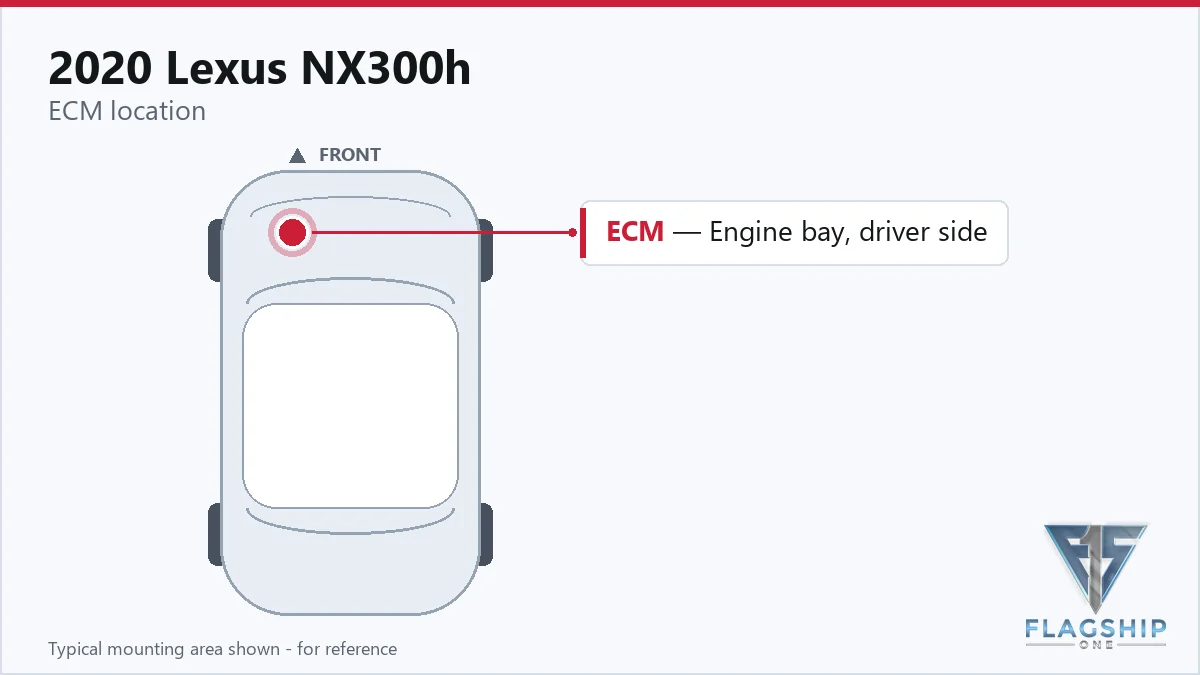
Work with the ignition off, and treat the module as static-sensitive: avoid touching the connector pins at any point.
| Operation | Configuration | Book Time |
|---|---|---|
| Powertrain Control Module Relearn | All configurations | 0.5 hr |
| Powertrain Control Module R&R | All configurations | 1.0 hr |
| Engine Control Module Reset | All configurations | 0.3 hr |
| Engine Control Module R&R | All configurations | 1.0 hr |
| Engine Control Module Relearn | All configurations | 0.5 hr |
Once the module is installed, the factory procedure typically calls for a PCM relearn or ECM reset to synchronize sensor data. Flagship One supplies a a VIN-programmed replacement unit that already contains the correct vehicle calibration, so those steps are completed before the unit reaches you.
A failing PCM/ECM in the 2020 Lexus NX300h often presents as a no‑start condition, intermittent stalling, rough idle, or transmission shift delays. Diagnostic scans may reveal a internal control fault indicating internal processor errors. You might also notice loss of communication with scan tools or unexpected limp‑mode operation.
The following internal fault codes are documented for the powertrain control module in this vehicle:
| Code | Meaning | Full Guide |
|---|---|---|
| P0606 | Module processor failure | Full P0606 guide → |
P0606 indicates an internal control module error, often resulting from a faulty PCM/ECM, corrupted software, or a poor electrical connection.
A reset can be performed with a scan tool, but a full relearn may require disconnecting the battery and following the factory timing guidelines.
Factory labor estimates suggest about one hour for removal and replacement, plus additional time for any required relearn procedures.
When the powertrain control module fails, you can either have a qualified shop repair the existing unit or install a refurbished replacement that matches factory specifications. Both options restore engine management, but a refurbished module from Flagship One arrives pre‑programmed, reducing shop time and ensuring proper calibration for your 2020 Lexus NX300h.
Flagship One stocks a refurbished, VIN-programmed PCM for the 2020 Lexus NX300h with a lifetime warranty, free shipping and no core charge. The full Lexus NX300h module lineup covers other engine configurations as well.
If your 2020 Lexus NX300h shows powertrain control issues, consider a replacement that eliminates programming steps and meets OEM standards. Contact a trusted service provider to evaluate repair versus replacement options.