
Last updated on August 25th, 2026 at 11:56 am
The engine control module in the 2017 Toyota Highlander Hybrid manages critical powertrain functions including fuel delivery and hybrid system coordination. When this module fails, it may cause no-start conditions, stalling, or illumination of the check engine light with internal processor fault codes like P0606.
When your 2017 Toyota Highlander Hybrid develops electrical gremlins or fails to start, the engine control module may be the culprit. This computer governs essential engine and hybrid system operations, and when it malfunctions, drivability suffers significantly. Understanding what this module does, where it lives in your vehicle, and what replacement involves helps you make informed repair decisions rather than guessing at the problem. You will learn about common symptoms that point to ECM failure, factory-required programming steps, and how choosing a pre-programmed unit can streamline the installation process considerably. Whether you are a DIY mechanic tackling this job in your garage or working with a professional shop, knowing the book times and access procedures specific to the Highlander Hybrid prepares you for an efficient, confident repair.
The engine control module in the 2017 Toyota Highlander Hybrid serves as the central processor for powertrain management. It continuously adjusts fuel injection timing, monitors hybrid system integration, and regulates emission controls based on sensor inputs from throughout the vehicle. This module communicates with the transmission controller and hybrid inverter to coordinate smooth power delivery between the gasoline engine and electric motor. When searching for Highlander Hybrid ECM replacements, it helps to understand that this computer processes thousands of data points per second to maintain optimal combustion and efficiency. A failing module disrupts these calculations, leading to rough running, poor fuel economy, or complete shutdown. The ECM also stores diagnostic trouble codes that help technicians pinpoint failures, though internal faults like processor errors mean the module itself has become the problem rather than a sensor it monitors.
2017 Toyota Highlander Hybrid
OEM programmed ECM for your 2017 Toyota Highlander Hybrid — plug & play, no dealer visit.
Free shipping · Lifetime warranty
The factory service manual places the engine control module adjacent to the air cleaner on the 2017 Toyota Highlander Hybrid. Reaching this unit requires removing several intake components in a specific sequence: disconnect the negative battery cable first, then remove the left-side radiator deflector seal, followed by the right-side radiator seal. Next, take off the intake duct seal, the inlet air cleaner, and finally the complete air cleaner assembly with hose. Book time for module removal and installation comes in at 0.7 hours, while the relearn procedure adds another 0.5 hours. After turning off the ignition, a waiting period may be necessary before proceeding with battery disconnection to allow system capacitors to discharge fully. Handle the replacement unit carefully, as any impact or drop requires discarding the module entirely rather than attempting installation.
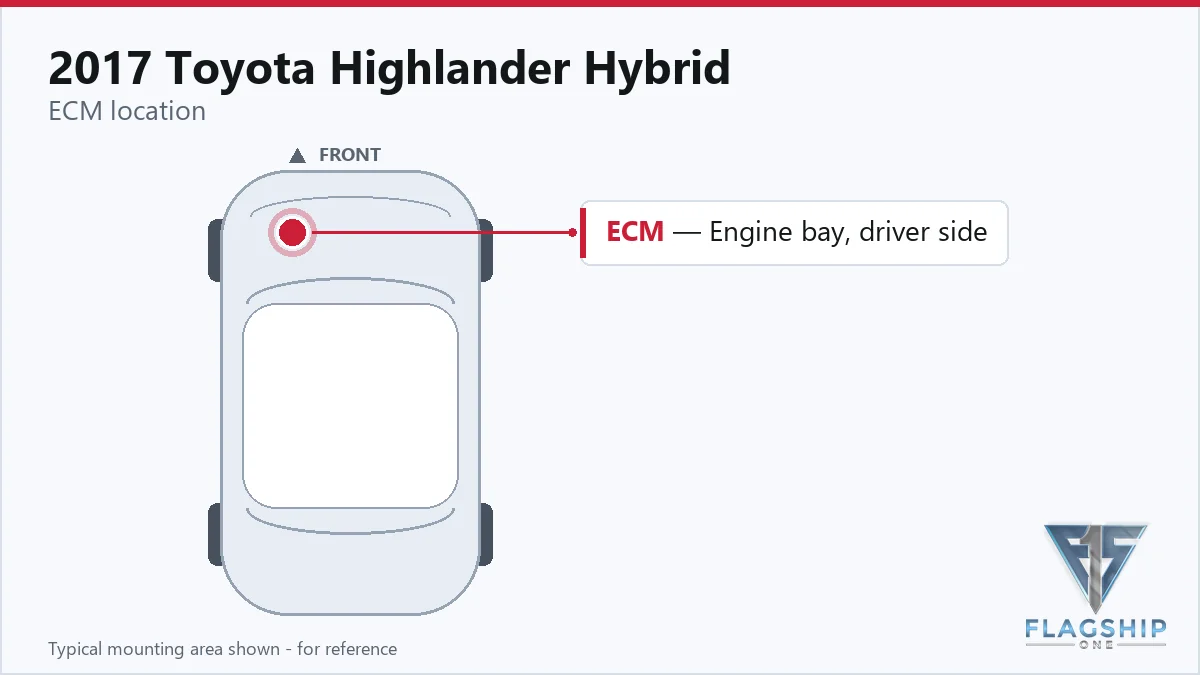
Work with the ignition off, and treat the module as static-sensitive: avoid touching the connector pins at any point.
| Operation | Configuration | Book Time |
|---|---|---|
| Powertrain Control Module R&R | All configurations | 0.7 hr |
| Engine Control Module Relearn | All configurations | 0.5 hr |
| Engine Control Module R&R | All configurations | 0.7 hr |
Toyota requires VIN registration whenever the engine control module is replaced on the 2017 Highlander Hybrid, along with a relearn procedure that takes 0.5 hours of book time. The factory also directs technicians to consult the Registration section of the service manual before swapping the unit. These programming steps ensure the new module communicates properly with the vehicle immobilizer and other onboard systems. Selecting a pre-programmed ECM unit from Flagship One means the VIN registration and initialization steps are already completed before the part ships. Your installation focuses purely on the physical swap and relearn, saving significant diagnostic and programming time at the shop or in your garage.
A failing engine control module in the 2017 Toyota Highlander Hybrid often announces itself through drivability problems that mimic other issues. The vehicle may crank without starting, stall unexpectedly at idle or under load, or experience misfires across multiple cylinders. Shift quality in the hybrid drivetrain can degrade, with harsh or delayed gear changes that feel transmission-related but stem from faulty computer commands. Scan tool communication may drop entirely, preventing code retrieval. When the module suffers an internal processor fault, PCM processor failure will set in the system and typically illuminates the check engine light. This code specifically points to a malfunction within the module rather than an external sensor or wiring problem. Other symptoms include poor fuel economy, erratic cooling fan operation, and intermittent loss of hybrid drive modes that leave the vehicle running on gasoline power alone.
The following table lists module-internal trouble codes documented specifically for the 2017 Toyota Highlander Hybrid. These codes indicate faults within the engine control module itself rather than external sensors or wiring, which typically necessitates complete module replacement rather than traditional component-level repair approaches.
| Code | Meaning | Full Guide |
|---|---|---|
| P0606 | Module processor failure | Full P0606 guide → |
The book time for engine control module removal and installation is 0.7 hours, with an additional 0.5 hours for the relearn procedure. Actual shop time may vary depending on diagnostic work required.
A P0606 code indicates an internal processor malfunction in the engine control module, which may cause unpredictable drivability issues. It is generally not advisable to drive the vehicle with this fault present, as stalling or loss of hybrid function could occur without warning.
The engine control module sits adjacent to the air cleaner assembly. Access requires removing the air cleaner housing, intake duct seal, and radiator side seals after disconnecting the negative battery cable.
Choosing between a dealer replacement and a refurbished unit for your 2017 Toyota Highlander Hybrid depends on your budget and timeline. Dealer installations involve full programming fees on top of parts costs, while a pre-programmed unit from Flagship One arrives ready for installation with VIN registration already handled. Both paths require the 0.5-hour relearn procedure, but the pre-programmed option eliminates additional shop programming charges.
Flagship One stocks a refurbished, VIN-programmed PCM for the 2017 Toyota Highlander Hybrid with a lifetime warranty, free shipping and no core charge. The full Toyota Highlander Hybrid module lineup covers other engine configurations as well.
The 2017 Toyota Highlander Hybrid depends on a functioning engine control module for proper hybrid operation and fuel management. Recognizing symptoms early and understanding the replacement process helps you address failures efficiently. Whether dealing with a P0606 fault code or other drivability concerns, a pre-programmed replacement simplifies the repair. Flagship One offers units ready for your specific VIN, reducing downtime and getting your Highlander Hybrid back on the road.