
Last updated on August 25th, 2026 at 11:46 am
The Engine Control Module (ECM) in the 2017 Mercedes-Benz S-Class manages fuel injection, ignition timing, and emissions systems. Failures may cause rough idling, misfires, or complete engine shutdown, often triggered by voltage spikes or moisture intrusion.
If your 2017 Mercedes-Benz S-Class has developed unexplained stalling, rough running, or a refusal to start, the Engine Control Module (ECM) may be at fault. This critical computer manages everything from fuel delivery to ignition timing, and when it fails, your vehicle’s performance suffers. Replacing it isn’t just about swapping a box—it involves precise labor steps, proper access to the intake manifold area, and a mandatory relearn procedure to restore full functionality. Understanding these details helps you avoid unnecessary dealer visits or incomplete repairs. With the right replacement unit, you can skip the reprogramming step entirely, saving time and ensuring your S-Class runs as smoothly as it did from the factory. This guide covers what the ECM does, where it’s located, how replacement works, and what symptoms signal its failure in your specific model.
The Engine Control Module in your 2017 Mercedes-Benz S-Class serves as the brain of the engine, continuously monitoring sensors and adjusting fuel injection, ignition timing, and emissions controls for optimal performance. This module ensures the 5.5L V8 operates efficiently under all driving conditions, from cold starts to highway cruising. When it malfunctions, you may notice hesitation, poor throttle response, or even a complete loss of power. The ECM also communicates with other vehicle systems, including the transmission and stability control, meaning its failure can trigger a cascade of warning lights or erratic behavior. Replacing it requires careful handling, as the replacement engine computers for the S-Class must match your vehicle’s exact specifications to avoid compatibility issues. A faulty ECM doesn’t always announce itself with dramatic symptoms—sometimes, it’s a subtle misfire or a check engine light that won’t clear, making diagnosis tricky without proper tools.
2017 Mercedes-Benz S-Class
OEM programmed ECM for your 2017 Mercedes-Benz S-Class — plug & play, no dealer visit.
Free shipping · Lifetime warranty
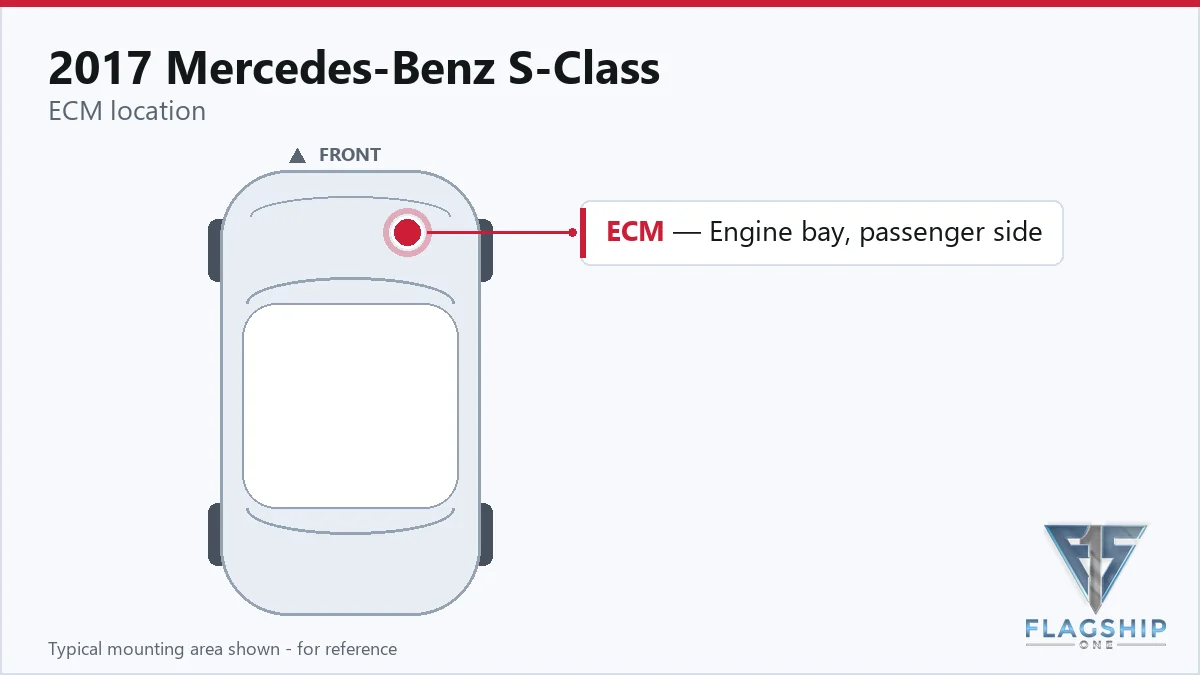
In the 2017 Mercedes-Benz S-Class, the ECM is mounted near the intake manifold, requiring removal of several components to access it. The factory procedure involves reaching behind the engine cover and disconnecting wiring harnesses before unbolting the module. Labor estimates for removal and reinstallation (R&R) are typically 0.6 hours, though this may vary slightly depending on technician experience and shop conditions. Once the old unit is removed, the new ECM must be secured in place, and all electrical connections reattached carefully to avoid damage. There are no torque specifications provided for this process, but proper seating of the module and connectors is critical to prevent future issues. The location makes replacement straightforward for professionals but challenging for DIYers due to the tight engine bay and risk of damaging nearby components.
Work with the ignition off, and treat the module as static-sensitive: avoid touching the connector pins at any point.
| Operation | Configuration | Book Time |
|---|---|---|
| Engine Control Module Reset | All configurations | 0.3 hr |
| Engine Control Module R&R | All configurations | 0.6 hr |
| Engine Control Module Relearn | All configurations | 0.5 hr |
| Powertrain Control Module R&R | All configurations | 0.6 hr |
After installing a new Engine Control Module in your 2017 Mercedes-Benz S-Class, the factory procedure requires a 0.5-hour relearn process to synchronize the module with the vehicle’s sensors and systems. This step ensures the ECM adapts to your specific engine’s characteristics, including fuel trims and ignition timing. Without this relearn, the vehicle may run poorly or fail to start altogether. However, opting for a VIN-programmed replacement unit eliminates the need for this step, as the module arrives pre-configured to your vehicle’s exact specifications. This not only saves time but also reduces the risk of errors during the programming process, which can occur if the relearn isn’t performed correctly. The labor estimate for the relearn alone is separate from the R&R time, so choosing a pre-programmed unit can streamline the repair significantly.
A failing Engine Control Module in your 2017 Mercedes-Benz S-Class can manifest in several ways, often mimicking other issues like fuel pump failure or ignition coil problems. One of the most common signs is a no-start condition, where the engine cranks but refuses to fire, often accompanied by a lack of spark or fuel injection. Stalling at idle or during acceleration is another red flag, particularly if it occurs intermittently and without warning. Misfire codes, such as internal control module memory check sum error, may appear on a scan tool, indicating the ECM is unable to maintain consistent engine operation. Other symptoms include rough idling, poor throttle response, or the vehicle entering a limp-home mode, where power is severely limited. In some cases, the check engine light may illuminate, but the vehicle still runs—albeit poorly—making the issue easy to overlook until it worsens. Dead scan tool communication, where the ECM fails to respond to diagnostic requests, is another telltale sign of module failure. If you notice any of these symptoms, it’s worth having the ECM checked, as ignoring them can lead to further damage or a stranded situation.
A failing ECM often triggers multiple symptoms at once, such as stalling, misfires, and no-start conditions, whereas a single sensor issue typically causes isolated problems. If your scan tool shows communication errors with the ECM or internal module codes like P0601, the ECM itself is likely the culprit. A professional diagnostic can confirm whether the issue lies with the module or a related component.
Driving with a faulty ECM is risky, as it can lead to poor engine performance, misfires, or even a sudden loss of power. In some cases, the vehicle may enter limp-home mode, severely limiting acceleration. Prolonged driving with a bad ECM may also cause damage to other components, such as the catalytic converter, due to improper fuel mixture or ignition timing.
The relearn process allows the new ECM to adapt to your specific engine’s characteristics, including fuel trims, sensor readings, and ignition timing. Without this step, the module may not communicate properly with the vehicle’s systems, leading to poor performance or failure to start. The factory procedure typically takes 0.5 hours and ensures the ECM operates as intended.
Yes, an ECM reset may resolve temporary glitches or stored error codes. The process involves disconnecting the battery for several minutes, which clears the module’s memory. However, if the ECM is physically damaged or corrupted, a reset won’t fix the issue, and replacement will be necessary. Labor estimates for a reset are typically 0.3 hours.
In the 2017 Mercedes-Benz S-Class, the ECM (Engine Control Module) specifically manages engine functions, while the PCM (Powertrain Control Module) oversees both engine and transmission operations. The terms are sometimes used interchangeably, but in this vehicle, the ECM is the primary module for engine control. Replacing either requires careful attention to programming and compatibility.
If your 2017 Mercedes-Benz S-Class is experiencing ECM-related issues, you have two main options: repair or replacement. While a repair may seem cost-effective, it often doesn’t address underlying corruption or hardware failures. A new or refurbished ECM, particularly one that’s VIN-programmed, ensures compatibility and eliminates the need for dealer reprogramming. Given the labor involved in accessing and replacing the module, choosing a pre-configured unit can save time and reduce the risk of post-installation issues. Whether you opt for a dealer visit or an independent shop, understanding the process helps you make an informed decision.
Flagship One stocks a refurbished, VIN-programmed PCM for the 2017 Mercedes-Benz S-Class with a lifetime warranty, free shipping and no core charge. The full Mercedes-Benz S-Class module lineup covers other engine configurations as well.
The Engine Control Module in your 2017 Mercedes-Benz S-Class plays a critical role in keeping your vehicle running smoothly. When it fails, symptoms like stalling, misfires, or a no-start condition can leave you stranded. Replacing it involves careful labor, proper access, and a relearn procedure—unless you choose a VIN-programmed unit, which simplifies the process. By understanding the module’s function, location, and common failure signs, you can address issues proactively and avoid unnecessary repairs. If you suspect ECM trouble, acting quickly ensures your S-Class remains reliable for years to come.