
Last updated on August 25th, 2026 at 01:20 pm
The Engine Control Module (ECM) in your 2017 Hyundai Sonata manages fuel delivery, ignition timing, and emissions systems. Failures may cause erratic engine behavior, poor performance, or complete no-start conditions due to corrupted data or electrical faults.
If your 2017 Hyundai Sonata has been stalling unexpectedly or refusing to start, the Engine Control Module (ECM) may be the source of the problem. This critical component acts as the brain of your vehicle’s engine, regulating everything from fuel injection to emissions control. When it fails, symptoms can range from subtle performance issues to complete engine shutdown. Understanding the replacement process, including labor times and programming requirements, helps you make informed decisions about repairs. This guide explains what the ECM does, where it’s located, and what steps are involved in getting your Sonata back on the road reliably.
In your 2017 Hyundai Sonata, the Engine Control Module (ECM) continuously monitors and adjusts engine functions to ensure optimal performance and efficiency. It processes data from sensors to control fuel delivery, ignition timing, and emissions systems, directly impacting how your vehicle drives. A faulty ECM may lead to poor acceleration, rough idling, or even a no-start condition. When replacement becomes necessary, replacement engine computers for the Sonata are designed to restore factory-level operation, but proper installation and programming are essential to avoid recurring issues.
2017 Hyundai Sonata
OEM programmed ECM for your 2017 Hyundai Sonata — plug & play, no dealer visit.
Free shipping · Lifetime warranty
The ECM in your 2017 Hyundai Sonata is positioned next to the air cleaner assembly, making it relatively accessible for replacement. According to factory procedures, removing and reinstalling the module typically takes 0.5 hours of labor. If a relearn procedure is required, an additional 0.5 hours may be needed to ensure the new module communicates correctly with the vehicle’s systems. During installation, mounting bolts and nuts should be tightened to a torque range of 9.8 to 11.8 N·m to prevent loosening or damage. The process involves disconnecting the battery, removing the air cleaner housing, and carefully handling the module’s electrical connectors.
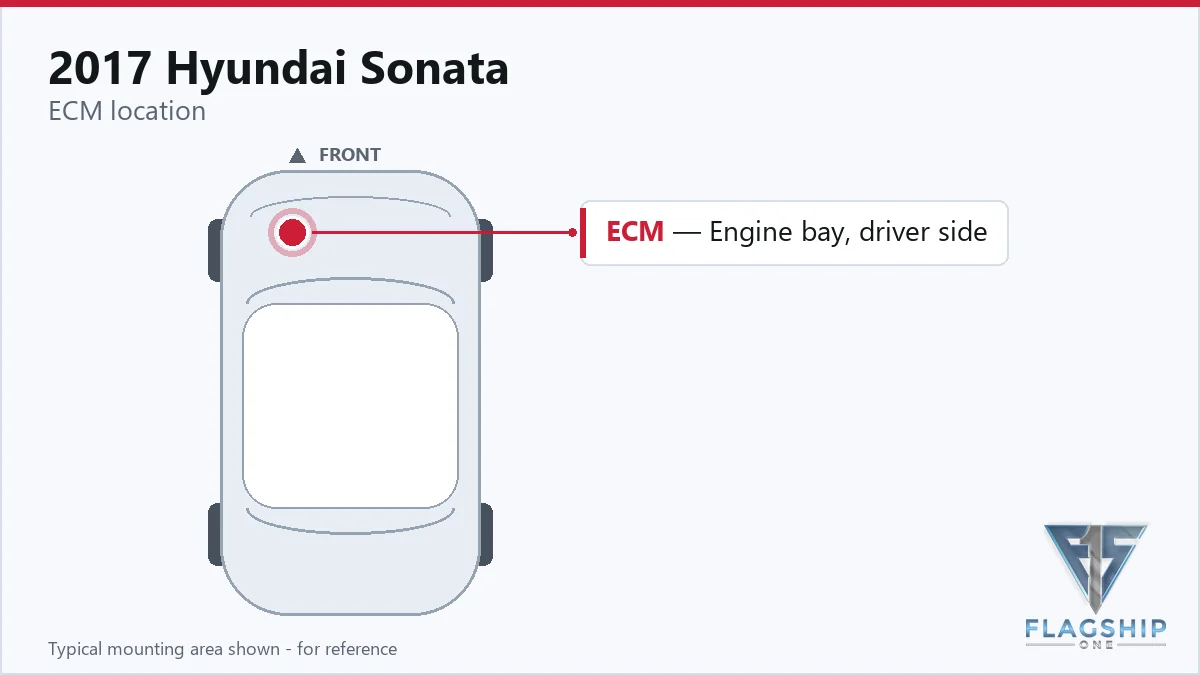
Work with the ignition off, and treat the module as static-sensitive: avoid touching the connector pins at any point.
| Operation | Configuration | Book Time |
|---|---|---|
| Engine Control Module R&R | All configurations | 0.5 hr |
| Engine Control Module Relearn | All configurations | 0.5 hr |
| Engine Control Module Reset | All configurations | 0.3 hr |
| Powertrain Control Module R&R | All configurations | 0.5 hr |
| Powertrain Control Module Relearn | All configurations | 0.5 hr |
After installing a new ECM in your 2017 Hyundai Sonata, the vehicle identification number (VIN) must be programmed into the module to ensure proper operation. This step is critical for the ECM to communicate with other systems and prevent drivability issues. Flagship One provides a VIN-programmed replacement unit, eliminating the need for this additional programming step. If you opt for a non-programmed module, a relearn procedure of 0.5 hours will be required to sync the ECM with your vehicle’s systems, adding to the overall repair time.
A failing ECM in your 2017 Hyundai Sonata may cause a variety of symptoms, including intermittent stalling, rough idling, or a complete no-start condition. You might also notice poor fuel economy, hesitation during acceleration, or warning lights on the dashboard. In some cases, the vehicle may enter a reduced-power mode to prevent further damage. If the ECM loses communication with the scan tool, diagnosing other issues becomes difficult. One documented internal trouble code for this module is an internal control module memory error, which often indicates a need for replacement or reprogramming.
Your 2017 Hyundai Sonata’s ECM may store specific trouble codes when internal faults occur. These codes help technicians diagnose issues and determine whether replacement or reprogramming is necessary.
| Code | Meaning | Full Guide |
|---|---|---|
| P0605 | Internal ROM error | Full P0605 guide → |
Hyundai has issued service bulletins addressing ECM-related procedures for various models, including the Sonata. Bulletin #04-36-019 outlines the correct method for writing the VIN during control module replacement, ensuring proper communication between the ECM and other vehicle systems. Another bulletin, #15-GI-001, provides updated procedures for ECU programming using tablet-based diagnostic tools. While these bulletins may not be specific to the 2017 Sonata, they offer guidance on best practices for module replacement and programming.
| Bulletin | Subject | What It Addresses |
|---|---|---|
| 04-36-019 | TSB • Fuel System • [04-36-019] 2005MY ECM AND PCM VIN WRITING DURING CONTROL MODULE REPLACEMEN | — |
| — | TSB • General Information • [15-GI-001] ECU UPDATE PROCEDURE FOR TABLET-BASED GDS MOBILE | — |
Common signs include a no-start condition, stalling, or warning lights on the dashboard. If the vehicle enters reduced-power mode or stores an internal ECM trouble code like P0605, replacement may be necessary. A diagnostic scan can confirm the issue.
While the ECM is accessible near the air cleaner assembly, replacement requires proper tools and knowledge of electrical systems. After installation, VIN programming is mandatory, which typically requires professional equipment. DIY replacement is possible but may lead to complications if not done correctly.
Without VIN programming, the ECM may not communicate properly with the vehicle’s systems, leading to drivability issues, warning lights, or a no-start condition. The vehicle may also fail emissions tests or enter a reduced-power mode to prevent damage.
If your 2017 Hyundai Sonata’s ECM has failed, you have options for repair or replacement. While a dealership may offer a new module, refurbished units provide a cost-effective alternative without sacrificing reliability. Given the labor and programming requirements, choosing a pre-programmed replacement can save time and ensure a smooth installation. Consider your budget and long-term needs when deciding the best approach for your vehicle.
Flagship One stocks a refurbished, VIN-programmed PCM for the 2017 Hyundai Sonata with a lifetime warranty, free shipping and no core charge. The full Hyundai Sonata module lineup covers other engine configurations as well.
Replacing the ECM in your 2017 Hyundai Sonata can resolve persistent drivability issues and restore reliable performance. Whether you opt for a new or refurbished module, proper installation and programming are key to avoiding future problems. If you’re experiencing symptoms of ECM failure, addressing the issue promptly can help keep your Sonata running smoothly for miles to come.