
Last updated on August 25th, 2026 at 12:16 pm
In the 2017 Dodge Charger, the powertrain control module (PCM) and engine control module (ECM) manage engine timing, fuel delivery, transmission shift points and emissions. Failure of either unit can disrupt engine start, cause erratic idle, trigger loss of power, or produce diagnostic trouble codes such as P0601 and P0606, indicating internal processor or communication problems.
If your 2017 Dodge Charger is showing erratic power delivery, unexpected stalling, or a loss of communication with the scan tool, the underlying cause may be a faulty powertrain control module or engine control module. Both modules serve as the vehicle’s brain, translating sensor data into precise commands that keep the engine and transmission operating smoothly. Understanding how these computers work, where they reside, and what the factory requires after a replacement can help you make an informed decision about repair versus a refurbished replacement. This guide walks you through the function of each module, typical labor estimates, required programming steps, common symptoms, relevant service bulletins, and practical steps to protect the electronics in your Charger.
The powertrain control module in the 2017 Dodge Charger coordinates engine output with transmission behavior, handling fuel injection timing, spark advance, and shift schedules. The engine control module focuses specifically on combustion control, monitoring crankshaft position, oxygen sensor feedback, and emissions systems. Both units rely on a microprocessor that must maintain accurate internal timing and communication with other vehicle networks. When the processor loses sync or encounters a fault, the vehicle may limit power, enter limp mode, or refuse to start. Proper operation is critical for performance, fuel economy, and emissions compliance. The module also stores calibration data that reflects the original VIN and mileage, which the factory expects to be retained after any replacement. For owners seeking a direct swap, replacement powertrain and engine computers for the 2017 Dodge Charger provide a drop‑in solution when paired with the correct programming.
2017 Dodge Charger
OEM programmed ECM for your 2017 Dodge Charger — plug & play, no dealer visit.
Free shipping · Lifetime warranty
In the 2017 Dodge Charger, the PCM is mounted near the firewall on the passenger side, while the ECM resides within the engine compartment close to the intake manifold. Access typically requires removal of a protective cover and disconnecting the battery to prevent voltage spikes. Labor estimates from the factory service guide list 0.5 hours for a PCM relearn, 0.6 hours for a PCM removal and reinstall, 0.5 hours for an ECM relearn, 0.3 hours for an ECM reset, and 0.6 hours for an ECM removal and reinstall. The process involves unplugging the module connectors, securing the unit with the original bolts, and reattaching all harnesses before any software steps are performed.
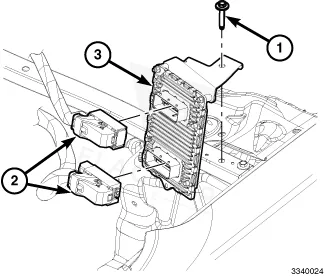
Work with the ignition off, and treat the module as static-sensitive: avoid touching the connector pins at any point.
| Operation | Configuration | Book Time |
|---|---|---|
| Powertrain Control Module Relearn | All configurations | 0.5 hr |
| Powertrain Control Module R&R | All configurations | 0.6 hr |
| Engine Control Module Relearn | All configurations | 0.5 hr |
| Engine Control Module Reset | All configurations | 0.3 hr |
| Engine Control Module R&R | All configurations | 0.6 hr |
When a new PCM or ECM is installed in the 2017 Dodge Charger, the factory procedure mandates programming the unit with the vehicle’s original VIN and current mileage to ensure proper identification and calibration. This step is documented in the service manual under the electronic control modules programming section. A Flagship One replacement arrives as a VIN-programmed replacement unit so the VIN and mileage data are already embedded, eliminating the need for the dealer‑only programming step and reducing the chance of human error during re‑flash.
Owners of a 2017 Dodge Charger may notice a range of issues when the PCM or ECM is compromised. Common signs include an inability to start the engine, intermittent stalling at idle, rough acceleration, unexpected transmission shifts, or a complete loss of powertrain-related diagnostic data on a scan tool. In some cases, the vehicle may illuminate the check engine light and store fault codes such as processor internal error or P0606, indicating internal communication problems. These symptoms often appear gradually, but a sudden loss of power or no‑start condition can also signal an outright hardware failure. Addressing these signs promptly can prevent further damage to related sensors or the drivetrain.
The following diagnostic trouble codes are documented for the 2017 Dodge Charger powertrain and engine control modules:
| Code | Meaning | Full Guide |
|---|---|---|
| P0601 | Internal memory checksum error | Full P0601 guide → |
| P0606 | Module processor failure | Full P0606 guide → |
Factory service bulletins for this model include Safety Recall U60, which requires reprogramming the powertrain control module, and Canadian Recall 30 covering broader safety concerns. Both bulletins emphasize the need to verify VIN and software level during any PCM work.
| Bulletin | Subject | What It Addresses |
|---|---|---|
| — | Service Bulletins/Recalls • 30 – Canadian Recalls • Safety Recall U60 – Reprogram Powertrain Co | — |
Yes, a refurbished PCM that has been tested and reprogrammed to match the original VIN and mileage can function like a new unit, provided it passes the factory‑specified functional tests.
P0601 signals an internal processor fault within the control module, suggesting that the module’s microprocessor is not operating correctly and may need replacement or reprogramming.
Disconnecting the battery is recommended to prevent accidental short circuits and to reset the module’s memory before removal and installation.
The factory book time for a PCM relearn is listed as 0.5 hours, which includes the necessary software initialization after the unit is installed.
Factory guidelines state that the new ECM must be programmed with the original VIN and mileage; a Flagship One unit arrives pre‑programmed, removing this requirement.
When the powertrain or engine control module in your 2017 Dodge Charger fails, you can choose a dealer‑performed repair that includes VIN programming, or opt for a Flagship One refurbished unit that arrives pre‑programmed and ready for install. Both paths restore the vehicle’s electronic management, but the refurbished option may reduce labor time and cost while meeting the same performance standards.
Flagship One stocks a refurbished, VIN-programmed PCM for the 2017 Dodge Charger with a lifetime warranty, free shipping and no core charge. The full Dodge Charger module lineup covers other engine configurations as well.
The 2017 Dodge Charger relies on its PCM and ECM to deliver smooth power and reliable shift performance. Whether you repair or replace these modules, ensuring proper VIN programming and following factory procedures will keep your Charger running as intended. Consider a Flagship One pre‑programmed unit for a streamlined solution.