
Last updated on August 25th, 2026 at 12:23 pm
The engine control module (ECM) in the 2017 Audi Q3 manages fuel injection, ignition timing, and emissions systems. Failures may cause rough idling, poor acceleration, or complete engine shutdown, often triggered by electrical issues or internal faults.
If your 2017 Audi Q3 has been stalling unexpectedly, refusing to start, or throwing cryptic engine codes, the engine control module (ECM) may be the culprit. This compact SUV relies on the ECM to regulate everything from fuel mixture to ignition timing, making it one of the most critical components under the hood. When it fails, you’re left with a vehicle that may run poorly—or not at all. Replacing the ECM isn’t just about swapping a part; it involves precise labor, programming, and synchronization with the rest of the powertrain. Understanding the role of this module, where it’s located, and what to expect during replacement can save you time and frustration. Whether you’re diagnosing an intermittent issue or preparing for a full replacement, knowing these details helps you make informed decisions about repairs and avoid unnecessary complications.
The engine control module in your 2017 Audi Q3 acts as the brain of the engine, continuously monitoring sensors and adjusting fuel injection, ignition timing, and emissions controls to keep the 2.0L turbocharged engine running smoothly. This module also communicates with other systems, such as the transmission and all-wheel-drive controls, to ensure seamless operation. Without a properly functioning ECM, your Q3 may experience erratic performance, reduced fuel efficiency, or even a complete loss of power. Because the ECM integrates with the vehicle’s data network, a failure can trigger a cascade of issues, from transmission shifting problems to traction control malfunctions. If you’re considering replacement engine control modules for the Q3, it’s important to choose a unit that’s already programmed to your vehicle’s VIN to avoid additional setup steps. The ECM’s role extends beyond basic engine management—it also helps maintain compliance with emissions standards, making it essential for both performance and regulatory reasons.
2017 Audi Q3
OEM programmed ECM for your 2017 Audi Q3 — plug & play, no dealer visit.
Free shipping · Lifetime warranty
The engine control module in the 2017 Audi Q3 is located in the engine compartment, specifically within the center plenum chamber. Accessing it requires removing the plenum cover, which is a straightforward but precise process. Once exposed, the module is secured in place and connected via a wiring harness. Replacing the ECM involves disconnecting the battery, removing the harness connector, and unbolting the module from its mount. Labor time for removal and reinstallation is typically 1.4 hours for both front-wheel-drive and Quattro models. After installation, the module must be relearned to the vehicle’s systems, a procedure that adds another 0.5 hours of labor. The location is designed for accessibility, but care must be taken to avoid damaging the connector or surrounding components during the process.
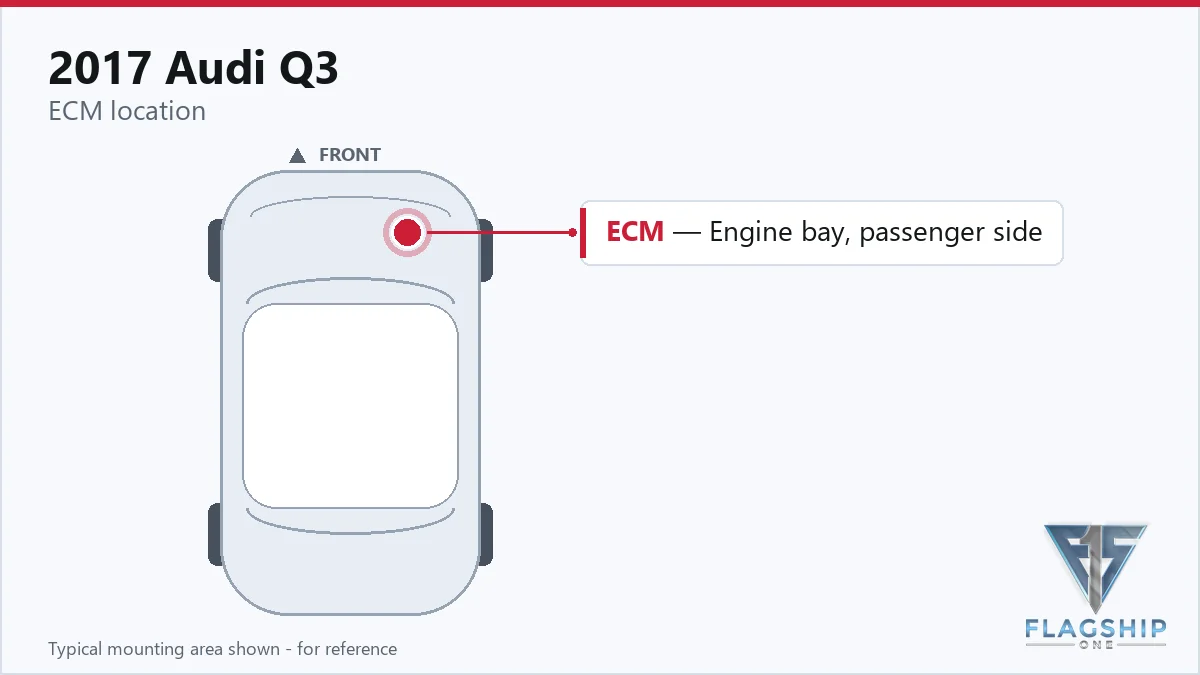
Work with the ignition off, and treat the module as static-sensitive: avoid touching the connector pins at any point.
| Operation | Configuration | Book Time |
|---|---|---|
| Engine Control Module Relearn | Q3 | 0.5 hr |
| Engine Control Module Relearn | Q3 Quattro | 0.5 hr |
| Engine Control Module R&R | Q3 | 1.4 hr |
| Engine Control Module R&R | Q3 Quattro | 1.4 hr |
| Powertrain Control System Diagnosis & Testing | Q3 | 0.5 hr |
| Powertrain Control System Diagnosis & Testing | Q3 Quattro | 0.5 hr |
After replacing the engine control module in your 2017 Audi Q3, a relearn procedure is required to synchronize the new unit with the vehicle’s systems. This process, which typically takes 0.5 hours, ensures the ECM communicates correctly with the transmission, ABS, and all-wheel-drive modules. Without this step, you may experience shifting issues, traction control warnings, or even a no-start condition. However, if you install a VIN-programmed replacement unit, these additional programming steps are already completed, saving you time and reducing the risk of errors during the relearn process. The factory procedure involves using a diagnostic tool to reset the module and recalibrate it to the vehicle’s specific parameters. While this step is critical, opting for a pre-programmed unit eliminates the need for on-site coding, streamlining the repair process.
When the engine control module in your 2017 Audi Q3 begins to fail, you may notice a range of symptoms that can vary in severity. One of the most common signs is a no-start condition, where the engine cranks but refuses to fire. Stalling at idle or during acceleration is another frequent issue, often accompanied by rough idling or hesitation when pressing the throttle. Misfire codes, such as internal control module memory checksum error, may appear on your scan tool, indicating a problem with the ECM’s internal processing. You might also experience communication errors, where the scan tool fails to connect to the module or retrieves incomplete data. In some cases, the vehicle may enter a limp mode, limiting power to prevent further damage. Transmission shifting issues, such as delayed or harsh gear changes, can also occur if the ECM isn’t communicating properly with the transmission control module. Electrical gremlins, like flickering dashboard lights or intermittent sensor failures, may point to an ECM on the verge of failure. If you’re seeing multiple unrelated codes or erratic behavior, the module itself is often the root cause.
Factory service bulletins for the 2017 Audi Q3 highlight precautions related to the engine control module and its communication with other systems. One key caution involves the signals transmitted between the ECM and the ABS control module, which are relayed via the data bus to the all-wheel-drive control module. Removing or installing the ECM without following proper procedures may disrupt this communication, leading to traction control warnings or all-wheel-drive malfunctions. While no specific bulletin numbers are provided, Audi emphasizes the importance of adhering to factory guidelines during ECM replacement to avoid unintended consequences. Always ensure the battery is disconnected and the vehicle’s systems are properly reset after installation to prevent these issues.
Random stalling in your Q3 may be linked to a failing ECM, especially if the issue occurs alongside other symptoms like rough idling or misfire codes. The ECM controls fuel delivery and ignition timing, so any disruption in these functions can cause the engine to shut off unexpectedly. A diagnostic scan can help determine if the ECM is the root cause.
If your Q3 is throwing persistent internal control module codes, such as P0601, or experiencing communication errors that prevent the scan tool from connecting, the ECM may need replacement. Reprogramming is typically effective for software-related issues, but hardware failures require a new unit.
Skipping the relearn procedure after replacing the ECM in your Q3 may result in shifting issues, traction control warnings, or a no-start condition. The relearn ensures the new module synchronizes with the vehicle’s systems, including the transmission and all-wheel-drive controls. Without it, the ECM may not communicate properly with these components.
Yes, a weak or failing battery can lead to ECM issues in your Q3. Low voltage may cause the module to reset unexpectedly or fail to retain critical data, leading to erratic engine behavior. Always ensure your battery is in good condition and properly charged to avoid these problems.
While your Q3 may still run with a failing ECM, it’s not advisable to drive it for long. A compromised ECM can cause sudden stalling, misfires, or loss of power, which may put you at risk of an accident. Additionally, prolonged driving with a faulty ECM can lead to further damage to other systems, such as the transmission or emissions controls.
If your 2017 Audi Q3 is experiencing ECM-related issues, you have options for repair or replacement. While a dealership may recommend a new module, a refurbished or remanufactured unit can provide the same functionality at a lower cost. Opting for a VIN-programmed replacement eliminates the need for additional programming, simplifying the installation process. Whether you’re dealing with a no-start condition or persistent engine codes, addressing the ECM promptly can restore your Q3’s performance and reliability.
Flagship One stocks a refurbished, VIN-programmed PCM for the 2017 Audi Q3 with a lifetime warranty, free shipping and no core charge. The full Audi Q3 module lineup covers other engine configurations as well.
The engine control module in your 2017 Audi Q3 plays a vital role in managing engine performance, emissions, and communication with other vehicle systems. When it fails, the symptoms can range from subtle drivability issues to complete engine shutdown. Understanding the module’s function, location, and replacement process helps you make informed decisions about repairs. Whether you choose to replace the ECM yourself or leave it to a professional, opting for a VIN-programmed unit ensures a smoother, more efficient repair. Addressing ECM issues promptly can save you time, money, and frustration down the road.