
Last updated on August 25th, 2026 at 12:21 pm
The Engine Control Module (ECM) in your 2016 Kia Cadenza manages fuel delivery, ignition timing, and emissions systems. Failures may cause erratic engine behavior, stalling, or a complete no-start condition, often linked to internal memory corruption or voltage spikes.
If your 2016 Kia Cadenza has been stalling, refusing to start, or throwing cryptic engine codes, the Engine Control Module (ECM) may be the culprit. This small but critical computer oversees everything from fuel injection to ignition timing, ensuring smooth operation. When it fails, symptoms can range from subtle drivability issues to a complete breakdown. Replacing the ECM isn’t just about swapping a part—it involves precise installation, torque specifications, and programming to match your vehicle’s VIN. Understanding the process helps you make informed decisions, whether you’re tackling the job yourself or working with a shop. This guide covers what the ECM does, where it’s located, common failure signs, and what to expect during replacement, so you can get your Cadenza back on the road reliably.
The Engine Control Module (ECM) in your 2016 Kia Cadenza acts as the brain of the engine, processing data from sensors to optimize performance, fuel efficiency, and emissions. It adjusts fuel delivery, ignition timing, and idle speed in real time, ensuring the engine runs smoothly under all conditions. Without a functioning ECM, your vehicle may struggle to start, run roughly, or even enter a fail-safe mode that limits power. Over time, voltage spikes, moisture intrusion, or internal component degradation can cause the ECM to fail. When this happens, you’ll often notice symptoms like stalling, misfires, or warning lights on the dashboard. Replacing the module isn’t just about restoring function—it’s about ensuring your Cadenza operates as Kia intended. replacement engine computers for the Cadenza are designed to meet or exceed factory specifications, but proper installation and programming are critical to avoid further issues. The ECM’s role is particularly important in emissions-controlled vehicles, where precise fuel and air management directly impacts compliance with environmental regulations.
2016 Kia Cadenza
OEM programmed ECM for your 2016 Kia Cadenza — plug & play, no dealer visit.
Free shipping · Lifetime warranty
In the 2016 Kia Cadenza, the ECM is located next to the air cleaner assembly, making it relatively accessible compared to some vehicles where the module is buried deep in the engine bay. To replace it, a technician will typically remove the air cleaner housing or surrounding components to gain clear access. The factory procedure specifies that the ECM is secured with either nuts or bolts, both of which must be torqued to 9.8 to 11.8 N·m during reinstallation. Labor time for removal and replacement is estimated at 0.5 hours, though additional time may be needed if other components obstruct access. Once the old ECM is removed, the new unit must be carefully installed, ensuring all electrical connectors are properly seated and free of corrosion. The torque specifications are critical—over-tightening can damage the mounting points, while under-tightening may lead to vibration or poor electrical contact.
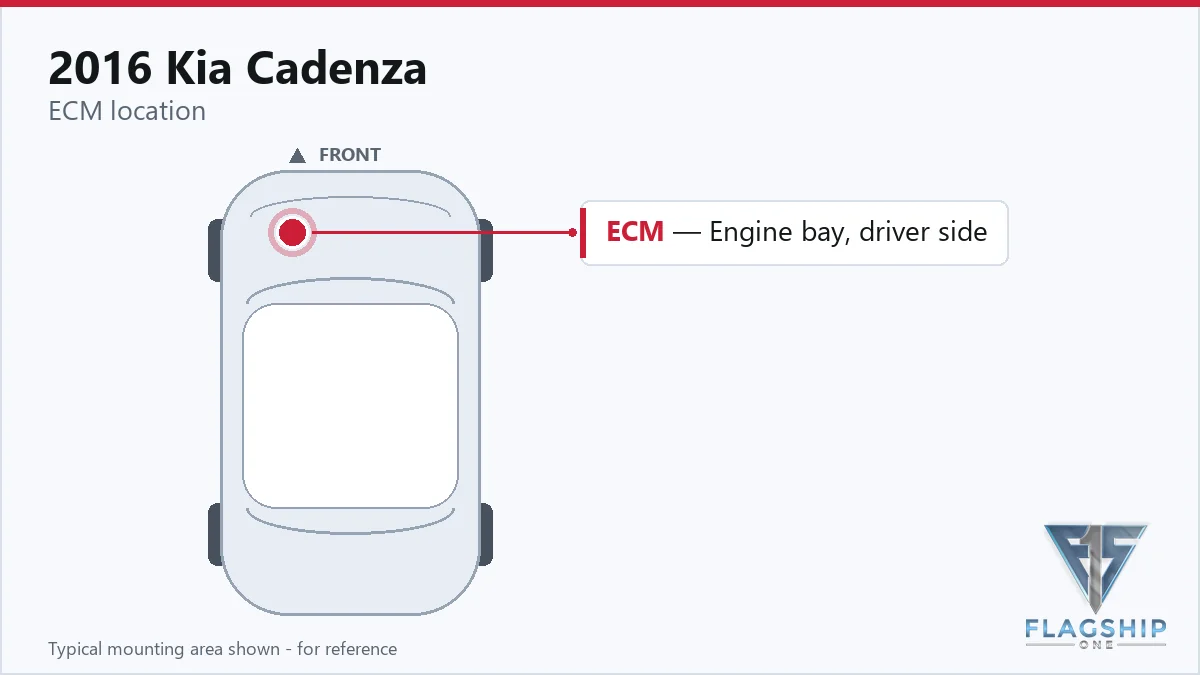
Work with the ignition off, and treat the module as static-sensitive: avoid touching the connector pins at any point.
| Operation | Configuration | Book Time |
|---|---|---|
| Powertrain Control Module R&R | All configurations | 0.7 hr |
| Engine Control Module R&R | All configurations | 0.5 hr |
| Engine Control Module Relearn | All configurations | 0.5 hr |
After installing a new ECM in your 2016 Kia Cadenza, the factory procedure requires programming the vehicle’s VIN into the module to ensure proper communication with the rest of the vehicle’s systems. This step is essential because the ECM relies on the VIN to access the correct calibration data for fuel mapping, emissions controls, and other critical functions. Without this programming, the engine may run poorly or fail to start at all. The process typically involves using specialized diagnostic equipment to input the VIN and perform a relearn procedure, which can add 0.5 hours of labor. However, when you opt for a VIN-programmed replacement unit, this step is already completed before the module arrives. This not only saves time but also reduces the risk of programming errors, ensuring your Cadenza starts and runs as expected right out of the box. Always confirm that the replacement ECM is compatible with your vehicle’s specific engine and emissions configuration.
When the ECM in your 2016 Kia Cadenza begins to fail, symptoms can vary but often include a no-start condition, stalling at idle, or erratic engine behavior. You may notice the engine misfiring, hesitating during acceleration, or running roughly, especially in cold weather. In some cases, the vehicle may enter a fail-safe mode, limiting power to prevent further damage. Warning lights on the dashboard, such as the check engine light, are common, and a scan tool may reveal codes related to internal ECM faults. One specific code documented for this vehicle is internal control module memory error, which indicates corruption in the ECM’s memory. This fault can cause the module to lose its ability to store or retrieve critical operating data, leading to intermittent or persistent drivability issues. Other symptoms may include poor fuel economy, rough shifting (if the ECM communicates with the transmission control module), or even a complete loss of communication with diagnostic tools. If you experience any of these issues, it’s important to address them promptly, as ignoring ECM problems can lead to further damage or leave you stranded.
The codes below point to the PCM itself rather than to a sensor or circuit it monitors. Each one links through to its full diagnostic guide.
| Code | Meaning | Full Guide |
|---|---|---|
| P0605 | Internal ROM error | Full P0605 guide → |
Kia has issued a service bulletin related to the emissions control system in the 2016 Cadenza. The bulletin, identified as ENG137 Rev 2 (DC005), outlines a procedure for extracting California emissions data from the ECM. This process is typically required during diagnostics or compliance checks and involves using specialized tools to retrieve stored data. While this bulletin doesn’t directly address ECM failures, it highlights the importance of proper module function in maintaining emissions compliance. If your vehicle is experiencing ECM-related issues, ensuring the module is correctly programmed and functioning is critical to passing emissions tests and avoiding potential fines.
| Bulletin | Subject | What It Addresses |
|---|---|---|
| — | TSB • Emissions Control System • [ENG137] Data Collection: Extract California Emission Data Fro | — |
Replacing the ECM is technically possible if you have basic mechanical skills and the right tools. However, the process requires careful handling of electrical components and adherence to torque specifications. Additionally, the new ECM must be programmed with your vehicle’s VIN, which typically requires specialized diagnostic equipment. If you’re not comfortable with these steps, it’s best to have the work done by a professional.
Common signs of ECM failure include a no-start condition, stalling, rough idling, or warning lights on the dashboard. You may also notice poor fuel economy or erratic engine behavior. A scan tool can help identify specific trouble codes, such as P0605, which indicate internal ECM faults. If you experience any of these symptoms, it’s worth having the ECM checked.
Without the VIN programmed into the ECM, your 2016 Kia Cadenza may not start or may run poorly. The ECM relies on the VIN to access the correct calibration data for fuel mapping, emissions controls, and other critical functions. Skipping this step can result in drivability issues, warning lights, or even damage to other components due to incorrect engine management.
Driving with a faulty ECM can be risky. The vehicle may stall unexpectedly, lose power, or enter a fail-safe mode that limits performance. In some cases, a failing ECM can cause the engine to run too rich or too lean, potentially damaging the catalytic converter or other components. If you suspect ECM issues, it’s best to address them promptly.
Replacing the ECM typically takes 0.5 hours of labor, while the VIN programming and relearn procedure may add another 0.5 hours. However, if other components obstruct access or additional diagnostics are needed, the total time may be longer. Using a pre-programmed ECM can save time and reduce the risk of errors.
If your 2016 Kia Cadenza is experiencing ECM-related issues, you have options. A repair may be possible in some cases, but if the module is beyond repair, a replacement is often the most reliable solution. Refurbished or new ECM units designed for the Cadenza can restore full functionality, especially when they arrive pre-programmed with your vehicle’s VIN. This eliminates the need for additional programming steps and ensures a smoother installation process. Whether you choose to tackle the job yourself or leave it to a professional, understanding the requirements helps you make the best decision for your vehicle.
Flagship One stocks a refurbished, VIN-programmed PCM for the 2016 Kia Cadenza with a lifetime warranty, free shipping and no core charge. The full Kia Cadenza module lineup covers other engine configurations as well.
The ECM in your 2016 Kia Cadenza plays a vital role in keeping your engine running smoothly and efficiently. When it fails, symptoms like stalling, no-start conditions, or warning lights can disrupt your daily routine. Replacing the ECM involves careful installation, proper torque specifications, and VIN programming to ensure everything works as intended. By addressing ECM issues promptly and opting for a reliable replacement unit, you can restore your Cadenza’s performance and avoid further complications down the road.