
Last updated on August 25th, 2026 at 12:13 pm
The engine control module in your 2015 Kia Cadenza manages fuel delivery, ignition timing, and emissions functions for the 3.3L V6. When this unit fails, your vehicle may experience starting difficulties, erratic idle behavior, or complete loss of diagnostic communication, preventing proper troubleshooting of other systems.
When your 2015 Kia Cadenza begins to exhibit drivability concerns that resist conventional repair approaches, the engine control module often becomes a suspect worth investigating. This computer, responsible for orchestrating the complex relationship between fuel injection, ignition timing, and emissions monitoring in the 3.3L V6, plays a central role in how your vehicle starts, idles, and responds to throttle input. A failing module may produce symptoms that mimic other mechanical or electrical problems, which can lead to extensive and unnecessary parts replacement before the true cause is identified. Understanding what this component does, where it resides in your vehicle, and what procedures follow installation gives you the ability to make informed decisions about diagnosis and repair. The 2015 Kia Cadenza shares its engine management architecture with other vehicles in its family, but the specific calibration, programming requirements, and physical placement of the module are unique to this model. By familiarizing yourself with the factory service information that applies to your vehicle, you can approach ECM replacement with realistic expectations about labor time, programming needs, and the steps required to return your Cadenza to proper operating condition.
The engine control module in your 2015 Kia Cadenza functions as the central processor for the 3.3L V6 powertrain, continuously reading input from dozens of sensors and adjusting output commands to actuators, injectors, and ignition coils. Every time you start the vehicle, the module runs through calibration checks, compares sensor readings against expected values, and adjusts fuel trim and timing advance to maintain efficient combustion. In the Cadenza, this unit also coordinates with the transmission control module to manage shift points and torque converter lockup, ensuring smooth power delivery across a wide range of driving conditions. The module stores adaptive learning data that reflects how your particular engine has aged, compensating for minor wear in components like oxygen sensors and throttle bodies over thousands of miles of use. When the ECM begins to fail internally, it may lose the ability to process sensor signals correctly, store adaptive trim values, or communicate with other modules on the vehicle network. This can produce a cascade of seemingly unrelated symptoms that make diagnosis challenging without proper scan tool equipment. Because the module contains both the operating software and the vehicle-specific calibration data, replacing it involves more than simply swapping hardware; the new unit must receive programming that matches your Cadenza’s configuration. For owners seeking replacement engine computers for the Cadenza, understanding these requirements helps ensure the replacement process goes smoothly and the vehicle returns to full functionality without unnecessary delays. The module’s role in emissions monitoring also means that certain failures will trigger check engine illumination and prevent emissions testing from passing until the issue is resolved.
2015 Kia Cadenza
OEM programmed ECM for your 2015 Kia Cadenza — plug & play, no dealer visit.
Free shipping · Lifetime warranty
The factory service procedure for the 2015 Kia Cadenza indicates that the control module is reached beside the air cleaner assembly, which means removal typically begins with clearing the intake ducting and related components from that portion of the engine bay. The published book time for engine control module removal and replacement is 0.5 hours, while the powertrain control module removal and replacement carries a book time of 0.7 hours. After the module is physically installed, a relearn procedure is called for, adding 0.5 hours of labor to the job. When reinstalling the module, the mounting nuts should be tightened to a torque range of 9.8 to 11.8 N·m, and the mounting bolts follow the same specification of 9.8 to 11.8 N·m. These fasteners secure the module firmly without applying excessive force that could damage the housing or the internal circuitry. Accessing the area near the air cleaner assembly is generally straightforward, but technicians should verify that the electrical connectors are fully seated and that no debris has entered the connector pins during the swap.
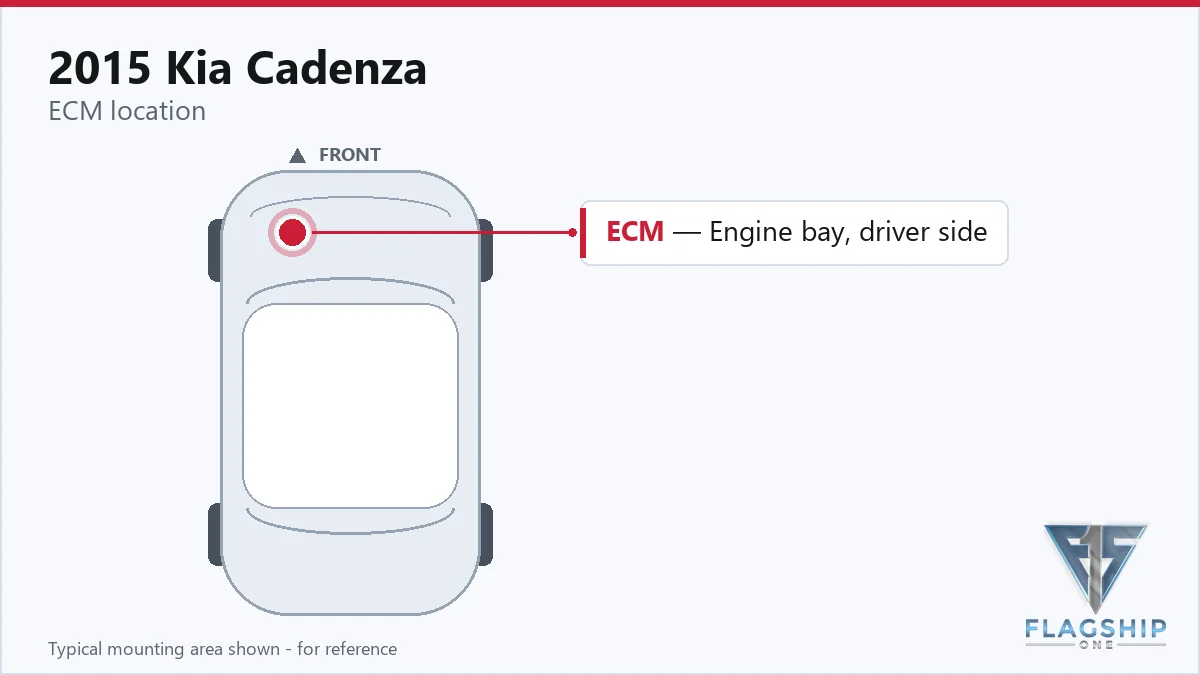
Work with the ignition off, and treat the module as static-sensitive: avoid touching the connector pins at any point.
| Operation | Configuration | Book Time |
|---|---|---|
| Powertrain Control Module R&R | All configurations | 0.7 hr |
| Engine Control Module R&R | All configurations | 0.5 hr |
| Engine Control Module Relearn | All configurations | 0.5 hr |
After a new engine control module is installed in the 2015 Kia Cadenza, the factory procedure requires that the vehicle identification number be programmed into the replacement unit. This step is mandatory because the ECM uses the VIN to confirm it is matched to the correct vehicle, and various onboard systems rely on that identification data for proper network communication. Without VIN programming, the module may not function correctly, and the vehicle may exhibit starting problems or fail to communicate with diagnostic tools. In addition to VIN programming, the relearn procedure mentioned in the labor time guide helps the new module establish baseline values for idle control, fuel trim, and other adaptive parameters. Flagship One addresses this requirement by providing a VIN-programmed replacement unit that arrives with your vehicle’s identification number already entered, so the VIN programming step is completed before the part ships. This means that after installation, the remaining work typically involves the relearn procedure to let the module calibrate itself to your engine’s current condition, rather than starting from a blank state.
A failing engine control module in the 2015 Kia Cadenza can produce a range of symptoms that often overlap with other common automotive issues, which is why careful diagnosis matters. One of the most frequent signs is a no-start condition where the engine cranks but does not fire, or starts briefly and stalls immediately. You may also experience intermittent stalling while driving, particularly at idle or during deceleration, as the module struggles to maintain proper fuel and spark coordination. Misfire codes may appear even when the ignition coils, spark plugs, and fuel injectors have been verified as functional, because the module itself may be failing to trigger those components at the correct time. Another common indicator is the loss of scan tool communication; if your diagnostic equipment cannot establish a link with the ECM, the module may have suffered an internal failure that prevents it from responding to external requests. Shifting irregularities can also surface, since the ECM communicates with the transmission control module to coordinate gear changes and torque management. When the internal memory of the module becomes corrupted, your vehicle may store diagnostic trouble codes that point to the module itself. A documented internal fault code for this vehicle, internal control module read memory error, indicates that the module’s read-only memory has encountered a problem that affects its ability to execute stored instructions properly. Additional symptoms may include poor fuel economy, rough idle, illuminated warning lights that resist clearing, and a noticeable decrease in throttle response. Because these symptoms can stem from many different sources, confirming an ECM failure typically requires ruling out sensor, wiring, and mechanical causes first.
The following trouble code has been documented as a module-internal fault for the 2015 Kia Cadenza. This code specifically relates to the engine control module’s internal memory rather than an external sensor or circuit problem, which helps distinguish a true module failure from other issues that may produce similar drivability symptoms.
| Code | Meaning | Full Guide |
|---|---|---|
| P0605 | Internal ROM error | Full P0605 guide → |
Kia has issued service bulletins relevant to the 2015 Kia Cadenza that address both transmission and emissions control systems. Bulletin TRA056 covers a TCM upgrade intended to improve shift logic, which may benefit vehicles experiencing inconsistent or harsh shifting behavior. Bulletin ENG137 Revision 2 addresses the process of retrieving California emissions information from the engine control unit, referenced under DC005. This bulletin relates to data collection from the engine control unit for emissions compliance purposes. While neither bulletin directly mandates ECM replacement, both documents involve the engine management system and may be relevant if your vehicle is undergoing diagnosis or repair related to shifting behavior or emissions testing requirements. Reviewing these bulletins with your service technician can provide additional context for any drivability or emissions concerns you may be experiencing.
| Bulletin | Subject | What It Addresses |
|---|---|---|
| — | TSB • Automatic Transaxle • [TRA056] TCM Upgrade – Shift Logic Improvement (TRA 056) | — |
| — | TSB • Emissions Control System • [ENG137] Data Collection: Extract California Emission Data Fro | — |
The factory book time for engine control module removal and replacement is 0.5 hours, and a relearn procedure adds another 0.5 hours. Powertrain control module removal and replacement carries a book time of 0.7 hours. Actual repair time may vary depending on shop conditions and whether any additional diagnosis is needed.
Yes, the factory procedure requires the vehicle identification number to be programmed into the replacement ECM. Flagship One units arrive with the VIN already programmed, which eliminates that step. A relearn procedure is still recommended after installation so the module can calibrate to your engine’s current condition.
The factory removal procedure indicates the control module is reached beside the air cleaner assembly. This location typically requires removing or repositioning the intake ducting and related components to gain access to the module for service.
Both the installation nuts and the installation bolts for the ECM should be tightened to a torque range of 9.8 to 11.8 N·m. Applying the correct torque helps secure the module without risking damage to the housing or internal components.
Code P0605 is an internal control module fault indicating a problem with the module’s read-only memory. This code suggests the ECM itself may need replacement rather than an external sensor or wiring repair. Professional diagnosis is recommended to confirm the module has failed before replacing it.
When your 2015 Kia Cadenza needs an engine control module, you have options. A dealership will typically install a new unit and handle the VIN programming and relearn procedures on site, which is effective but often comes with a higher price tag. A refurbished replacement from Flagship One arrives already programmed with your vehicle’s identification number, reducing the steps required after installation. Either path can return your Cadenza to proper operating condition, so the decision often comes down to cost, convenience, and how quickly you need the repair completed.
Flagship One stocks a refurbished, VIN-programmed PCM for the 2015 Kia Cadenza with a lifetime warranty, free shipping and no core charge. The full Kia Cadenza module lineup covers other engine configurations as well.
The 2015 Kia Cadenza relies on its engine control module to keep the 3.3L V6 running efficiently and communicating properly with other vehicle systems. Understanding the replacement process, programming requirements, and common failure signs helps you make confident repair decisions. If your Cadenza is showing symptoms of ECM failure, exploring a pre-programmed replacement from Flagship One may save time and reduce the complexity of getting your vehicle back on the road.