
Last updated on August 25th, 2026 at 12:18 pm
The engine control module (ECM) in the 2015 Audi RS7 manages fuel delivery, ignition timing, and emissions systems. Failure may cause drivability issues, including stalling, misfires, or a complete no-start condition, often triggered by electrical faults or internal corruption.
If your 2015 Audi RS7 has developed intermittent stalling, a stubborn no-start condition, or a check-engine light with cryptic powertrain codes, the engine control module (ECM) may be the culprit. This compact but critical computer oversees fuel injection, ignition timing, and emissions controls, translating sensor data into precise engine commands. When it fails, your vehicle may run poorly—or not at all. Replacing the ECM isn’t just about swapping a box; the factory procedure involves careful removal, installation, and a mandatory relearn process to ensure seamless operation. Understanding what the ECM does, where it’s located, and what to expect during replacement can save you time and frustration. This guide covers the essentials: symptoms of failure, labor requirements, and why a pre-programmed unit can simplify the repair.
The engine control module in your 2015 Audi RS7 acts as the brain of the powertrain, continuously adjusting fuel delivery, ignition timing, and turbocharger boost to match driving conditions. It monitors inputs from sensors across the engine, transmission, and emissions systems, ensuring optimal performance while meeting strict emissions standards. Without a functioning ECM, your RS7 may struggle to start, idle roughly, or enter a protective limp mode to prevent damage. The module’s role extends beyond basic engine management; it also interfaces with the transmission control unit to coordinate smooth gear shifts, particularly important in a high-performance vehicle like the RS7. When internal faults occur, the ECM may log specific trouble codes, such as P060A or P0613, which often point to memory corruption or communication failures. Replacing the module isn’t just about restoring functionality—it’s about ensuring your replacement engine computers for the RS7 can seamlessly integrate with the vehicle’s existing systems. A faulty ECM can also trigger cascading issues, such as misfires or fuel trim errors, which may lead to more extensive repairs if left unaddressed.
2015 Audi RS7
OEM programmed ECM for your 2015 Audi RS7 — plug & play, no dealer visit.
Free shipping · Lifetime warranty
The engine control module in the 2015 Audi RS7 is tucked beneath the plenum chamber at the base of the windshield, a location chosen for protection from heat and moisture but one that complicates access. Replacing the module requires removing the windshield cowl panel and possibly the wiper assembly, depending on the technician’s approach. According to factory labor guides, the entire removal and reinstallation process typically takes 1.4 hours. This includes disconnecting the battery, unplugging the module’s electrical connectors, and carefully extracting the unit without damaging surrounding components. Once the new module is installed, the electrical connections must be secured, and the battery reconnected to restore power. The location isn’t just inconvenient—it also means that any water intrusion or debris accumulation in the plenum area could potentially affect the module’s longevity, making regular inspection of the area a good practice.
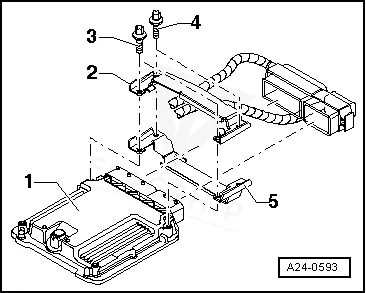
Work with the ignition off, and treat the module as static-sensitive: avoid touching the connector pins at any point.
| Operation | Configuration | Book Time |
|---|---|---|
| Engine Control Module Relearn | RS7 | 0.5 hr |
| Engine Control Module Relearn | S7 | 0.5 hr |
| Engine Control Module Relearn | A7 Quattro | 0.5 hr |
| Engine Control Module R&R | RS7 | 1.4 hr |
| Engine Control Module R&R | S7 | 1.4 hr |
| Engine Control Module R&R | A7 Quattro | 1.4 hr |
| Powertrain Control Module R&R | RS7 | 0.5 hr |
| Powertrain Control Module R&R | S7 | 0.5 hr |
After installing a new engine control module in your 2015 Audi RS7, the factory procedure requires a 0.5-hour relearn process to synchronize the module with the vehicle’s other systems. This step ensures the ECM recognizes the transmission, anti-lock brakes, and other critical components, preventing communication errors or drivability issues. The relearn typically involves connecting a factory-level scan tool to initiate a series of calibrations, which can include resetting fuel trims, ignition timing, and throttle adaptation values. However, if you opt for a VIN-programmed replacement unit, these steps are already completed before the module arrives. This eliminates the need for additional programming, saving time and reducing the risk of errors during the installation process. It’s worth noting that the relearn isn’t just a formality—skipping it may result in poor engine performance, shifting issues, or even a no-start condition, as the vehicle’s systems won’t recognize the new module without proper initialization.
When the engine control module in your 2015 Audi RS7 begins to fail, the symptoms can range from subtle to severe, often mimicking other issues like fuel pump or sensor failures. One of the most common signs is a no-start condition, where the engine cranks but refuses to fire, often accompanied by a lack of spark or fuel injection. Stalling at idle or during acceleration is another frequent complaint, particularly if the ECM loses communication with critical sensors or the transmission control module. You may also notice the check-engine light illuminating, sometimes flashing, with codes that point to internal ECM faults. For example, a control module keep-alive memory error suggests the module’s memory has been corrupted, which can lead to erratic engine behavior or even a complete shutdown. Other symptoms include rough idling, misfires, or the vehicle entering limp mode, where power and RPM are severely limited to prevent damage. In some cases, the ECM may fail to communicate with a scan tool, leaving you with no diagnostic data to pinpoint the issue. Transmission shifting problems, such as delayed or harsh gear changes, can also occur if the ECM isn’t properly coordinating with the transmission control unit. Because these symptoms can overlap with other failures, it’s important to diagnose the ECM thoroughly before proceeding with replacement.
The 2015 Audi RS7’s engine control module may log specific trouble codes when internal faults occur. These codes often indicate memory corruption, communication errors, or power supply issues within the module itself. Below are the documented codes associated with ECM failures in this vehicle.
| Code | Meaning | Full Guide |
|---|---|---|
| P0603 | Keep-alive memory (KAM) error | Full P0603 guide → |
| P0605 | Internal ROM error | Full P0605 guide → |
| P060A | Module-internal fault | — |
| P060B | Module-internal fault | — |
| P0613 | Module-internal fault | Full P0613 guide → |
| P0667 | Module-internal fault | Full P0667 guide → |
Intermittent stalling in the RS7 can stem from several issues, including a failing ECM. The module may lose communication with sensors or the transmission control unit, causing the engine to shut off unexpectedly. If the stalling is accompanied by a check-engine light or codes like P060A, the ECM is a likely culprit.
If your vehicle exhibits persistent no-start conditions, stalling, or internal ECM codes (e.g., P0603, P0605) that return after a reset, replacement is often necessary. A scan tool can confirm whether the module is communicating properly or if it’s logging irrecoverable faults.
In the RS7, the ECM (engine control module) focuses on engine management, while the PCM (powertrain control module) typically integrates transmission control. However, some vehicles use the terms interchangeably. The RS7’s ECM handles fuel, ignition, and emissions, while the PCM may oversee gear shifts and torque management.
Yes, a weak or failing battery can lead to voltage spikes or low power supply, which may corrupt the ECM’s memory or damage its circuitry. If your battery is old or struggling to hold a charge, it’s wise to replace it before addressing ECM issues.
A P060B code indicates an internal control module processor performance issue, which can lead to erratic engine behavior or stalling. While the vehicle may still run, driving with this code risks further damage or a sudden no-start condition. It’s best to address the issue promptly.
If your 2015 Audi RS7 is experiencing ECM-related issues, you have two primary options: pursue a repair or opt for a replacement. Repairs may be viable for minor electrical faults, but internal corruption or memory failures often necessitate a new module. Given the labor involved in accessing and replacing the ECM, choosing a pre-programmed unit can streamline the process, eliminating the need for additional programming steps. This approach ensures your vehicle is back on the road quickly, with minimal downtime and reduced risk of post-installation issues.
Flagship One stocks a refurbished, VIN-programmed PCM for the 2015 Audi RS7 with a lifetime warranty, free shipping and no core charge. The full Audi RS7 module lineup covers other engine configurations as well.
The engine control module in your 2015 Audi RS7 plays a critical role in managing engine performance, emissions, and drivability. When it fails, symptoms like stalling, no-start conditions, or persistent trouble codes can disrupt your driving experience. Understanding the module’s location, replacement process, and programming requirements can help you make informed decisions about repairs. Whether you opt for a repair or a pre-programmed replacement, addressing ECM issues promptly will keep your RS7 running smoothly and reliably.