
Last updated on August 25th, 2026 at 02:41 pm
The Engine Control Module (ECM) in your 2014 BMW Z4 manages fuel injection, ignition timing, and emissions systems for the 2.0L turbo engine. Failures may cause rough running, stalling, or complete no-start conditions due to corrupted data or electrical faults.
If your 2014 BMW Z4 has developed a stubborn no-start condition, intermittent stalling, or persistent check-engine lights, the Engine Control Module (ECM) may be the culprit. This compact computer, tucked inside the electronics box near the engine, governs everything from fuel delivery to ignition timing. When it fails, your roadster’s performance can degrade quickly—or leave you stranded entirely. Replacing it involves more than just swapping hardware; the factory requires precise programming to restore full functionality. Understanding the process, from access to post-install procedures, helps you make informed decisions about repairs. Whether you’re considering a dealer visit or a DIY approach, knowing what to expect can save time and prevent costly mistakes. This guide covers the essentials: where the module lives, how replacement works, and what steps follow installation to get your Z4 back on the road reliably.
The Engine Control Module in your 2014 BMW Z4 serves as the brain of the 2.0L turbocharged engine, continuously adjusting fuel injection, ignition timing, and turbo boost to optimize performance and efficiency. It monitors sensors throughout the engine bay, ensuring smooth operation under varying conditions—from cold starts to spirited drives. Without a functioning ECM, the engine may run poorly, misfire, or refuse to start at all. This module also plays a critical role in emissions compliance, communicating with the vehicle’s onboard diagnostics to detect and store fault codes when issues arise. Over time, electrical surges, moisture intrusion, or software corruption can compromise its operation. When replacement becomes necessary, replacement engine computers for the BMW Z4 are available to restore full functionality, but proper installation and programming are essential to avoid further complications. The module’s location in the E-box makes it accessible, though care must be taken to avoid static damage during handling.
2014 BMW Z4
OEM programmed ECM for your 2014 BMW Z4 — plug & play, no dealer visit.
Free shipping · Lifetime warranty
The ECM in your 2014 BMW Z4 is housed in the electronics box (E-box), located in the engine compartment. Accessing it requires removing the E-box cover, which is typically secured with clips or fasteners. The factory procedure specifies switching off the ignition and disconnecting the battery’s negative terminal before handling the module to prevent electrical damage. Once exposed, the ECM can be unplugged and removed, though caution is necessary to avoid bending pins or introducing static discharge. Reinstallation follows the reverse process, with the new module seated securely in its mount. Labor estimates for this job are relatively short—0.7 hours for the 2.0L model—reflecting the straightforward access. However, the factory warns that programming and encoding must follow installation to ensure the module communicates correctly with the vehicle’s systems.
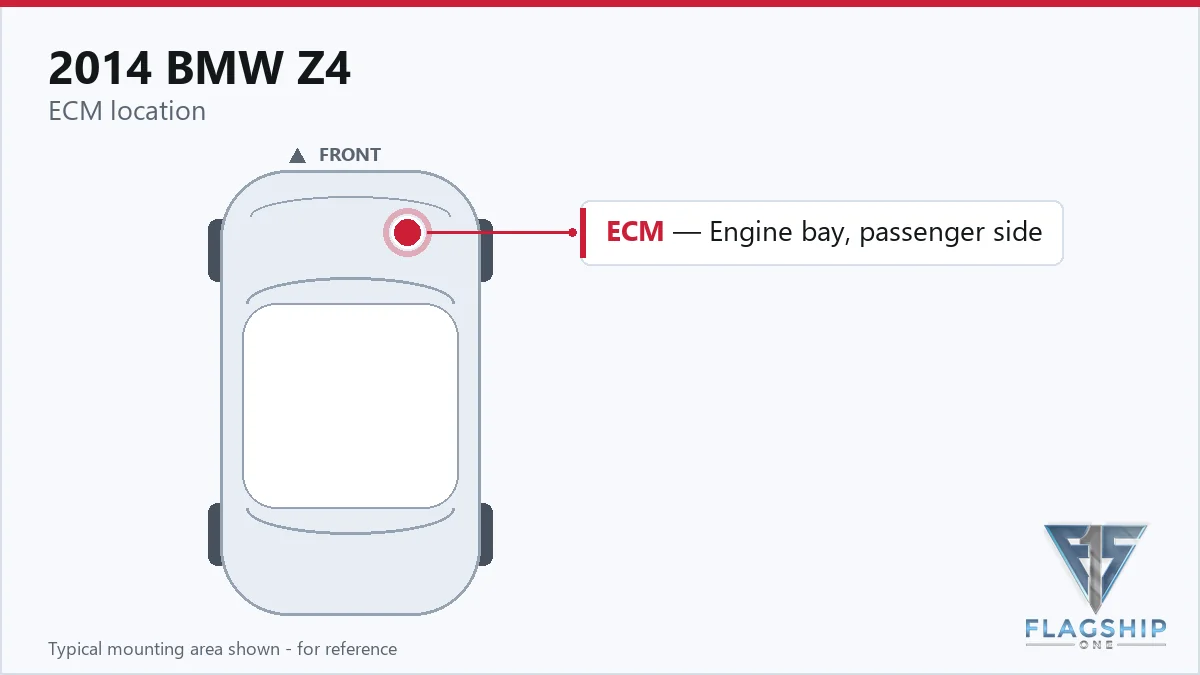
Work with the ignition off, and treat the module as static-sensitive: avoid touching the connector pins at any point.
| Operation | Configuration | Book Time |
|---|---|---|
| Powertrain Control Module R&R | 2.0L | 0.7 hr |
| Powertrain Control Module R&R | 3.0L | 1.6 hr |
| Engine Control Module R&R | 3.0L | 1.6 hr |
| Engine Control Module R&R | 2.0L | 0.7 hr |
| Engine Control Module Relearn | All configurations | 0.5 hr |
After replacing the ECM in your 2014 BMW Z4, the factory procedure requires programming and encoding to synchronize the new module with the vehicle’s systems. This step ensures the ECM recognizes the engine’s sensors, fuel injectors, and other components, allowing for proper operation. If the original module’s data cannot be retrieved, additional steps like injection quantity compensation may be necessary. These procedures typically require specialized diagnostic tools and software, which is why many owners opt for a VIN-programmed replacement unit to avoid the complexity. Flagship One provides modules pre-programmed to your Z4’s VIN, eliminating the need for post-install programming and reducing the risk of errors. This approach streamlines the process, allowing your vehicle to return to service without additional dealer visits or software updates.
When the ECM in your 2014 BMW Z4 begins to fail, symptoms often appear gradually before escalating. Common signs include rough idling, hesitation during acceleration, or unexpected stalling—especially when the engine is warm. You may also notice the check-engine light illuminating, often accompanied by codes related to fuel trim, misfires, or sensor malfunctions. In some cases, the vehicle may crank but fail to start, indicating the ECM is not sending the correct signals to the fuel injectors or ignition coils. Another telltale sign is poor scan-tool communication; if the ECM is unresponsive or only partially functional, diagnostic tools may struggle to retrieve fault codes. One frequent code associated with ECM failure is an internal control module memory check sum error, which suggests the module’s software or hardware has been corrupted. If left unaddressed, these issues can lead to more severe drivability problems, including transmission shifting irregularities or complete engine shutdowns. Addressing ECM-related symptoms promptly can prevent further damage and restore your Z4’s performance.
If your Z4 cranks but doesn’t start after an ECM replacement, the module may not be properly programmed or encoded to the vehicle. The factory procedure requires post-install programming to synchronize the ECM with the engine’s sensors and fuel system. Without this step, the module may not send the correct signals to start the engine. A VIN-programmed replacement unit eliminates this issue by arriving ready for installation.
Driving with a failing ECM is risky, as it can lead to sudden stalling, misfires, or complete engine shutdown. The module controls critical functions like fuel injection and ignition timing, so erratic behavior may leave you stranded or cause further damage. If you suspect ECM issues, it’s best to address them promptly to avoid unsafe driving conditions.
Distinguishing between ECM failure and sensor issues can be challenging, as both may trigger similar symptoms like rough idling or check-engine lights. A diagnostic scan can help; if multiple unrelated codes appear simultaneously, the ECM may be at fault. Sensor issues typically trigger codes specific to their function, such as oxygen sensor or mass airflow sensor faults. If the scan tool cannot communicate with the ECM at all, the module itself is likely the problem.
ECM failures in the Z4 can stem from electrical surges, moisture intrusion, or software corruption. Voltage spikes from a faulty alternator or improper jump-starting can damage the module’s circuitry. Moisture entering the E-box may cause short circuits, while software glitches can disrupt communication with sensors. Age-related wear or manufacturing defects may also play a role in premature failure.
Replacing the ECM in your Z4 is physically straightforward, as it’s located in the E-box in the engine compartment. However, the factory requires programming and encoding after installation, which typically requires specialized tools and software. If you’re not equipped to handle these steps, a VIN-programmed replacement unit can simplify the process. Always follow ESD precautions to avoid static damage during handling.
When your 2014 BMW Z4’s ECM fails, you have two primary options: repair or replacement. Dealerships may offer refurbished modules, but these often require programming and encoding, adding time and cost. A VIN-programmed replacement unit from Flagship One arrives ready for installation, eliminating the need for post-install procedures. This approach reduces downtime and ensures your Z4 returns to the road quickly, with all systems functioning as intended. Whether you choose to tackle the job yourself or leave it to a professional, understanding the process helps you make the best decision for your vehicle’s needs.
Flagship One stocks a refurbished, VIN-programmed PCM for the 2014 BMW Z4 with a lifetime warranty, free shipping and no core charge. The full BMW Z4 module lineup covers other engine configurations as well.
The Engine Control Module in your 2014 BMW Z4 is a critical component that demands careful handling when replacement becomes necessary. From accessing the E-box to ensuring proper programming, each step plays a role in restoring your roadster’s performance. Whether you opt for a dealer visit or a DIY approach, a VIN-programmed replacement unit can simplify the process and get you back on the road with confidence. Addressing ECM issues promptly ensures your Z4 continues to deliver the driving experience it was designed for.