
Last updated on August 25th, 2026 at 02:42 pm
The engine control module (ECM) in the 2014 BMW X5 manages fuel injection, ignition timing, and emissions systems. Failures may cause erratic engine behavior, poor performance, or complete stalls, often triggered by electrical issues or internal faults.
If your 2014 BMW X5 has begun stalling unexpectedly, refusing to start, or throwing cryptic engine codes, the engine control module (ECM) may be the culprit. This compact but powerful computer oversees everything from fuel injection to ignition timing, ensuring smooth operation. When it fails, the effects can range from subtle performance hiccups to complete immobilization. Replacing the ECM isn’t just about swapping a part—it involves careful handling, precise installation, and post-replacement programming to restore full functionality. Understanding the role of this module, where it’s located, and what to expect during replacement can save you time and frustration. Whether you’re diagnosing symptoms or preparing for a repair, this guide covers the essentials for the 2014 BMW X5, helping you make informed decisions about your vehicle’s health.
The engine control module in the 2014 BMW X5 acts as the brain of the engine, continuously monitoring and adjusting critical systems to maintain optimal performance. It processes data from sensors throughout the vehicle, such as the oxygen sensor, throttle position sensor, and mass airflow sensor, to fine-tune fuel delivery, ignition timing, and emissions controls. Without a functioning ECM, your X5 may struggle to start, run inefficiently, or even enter a protective limp mode to prevent further damage. This module is particularly vital in turbocharged engines like the 4.4L V8, where precise air-fuel ratios are essential for power and efficiency. When considering replacement engine computers for the X5, it’s important to choose a unit that matches the vehicle’s specifications to avoid compatibility issues or additional programming steps. The ECM’s role extends beyond basic engine management—it also influences transmission behavior, making it a key player in the overall drivability of your BMW.
2014 BMW X5
OEM programmed ECM for your 2014 BMW X5 — plug & play, no dealer visit.
Free shipping · Lifetime warranty
The engine control module in the 2014 BMW X5 is located in the plenum chamber at the base of the windshield, a position that requires careful access during replacement. To reach it, you’ll typically need to remove components like the windshield cowl or plenum cover, which adds complexity to the job. Labor times for replacement vary depending on the procedure: the book time for removing and reinstalling the ECM is 0.8 hours for the 4.4L engine, while a full replacement including relearn procedures may take up to 1.7 hours. The factory procedure emphasizes the importance of switching off the ignition before handling the module to prevent electrical damage. Once the old unit is removed, the new ECM must be installed securely, with attention to proper alignment and connector engagement to avoid future issues.
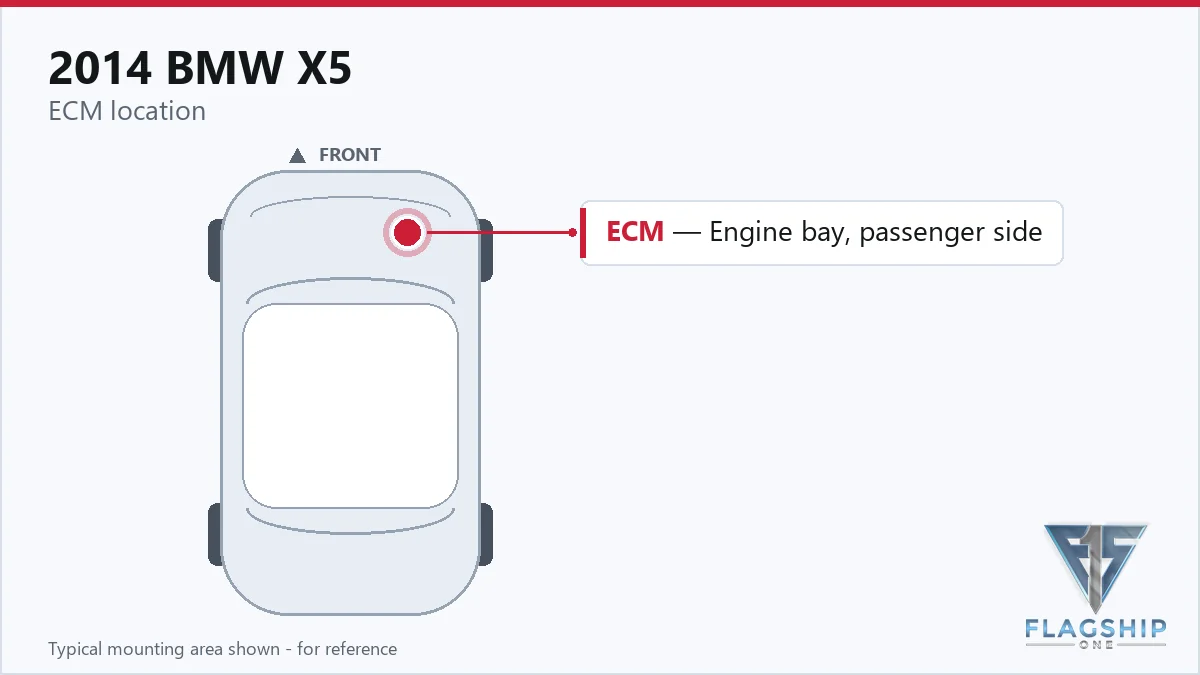
Work with the ignition off, and treat the module as static-sensitive: avoid touching the connector pins at any point.
| Operation | Configuration | Book Time |
|---|---|---|
| Engine Control Module R&R | GAS | 1.7 hr |
| Engine Control Module R&R | DIESEL | 1.0 hr |
| Engine Control Module R&R | GAS | 0.8 hr |
| Engine Control Module Relearn | All configurations | 0.5 hr |
| Powertrain Control Module R&R | GAS | 1.7 hr |
| Powertrain Control Module R&R | DIESEL | 1.0 hr |
| Powertrain Control Module R&R | 4.4L | 0.8 hr |
| Powertrain Control Module Relearn | All configurations | 0.5 hr |
After replacing the engine control module in your 2014 BMW X5, the factory procedure requires several critical steps to ensure the new unit functions correctly. These include programming or encoding the module to match your vehicle’s specifications and performing an injection quantity compensation if data from the old ECM cannot be retrieved. These steps are essential for restoring engine performance, fuel efficiency, and emissions compliance. However, if you opt for a VIN-programmed replacement unit, these programming tasks are already completed before installation, saving you time and reducing the risk of errors. This pre-programming ensures the module is ready to communicate with your X5’s systems right out of the box, allowing for a smoother and more efficient replacement process. Always follow ESD protection protocols during installation to avoid damaging the sensitive electronics in the new module.
A failing engine control module in the 2014 BMW X5 can manifest in several ways, often mimicking other common engine issues. One of the most frequent symptoms is a no-start condition, where the engine cranks but fails to fire, often due to the ECM’s inability to manage fuel or ignition systems. Stalling at idle or during acceleration is another red flag, as the module may struggle to maintain consistent engine operation. Misfires, rough idling, or a noticeable drop in power can also indicate ECM problems, particularly if accompanied by warning lights on the dashboard. In some cases, the vehicle may enter a limp mode, severely limiting performance to protect the engine. Scan tool communication issues, where the ECM fails to respond to diagnostic requests, are another telltale sign of internal failure. Trouble codes like internal control module memory checksum error may appear, pointing directly to the ECM as the source of the problem. Shifting issues, such as delayed or harsh gear changes, can also occur if the ECM’s signals to the transmission control module are disrupted.
Intermittent stalling in your X5 may be caused by a failing engine control module. The ECM manages fuel delivery and ignition timing, and if it malfunctions, the engine may cut out unexpectedly. Other potential causes include fuel pump issues or sensor failures, but the ECM is a common culprit in these scenarios.
Signs of a bad ECM in your 2014 BMW X5 include no-start conditions, stalling, misfires, or warning lights on the dashboard. A diagnostic scan may reveal trouble codes like P0601, indicating internal module faults. If the ECM fails to communicate with a scan tool, it’s another strong indicator of failure.
Replacing the ECM in your 2014 BMW X5 is possible if you have mechanical experience and the right tools. However, the module is located in the plenum chamber, which requires careful disassembly. Additionally, the new ECM must be programmed or encoded to match your vehicle, which may require specialized equipment or dealer assistance.
If the new ECM in your 2014 BMW X5 isn’t programmed, the engine may not start or run properly. The module needs to be encoded to communicate with the vehicle’s systems, including the transmission and emissions controls. Without programming, you may experience poor performance, shifting issues, or even a complete no-start condition.
Replacing the ECM in your 2014 BMW X5 typically takes 0.8 hours for the 4.4L engine, according to book times. However, if programming or relearn procedures are required, the total labor time may extend to 1.7 hours. The exact duration depends on the complexity of the job and whether additional steps are needed.
When faced with a failing engine control module in your 2014 BMW X5, you have options. A dealership replacement may offer peace of mind but often comes with higher costs and longer wait times. Alternatively, a refurbished or remanufactured ECM can provide a cost-effective solution without sacrificing quality. For the 2014 X5, choosing a VIN-programmed unit eliminates the need for post-installation programming, streamlining the repair process and getting you back on the road faster.
Flagship One stocks a refurbished, VIN-programmed PCM for the 2014 BMW X5 with a lifetime warranty, free shipping and no core charge. The full BMW X5 module lineup covers other engine configurations as well.
The engine control module plays a critical role in the performance and reliability of your 2014 BMW X5. Whether you’re dealing with stalling, no-start conditions, or mysterious engine codes, understanding the function and replacement process of this module can help you make informed decisions. Proper handling, installation, and programming are key to restoring your X5’s drivability. If you suspect ECM issues, addressing them promptly can prevent further complications and keep your vehicle running smoothly.