
Last updated on August 25th, 2026 at 02:19 pm
The Powertrain Control Module on your 2014 BMW X3 (2.0L) serves as the central computer managing engine and transmission functions. When internal circuitry degrades from heat cycling, voltage spikes, or age, the module may lose communication with sensors, trigger multiple fault codes, or leave your vehicle inoperable. Replacement restores complete engine management capability.
When your 2014 BMW X3 with the 2.0L turbocharged engine develops starting problems, stalling, or mysterious check engine lights that resist conventional repair, the Powertrain Control Module often deserves scrutiny. This comprehensive guide walks you through understanding what the PCM does in your specific vehicle, recognizing failure symptoms, and navigating the replacement process with clear expectations. The PCM serves as the electronic brain for your turbocharged four-cylinder, processing data from dozens of sensors to maintain optimal combustion under all driving conditions. Factory procedures for this vehicle require careful ESD handling, specific disassembly steps, and post-installation programming that adds complexity beyond simply bolting in a replacement part. By understanding what the process entails, you can make an informed decision between dealer service, independent shop repair, or tackling the project yourself with a pre-programmed replacement unit.
The Powertrain Control Module in your 2014 BMW X3 functions as the primary command center for the turbocharged 2.0L engine’s entire operation. This computer continuously monitors intake air temperature, mass airflow, crankshaft position, camshaft phasing, oxygen sensors, and numerous other inputs to calculate ideal fuel injection duration, spark advance, boost pressure from the turbocharger, and transmission shift points. Without this module functioning properly, your engine may run in a degraded limp mode, fail to start entirely, or experience erratic behavior that makes reliable transportation impossible. The module processes these calculations dozens of times per second, adjusting parameters based on your driving demands, ambient conditions, and fuel quality. For owners seeking information on replacement engine computers for the X3, understanding this module’s central role clarifies why a failure affects nearly every engine operation. BMW designed this control system to meet strict emissions standards while delivering the responsive power delivery drivers expect from the N20 turbocharged engine. The PCM also manages communication between your engine and the automatic transmission control unit, making it essential for proper gear selection and shift quality. When this module fails, symptoms range from subtle drivability concerns to complete vehicle disablement depending on the nature of the internal fault.
Flagship One keeps BMW X3 replacement engine computers in stock for exactly this failure pattern.
2014 BMW X3
OEM programmed ECM for your 2014 BMW X3 — plug & play, no dealer visit.
Free shipping · Lifetime warranty
The factory service documentation specifies that accessing the Powertrain Control Module on your 2014 BMW X3 requires reaching into the plenum chamber located at the base of the windshield. This location means significant disassembly of interior trim and potentially the cabin air filtration housing to create adequate working room. The book time for removing and replacing this module on the 2.0L engine is established at 1.5 hours, though this represents only the physical R&R procedure. Actual access typically involves removing panels beneath the windshield wiper mechanism and potentially disconnecting the cabin air intake ductwork. Once you reach the module, proper handling precautions must be observed throughout the removal and installation process. The replacement procedure requires disconnecting the battery negative terminal before beginning work to prevent electrical damage. After installing the new module, you must secure all electrical connections properly and verify their integrity before reassembling the interior components in reverse order.
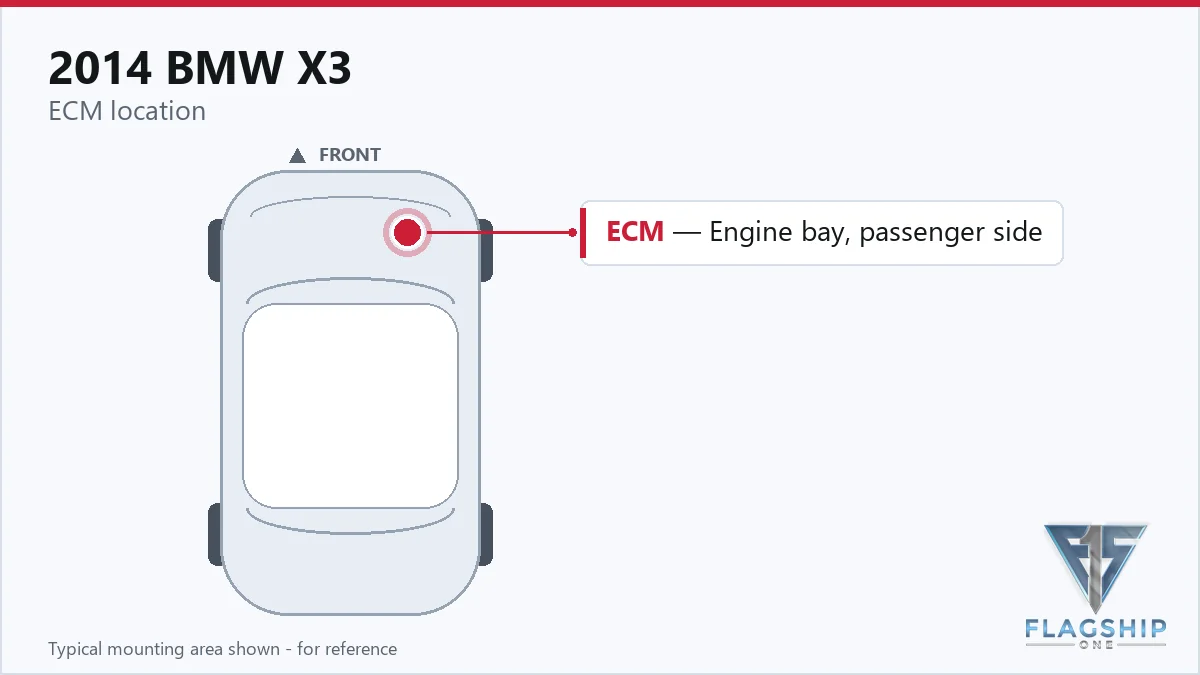
Work with the ignition off, and treat the module as static-sensitive: avoid touching the connector pins at any point.
| Operation | Configuration | Book Time |
|---|---|---|
| Powertrain Control Module R&R | All configurations | 1.5 hr |
| Engine Control Module R&R | 3.0L | 2.9 hr |
| Engine Control Module R&R | GAS | 1.5 hr |
| Engine Control Module Relearn | All configurations | 0.5 hr |
The factory replacement procedure for your 2014 BMW X3 PCM includes mandatory programming and encoding steps after the physical installation is complete. If the previous defective module retained readable data, that information may transfer to the replacement unit. However, when no data can be extracted from the old module, injection quantity compensation becomes necessary as part of the post-installation process. This calibration ensures your 2.0L turbocharged engine receives proper fuel delivery values, a critical requirement for maintaining engine performance and preventing drivability issues. The relearn procedure accounts for an additional 0.5 hours of labor beyond the physical replacement. Flagship One addresses this requirement by shipping units pre-programmed with your specific vehicle identification number, meaning the time-consuming encoding steps may already be completed when your replacement arrives. This approach eliminates waiting for programming at a dealership or specialty shop and allows the installation to proceed with just the relearn verification procedure if all connections are sound.
Every VIN-programmed replacement unit from Flagship One arrives with these steps already completed.
Powertrain Control Module failures on the 2014 BMW X3 2.0L typically announce themselves through multiple distinct warning signs that may appear individually or in combination. A no-start condition where the engine cranks but refuses to fire often indicates the PCM has stopped sending fuel injector or ignition commands. Intermittent stalling during acceleration or at idle suggests the module has lost reliable communication with critical sensors like the crankshaft position indicator. Persistent check engine lights that illuminate even after replacing oxygen sensors or catalytic converters frequently point toward module-internal faults or corrupted calibration data. Transmission shifting problems such as harsh engagements or failure to shift out of a particular gear may occur because the PCM coordinates with the transmission control unit. Some owners report complete communication failure where scan tools cannot establish contact with the engine computer at all. Dead bus communication often indicates the module has lost internal processing capability rather than suffering from external sensor faults. Addressing these symptoms promptly prevents secondary damage to other emission control components and restores your vehicle to reliable operation.
No factory service bulletin information was provided in the available documentation for the 2014 BMW X3 with the 2.0L turbocharged engine regarding Powertrain Control Module replacement procedures. This absence of published TSBs does not indicate that module failures do not occur on this vehicle, but rather that no widespread campaign addressing a specific failure mode has been issued by the manufacturer. Owners experiencing persistent drivability concerns that resist conventional diagnosis should still pursue module evaluation as a potential root cause regardless of TSB status.
Physical replacement can be performed by a qualified independent shop or experienced DIY technician, but programming the replacement module typically requires BMW-compatible diagnostic equipment. Units from Flagship One arrive pre-programmed with your VIN, which may eliminate the need for dealer programming depending on your specific situation.
Diagnostic steps involve checking for multiple unrelated fault codes, verifying proper sensor operation with a known-good module, and confirming that scan tool communication remains stable. If multiple sensors show implausible data simultaneously while wiring checks out, the module itself often bears responsibility.
Used modules typically require reprogramming to match your specific vehicle identification number and configuration, and their service history remains unknown. Pre-programmed replacements from reputable suppliers arrive ready to install, reducing downtime and eliminating uncertainty about the module’s condition.
The factory procedure specifies injection quantity compensation as a required step when the previous module data cannot be retrieved. This calibration process ensures your engine receives proper fuel delivery values for the replacement unit to manage effectively.
The factory service documentation explicitly requires ESD protection precautions during removal and installation of control units. Static discharge can damage sensitive electronic components before or during installation, potentially causing immediate or delayed failure of a new replacement module.
Choosing between repair and replacement for your 2014 BMW X3 Powertrain Control Module depends on your diagnostic findings, budget, and time constraints. Rebuilding an original module may cost less upfront but carries uncertainty about long-term reliability, while a quality replacement unit from Flagship One arrives ready to install with your VIN already programmed. Given the 1.5 hours of book labor plus relearn time required, professional installation ensures proper handling, connection verification, and system calibration. Weigh the costs of continued diagnosis against the certainty of known-good replacement hardware for your specific vehicle.
Flagship One stocks a refurbished, VIN-programmed PCM for the 2014 BMW X3 with a lifetime warranty, free shipping and no core charge. The full BMW X3 module lineup covers other engine configurations as well.
The Powertrain Control Module serves as the electronic nerve center of your 2014 BMW X3 with the 2.0L turbocharged engine, making its reliability essential for dependable operation. Understanding the access location in the plenum chamber, the programming requirements after installation, and the prevention steps that protect your investment empowers you to address failures decisively. Whether you pursue professional installation or handle the replacement yourself, a pre-programmed replacement unit for your specific BMW model eliminates one variable from the repair equation and gets you back on the road with confidence.