
Last updated on August 25th, 2026 at 12:57 pm
In the 2014 Audi TTS the Powertrain Control Module (PCM) and Engine Control Module (ECM) manage engine speed, fuel delivery and transmission shifting. Failure typically disables communication with the vehicle’s diagnostics, causing loss of power, stalling or gear‑selection problems.
When a 2014 Audi TTS begins to exhibit intermittent power loss, unexpected gear changes, or a complete no‑start condition, the electronic brain of the vehicle is often at fault. The Powertrain Control Module and Engine Control Module work together to interpret sensor data and command the engine and transmission. Understanding how these computers operate, where they sit, and what factory procedures are required after replacement can help you decide between a repair or a refurbished swap. This guide walks you through the module’s role, its location, the labor involved, and how Flagship One products simplify the programming phase, giving you confidence in the next step for your vehicle.
The Powertrain Control Module in the 2014 Audi TTS gathers inputs from the throttle, crankshaft, and transmission sensors to calculate fuel injection timing, ignition spark, and shift points. It also stores diagnostic trouble codes and communicates with the vehicle’s infotainment system. The Engine Control Module performs a similar function focused on engine‑specific parameters, handling idle control, emissions monitoring, and engine‑brake integration. Together they ensure smooth acceleration, efficient fuel use, and compliance with emissions standards. When either unit loses its calibration or suffers internal damage, the vehicle may experience no‑start, rough idle, or erratic shifting. Maintaining accurate programming is critical because the PCM and ECM reference each other for coordinated operation. A properly installed replacement PCM for 2014 Audi TTS restores the electronic link between powertrain components and the driver‑assist systems.
2014 Audi TTS
OEM programmed ECM for your 2014 Audi TTS — plug & play, no dealer visit.
Free shipping · Lifetime warranty
Both the PCM and ECM are reached through the factory removal procedure that opens the plenum chamber at the base of the windshield. Technicians first remove the windshield trim and the lower cowl to expose the chamber. The modules are bolted in place and secured with torque specifications outlined in the service manual; however, only the labor times are provided here. Replacing the PCM typically requires 1.3 hours of work, while the ECM replacement also calls for 1.3 hours. After the unit is seated, the fasteners are torqued to the factory‑specified values before the cowl and trim are reinstalled. The access path means the modules are protected from road debris but also makes removal a moderate‑complexity task.
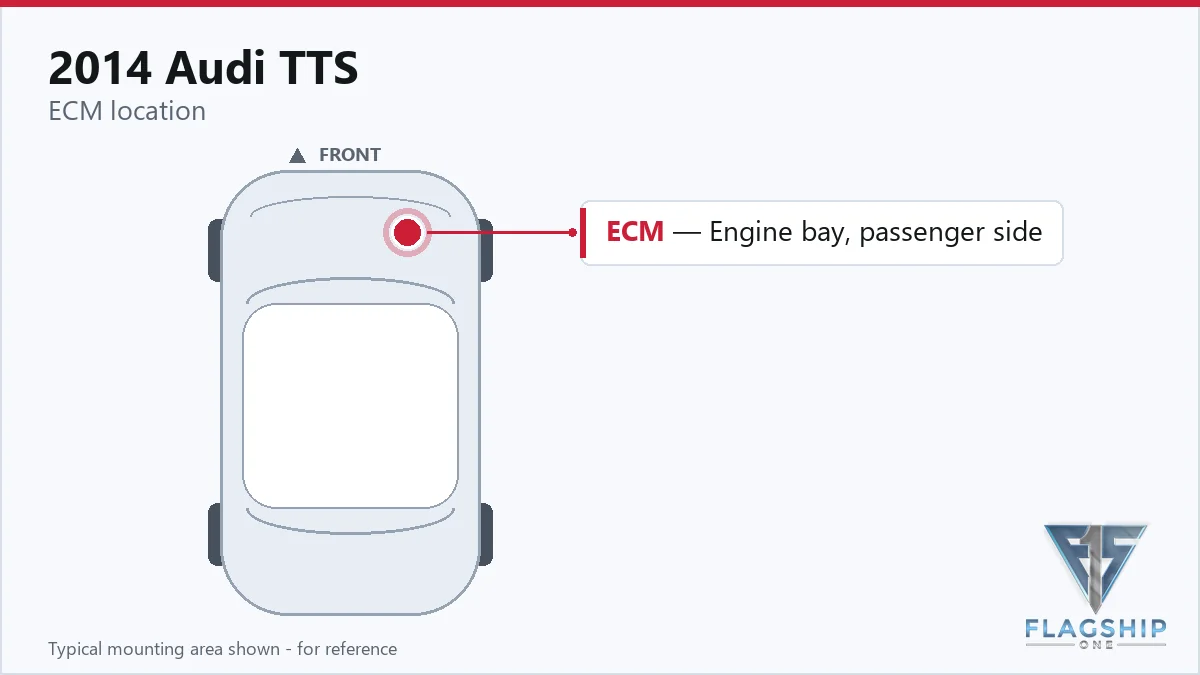
Work with the ignition off, and treat the module as static-sensitive: avoid touching the connector pins at any point.
| Operation | Configuration | Book Time |
|---|---|---|
| Powertrain Control Module R&R | All configurations | 1.3 hr |
| Powertrain Control Module Relearn | All configurations | 0.5 hr |
| Engine Control Module Relearn | All configurations | 0.5 hr |
| Engine Control Module Reset | All configurations | 0.3 hr |
| Engine Control Module R&R | All configurations | 1.3 hr |
Once the new module is physically installed, the factory service procedure calls for a Powertrain Control Module relearn of 0.5 hours and an Engine Control Module relearn of another 0.5 hours, plus an additional Engine Control Module reset of 0.3 hours. Flagship One supplies a a VIN-programmed replacement unit that arrives already matched to your vehicle’s identification, so those relearn and reset steps are completed at the factory and do not need to be performed in the shop. This eliminates the need for a dealer‑level programming session and reduces the overall turnaround time for your repair.
Typical signs of a failing PCM or ECM in the 2014 Audi TTS include a complete lack of engine cranking, sudden stalling while driving, irregular shifting patterns, and the illumination of the check‑engine light with codes related to communication failures. Drivers may also notice rough idle or misfire events that appear without obvious mechanical causes. When the control module cannot talk to the diagnostic scanner, a fault such as P0601 communication fault may be logged, indicating a breakdown in the internal data exchange that prevents the vehicle from operating correctly.
The factory labor guide lists 1.3 hours for removal and reinstall of the Powertrain Control Module.
Yes, the service procedure includes a 0.5‑hour relearn for the Engine Control Module and a 0.3‑hour reset.
Flagship One units arrive pre‑programmed to match your vehicle’s VIN, so the post‑install relearn steps are already completed.
It is accessed through the plenum chamber at the base of the windshield after removing the lower cowl and trim.
Common signs are no‑start conditions, erratic shifting, rough idle, and diagnostic codes such as P0601 that point to communication faults.
When the PCM or ECM in your 2014 Audi TTS shows signs of failure, you can choose a repair that restores the original unit or opt for a refurbished replacement from Flagship One. Both approaches address the underlying electronic issue, but a VIN‑programmed unit removes the need for additional coding steps, potentially saving time and cost while keeping your vehicle’s performance intact.
Flagship One stocks a refurbished, VIN-programmed PCM for the 2014 Audi TTS with a lifetime warranty, free shipping and no core charge. The full Audi TTS module lineup covers other engine configurations as well.
The 2014 Audi TTS relies on its PCM and ECM for smooth power delivery and reliable shifting. Whether you repair the original or install a Flagship One replacement, ensuring proper installation and programming will keep your vehicle operating as intended. Consider your options and choose the path that best fits your service needs.