
Last updated on August 25th, 2026 at 11:48 am
The engine control module in the 2013 Volkswagen Jetta Hybrid manages fuel delivery, ignition timing, and emissions while coordinating with the hybrid system. When it fails, the vehicle may not start, stall unexpectedly, or lose communication with diagnostic tools.
If your 2013 Volkswagen Jetta Hybrid is experiencing unexplained stalling, a no-start condition, or communication errors with diagnostic equipment, the engine control module (ECM) may be at fault. This compact computer is the brain of your vehicle’s engine management system, and when it malfunctions, it can trigger a range of driveability issues. Understanding the symptoms, replacement process, and programming requirements can help you make an informed repair decision. This guide covers the location of the ECM, the labor involved in swapping it, and the critical programming steps needed after installation. You’ll also learn about common trouble codes and how a pre-programmed replacement unit can simplify the job. Whether you’re a DIY mechanic or working with a shop, knowing what to expect can save time and prevent unnecessary parts swapping. The 2013 Jetta Hybrid’s ECM is integrated with the vehicle’s hybrid powertrain, so proper diagnosis and replacement are essential to restore performance and fuel efficiency.
The engine control module in the 2013 Volkswagen Jetta Hybrid orchestrates fuel delivery, ignition timing, and emissions controls while coordinating with the hybrid system. When this component degrades, it can lead to poor fuel economy, hesitation, or a complete no-start. Replacing it requires a replacement ECM for the Jetta Hybrid that matches the vehicle’s VIN and software calibration. Without a properly functioning ECM, the hybrid powertrain cannot manage the transition between electric and gasoline power, leading to drivability concerns and potential damage to other components. The module processes data from numerous sensors—including the mass airflow sensor, oxygen sensors, and throttle position sensor—to adjust fuel mixture and ignition timing in real time. It also communicates with the transmission control module to ensure smooth gear changes and optimal hybrid battery charging. Because the ECM is so central to vehicle operation, any internal fault can trigger limp-home mode or prevent the engine from starting altogether.
2013 Volkswagen Jetta Hybrid
OEM programmed ECM for your 2013 Volkswagen Jetta Hybrid — plug & play, no dealer visit.
Free shipping · Lifetime warranty
The factory component-location overview places the engine control module next to the engine compartment E-box on the left side. Accessing the ECM involves opening the hood and locating the E-box on the driver’s side. The module is secured with fasteners and electrical connectors that must be carefully disconnected. After physically swapping the unit, a relearn procedure is necessary to synchronize the new module with the vehicle’s immobilizer and hybrid systems. This relearn adds 0.5 hours to the job. For the powertrain control module, a similar process requires 1.0 hour for R&R and 0.5 hours for relearn. Proper handling is important to avoid static damage to the sensitive electronics. Always disconnect the battery before starting work.
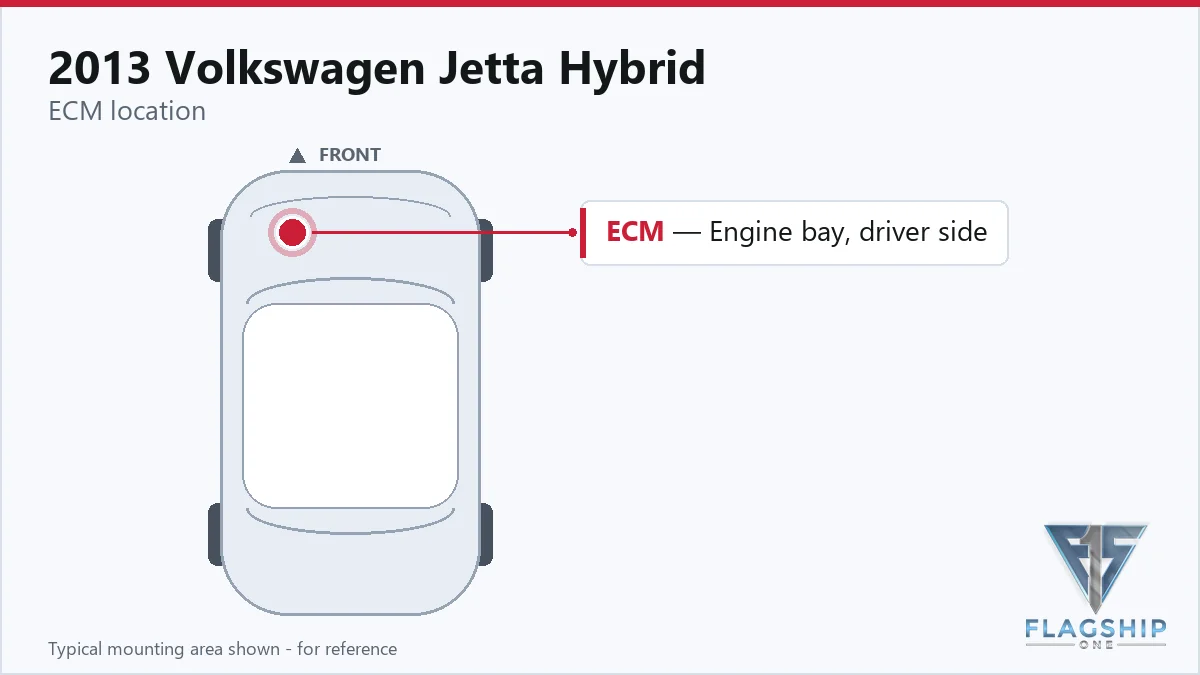
Work with the ignition off, and treat the module as static-sensitive: avoid touching the connector pins at any point.
| Operation | Configuration | Book Time |
|---|---|---|
| Engine Control Module R&R | All configurations | 1.0 hr |
| Engine Control Module Relearn | All configurations | 0.5 hr |
| Powertrain Control Module Relearn | All configurations | 0.5 hr |
| Powertrain Control Module R&R | All configurations | 1.0 hr |
After installing a replacement engine control module in the 2013 Jetta Hybrid, the factory service manual specifies a relearn procedure to sync the module with the vehicle’s security and powertrain systems. This typically requires a professional scan tool and can add 0.5 hours of labor. However, when you order a pre-programmed ECM from Flagship One, the unit is already configured with your VIN and immobilizer data, so the relearn is already completed. This plug-and-play approach eliminates the need for a separate programming step, saving time and potential trip charges to a dealer or specialist.
A failing engine control module in the 2013 Volkswagen Jetta Hybrid often produces symptoms like intermittent stalling, a no-start condition, or the engine cranking but not firing. You may notice the check engine light illuminated with codes such as control module programming error stored in memory. Other signs include poor fuel economy, rough idling, or the transmission refusing to shift properly. In hybrid models, the vehicle may fail to transition between electric and gasoline modes, or the hybrid system warning light may appear. Because the ECM manages critical engine functions, any internal fault can also cause a loss of communication with the scan tool, making diagnosis difficult. If you experience multiple, seemingly unrelated electrical issues, the ECM could be the common denominator. Ignoring these symptoms can lead to more severe damage or leave you stranded.
The 2013 Volkswagen Jetta Hybrid’s engine control module can log several internal fault codes that point directly to a failing unit. The following DTCs are commonly associated with ECM hardware or software issues in this model:
Common symptoms include a no-start condition, intermittent stalling, poor fuel economy, and communication errors with diagnostic tools. You may also see specific internal fault codes like P0602 or P0604.
Yes, the factory procedure requires a relearn process to sync the module with the vehicle’s immobilizer and hybrid system. However, a pre-programmed unit from Flagship One arrives with this step already completed, so no additional programming is needed.
The ECM is situated next to the engine compartment E-box on the left side. Accessing it typically involves removing the E-box cover and disconnecting the electrical connectors.
When your Jetta Hybrid’s ECM fails, you have two main options: dealer replacement and programming, which can be costly and time-consuming, or a pre-programmed unit from Flagship One that arrives ready to install. Our VIN-programmed modules are configured to your specific vehicle, eliminating the need for a separate programming step. This plug-and-play solution gets you back on the road faster, with the confidence that your module is calibrated to factory specifications.
Flagship One stocks a refurbished, VIN-programmed PCM for the 2013 Volkswagen Jetta Hybrid with a lifetime warranty, free shipping and no core charge. The full Volkswagen Jetta Hybrid module lineup covers other engine configurations as well.
If your 2013 Volkswagen Jetta Hybrid is showing signs of ECM failure, don’t let a faulty module keep you off the road. A properly programmed replacement can restore performance and reliability. Consider a pre-programmed unit to simplify the repair and avoid complex dealer programming. With the right part and straightforward installation, you can resolve those frustrating driveability issues and get back to enjoying your hybrid’s efficiency.