
Last updated on August 25th, 2026 at 11:49 am
The engine control module on the 2012 Volkswagen Jetta manages fuel delivery, ignition timing, and emissions functions; when it fails, the vehicle can experience a no‑start condition, rough idle, or stored fault codes because the processor can no longer execute its control algorithms.
When the 2012 Volkswagen Jetta begins to exhibit a no‑start condition, rough idle, or unexpected fault codes, the engine control module is often the first component technicians examine. This module governs fuel injection, ignition timing, and emissions strategies, so any internal fault can quickly affect drivability. Understanding the factory‑specified labor times, the module’s mounting location, and the required post‑install programming steps helps you plan the repair efficiently. The following sections outline the module’s role, where it lives in the engine bay, the book hours for removal and relearn, and the service bulletins that address common software‑related issues. With this information you can decide whether a bench repair, a refurbished unit, or a new replacement best fits your situation and avoid unnecessary downtime.
The engine control module in the 2012 Volkswagen Jetta acts as the central processor for the powertrain, coordinating fuel delivery, spark advance, and emission control loops based on sensor inputs. When the processor loses communication or its internal memory becomes corrupted, the vehicle may refuse to start, run rough, or set multiple diagnostic trouble codes. Because the module also stores adaptive learning values, a replacement must restore those parameters for the engine to operate smoothly. The factory service information notes that the module is mounted inside the plenum chamber on the right side, which means access requires removing the intake ducting and disconnecting several connectors. Technicians should plan for the listed removal and installation time of 1.0 hour and a relearn period of 0.5 hour, and they should also be aware of the related powertrain control module procedures that mirror these times. Using a replacement engine computers for the Jetta that arrives pre‑programmed to the vehicle identification number can eliminate the separate relearn steps and reduce overall shop time.
2012 Volkswagen Jetta
OEM programmed ECM for your 2012 Volkswagen Jetta — plug & play, no dealer visit.
Free shipping · Lifetime warranty
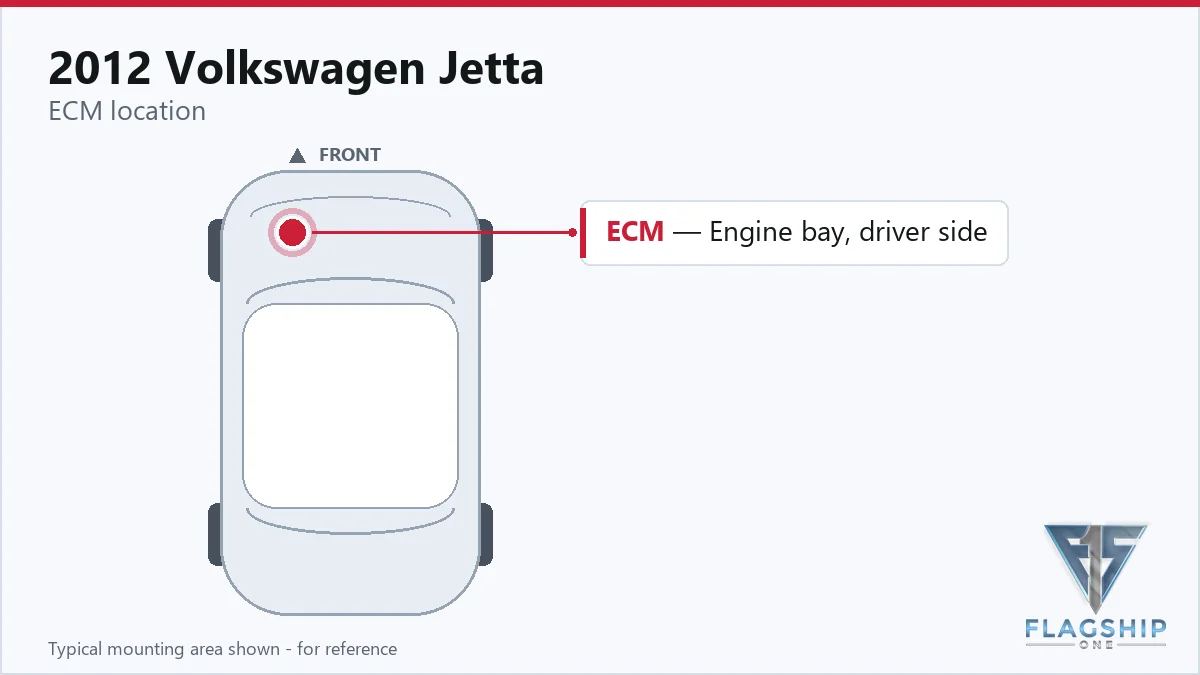
The engine control module for the 2012 Volkswagen Jetta is positioned inside the plenum chamber on the right side of the engine bay. To reach it, the intake duct and any retaining clips must be removed, then the electrical connectors are unplugged before the module can be unbolted. The factory labor guide assigns 1.0 hour for the removal and installation of the module itself, and an additional 0.5 hour for the required relearn procedure after the new unit is fitted. If the vehicle also uses a separate powertrain control module, the same 1.0 hour removal and 0.5 hour relearn times apply to that unit. No torque specifications are published for the mounting bolts, so a standard hand‑tight approach followed by a final snug turn is typical. Keeping the connector seals clean during disassembly helps prevent moisture intrusion that could cause future communication faults.
Work with the ignition off, and treat the module as static-sensitive: avoid touching the connector pins at any point.
| Operation | Configuration | Book Time |
|---|---|---|
| Engine Control Module R&R | All configurations | 1.0 hr |
| Engine Control Module Relearn | All configurations | 0.5 hr |
| Powertrain Control Module Relearn | All configurations | 0.5 hr |
| Powertrain Control Module R&R | All configurations | 1.0 hr |
After a new engine control module is installed, the factory procedure calls for a relearn sequence that lasts 0.5 hour and for any stored diagnostic trouble codes to be cleared from the ECM memory. The same relearn and code‑clear steps apply to the powertrain control module if it is replaced. Because Flagship One supplies a a VIN‑programmed replacement unit that already contains the correct vehicle identification data, the relearn and DTC‑erasure steps are completed before the part ships, allowing the technician to finish the job with only the physical installation time. This approach reduces the chance of a post‑repair check engine light and shortens overall bay time.
Typical signs that the engine control module on a 2012 Volkswagen Jetta is failing include a sudden no‑start condition, intermittent stalling while driving, and a rough idle that does not smooth out after warm‑up. The check engine light may illuminate and the scan tool can reveal multiple misfire codes, fuel‑system codes, or communication loss codes. In many cases the module will set a random misfire code along with other related codes such as P0102 or P0420, indicating that the processor can no longer manage combustion accurately. Shifting irregularities are less common but can appear if the powertrain control module shares data with the ECM. Because these symptoms overlap with other fuel or ignition faults, confirming the module’s health with a dedicated bench test or by monitoring live data is advisable before committing to replacement.
Two factory service bulletins address software‑related issues for the 2012 Volkswagen Jetta engine control module. Bulletin 24‑11‑05 describes a procedure for erasing diagnostic trouble codes from the ECM memory on vehicles equipped with UDS communication, which can resolve persistent fault codes after a repair. Bulletin 01‑09‑09 provides an update programming routine that clears a set of codes including P0300 through P0304, P0102, P1297, P0420, and P0441 when the malfunction indicator lamp is illuminated. Both bulletins emphasize that the programming steps must be performed with a factory‑level scan tool to ensure the module’s adaptive values are correctly reset. Technicians should verify whether the vehicle’s build date falls within the applicability range before applying the updates.
| Bulletin | Subject | What It Addresses |
|---|---|---|
| 24-11-05 | TT 24-11-05 2011> Vehicles with UDS communication Engine Control Modules – Erasing DTCs in t | — |
| 01-09-09 | Attachment: 01-09-09 – Update Programming, MIL ON, DTCs P0300-P0304, P0102, P1297, P0420 and P0 | — |
The factory labor guide lists 1.0 hour for removal and installation of the module, plus an additional 0.5 hour for the required relearn procedure. If a separate powertrain control module is also replaced, the same times apply to that unit.
Yes, the factory procedure requires a 0.5 hour relearn and clearing of any stored DTCs after the new module is fitted. Using a pre‑programmed replacement can eliminate this step because the adaptive data is already loaded.
A VIN‑programmed module arrives with the correct vehicle identification data, so the relearn and DTC‑erasure steps are already completed. The technician only needs to perform the physical installation, saving the 0.5 hour relearn time.
Choosing between a bench repair, a refurbished unit, or a new replacement depends on the severity of the fault and the shop’s equipment. A refurbished module that arrives already programmed to your 2012 Volkswagen Jetta can save the 0.5 hour relearn and the DTC‑clear steps, while a new unit offers the same benefit with a fresh warranty. Weigh the cost difference against the labor savings to decide the most efficient path for your repair.
Flagship One stocks a refurbished, VIN-programmed PCM for the 2012 Volkswagen Jetta with a lifetime warranty, free shipping and no core charge. The full Volkswagen Jetta module lineup covers other engine configurations as well.
The 2012 Volkswagen Jetta’s engine control module is a critical component that can be serviced with predictable labor times and well‑documented programming steps. By following the factory relearn procedure or using a pre‑programmed replacement, you can restore reliable operation without unnecessary delays. If you need a unit that matches your vehicle’s VIN, consider a source that provides ready‑to‑install modules for your shop.