
Last updated on August 25th, 2026 at 12:38 pm
The Engine Control Module in your 2011 Mercedes-Benz ML-Class is the primary computer managing fuel delivery, turbocharger operation, emissions systems, and transmission shifting. When this unit fails, your diesel-powered vehicle may exhibit starting problems, poor acceleration, or trigger protective limp-home mode to prevent drivetrain damage.
If your 2011 Mercedes-Benz ML-Class equipped with the 3.0L diesel engine has developed starting problems, irregular idle behavior, or unexpected power loss, the Engine Control Module may be the culprit. This comprehensive guide explains what the ECM does in your specific vehicle, how replacement works, what programming involves, and what symptoms to watch for before the problem worsens. Understanding the role of this critical control unit helps you make informed repair decisions and avoid unnecessary parts-swapping. Whether you are diagnosing a check engine light or planning a replacement, the information below gives you a clear picture of the process, timeline, and considerations for the ML-Class diesel application. You will learn exactly where this unit lives under the hood, what labor is involved, and why post-replacement programming matters for proper vehicle operation.
The Engine Control Module in your 2011 Mercedes-Benz ML-Class is the central processing hub governing all major engine functions on the 3.0L turbocharged diesel powerplant. Mercedes-Benz designates this particular control unit as the ME 9.7, and it handles fuel injection timing, exhaust gas recirculation rates, particulate filter regeneration cycles, and torque management coordination with the automatic transmission. This is not simply a fuel injector controller; the module continuously monitors dozens of sensors including mass airflow, exhaust gas temperature, manifold absolute pressure, and crankshaft position to maintain optimal combustion efficiency across all driving conditions. When you press the accelerator, the ME 9.7 calculates injection volume and timing within milliseconds, balancing power output against emissions compliance and fuel economy. The module also manages communication with the transmission control unit through the CAN bus network, ensuring gear changes occur at precisely the right engine speed and load parameters. Given the complexity of diesel emissions systems on this generation of Mercedes vehicles, the Engine Control Module essentially serves as the brain of the entire powertrain. A failing or internally corrupted module can cause your vehicle to enter reduced-power mode, prevent regeneration of the diesel particulate filter, or trigger cascading failures in related control units connected on the same network. Replacement engine computers for the ML-Class must be matched to the correct hardware revision and software calibration to restore full functionality without triggering compatibility faults. The ME 9.7 integrates so deeply with emissions monitoring that even minor calibration drift can cause your vehicle to fail emissions testing or illuminate the check engine light permanently.
Flagship One keeps Mercedes-Benz ML-Class replacement engine computers in stock for exactly this failure pattern.
2011 Mercedes-Benz ML-Class
OEM programmed ECM for your 2011 Mercedes-Benz ML-Class — plug & play, no dealer visit.
Free shipping · Lifetime warranty
Reaching the Engine Control Module on the 2011 Mercedes-Benz ML-Class requires working from the engine bay rather than through the cabin. The ME 9.7 control unit is positioned on the intake manifold supporting the engine, meaning technicians access it from above after removing the engine cover and any associated ductwork or plastic trim panels blocking the top of the motor. This mounting location places the module in a relatively protected environment compared to interior placements, but it sits near heat sources from the turbocharger and exhaust manifold, which contributes to long-term thermal stress on the unit’s internal circuitry. Replacement involves disconnecting the battery ground cable first, then unpluging the electrical harness from the module, removing the mounting fasteners, and lifting the old unit free. Installation reverses this sequence with the new module seated on the same mounting points. For the diesel engine in your ML-Class, factory book time assigns 0.6 hours for the ECM removal and reinstallation procedure. After the physical replacement, an additional 0.5 hours is allocated for the relearn procedure that re-establishes communication between the new module and the rest of the vehicle network. Total hands-on time at a professional shop typically falls within these published labor ranges assuming no unexpected complications with corroded connectors or stripped fasteners.
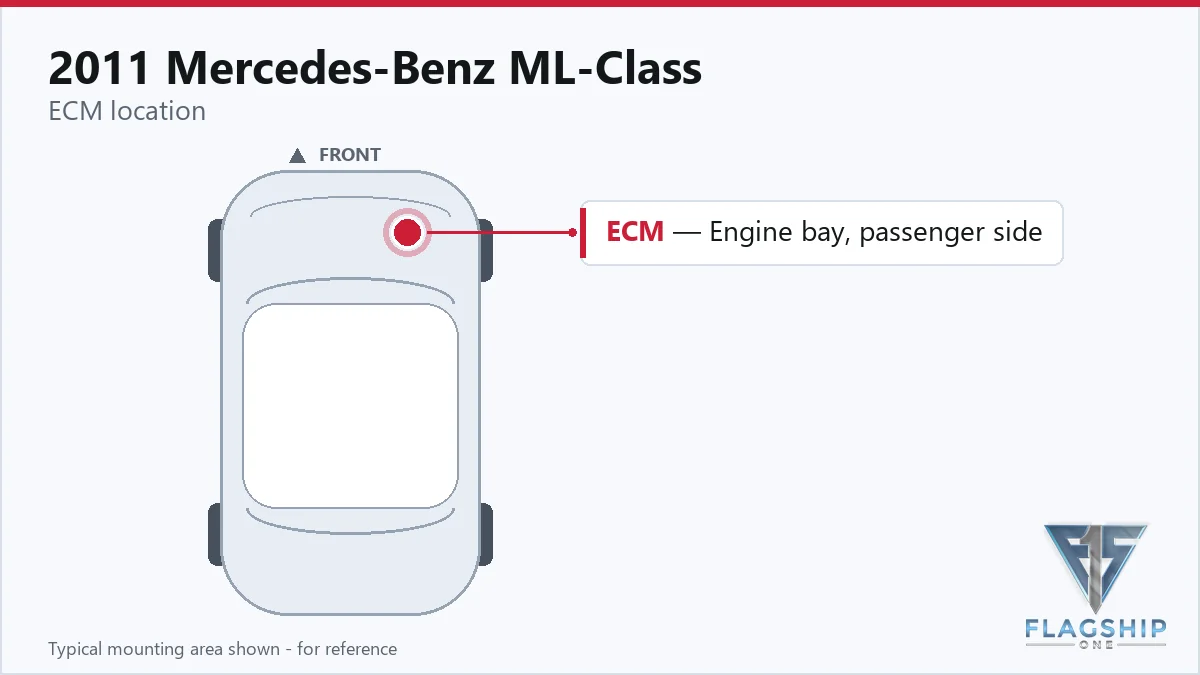
Work with the ignition off, and treat the module as static-sensitive: avoid touching the connector pins at any point.
| Operation | Configuration | Book Time |
|---|---|---|
| Engine Control Module R&R | GAS | 0.5 hr |
| Engine Control Module R&R | DIESEL | 0.6 hr |
| Engine Control Module Relearn | All configurations | 0.5 hr |
| Powertrain Control Module R&R | All configurations | 0.5 hr |
Once the new Engine Control Module is physically installed in your 2011 Mercedes-Benz ML-Class, the vehicle requires a programming session to configure it for your specific automobile. The factory service procedure involves connecting diagnostic equipment to establish communication with the replacement unit, then uploading the correct vehicle-specific calibration data including your exact VIN, optional equipment codes, and emissions configurations. This process ensures the new module recognizes your transmission, understands your powertrain specifications, and can properly communicate with other control units on the CAN network. Without completing this step, the engine may run poorly, the transmission may fail to shift correctly, and dashboard warning lights will likely remain illuminated. Flagship One addresses this requirement by shipping replacement units with your VIN already programmed into the module before it leaves the warehouse. This pre-programming means you or your mechanic can complete the physical installation and then perform only the post-installation relearn procedure, skipping the more involved dealer programming appointment. The relearn itself allows the vehicle systems to recognize the new hardware as valid and synchronize adaptive fuel trims and transmission clutch apply schedules to the fresh control unit.
Every VIN-programmed replacement unit from Flagship One arrives with these steps already completed.
When the ME 9.7 Engine Control Module begins to fail on your 2011 Mercedes-Benz ML-Class, the symptoms often develop gradually and may initially appear unrelated to the engine computer itself. Common presentations include hard starting or extended cranking before the engine fires, particularly in cold weather conditions when the module must command precise glow plug activation and injection timing. You might notice the engine stalls unexpectedly at idle or during low-speed maneuvering, sometimes without warning and occasionally with enough force to require a tow. Misfire-type trouble codes such as P0300 through P0304 frequently appear when the module incorrectly commands fuel delivery to individual cylinders, even though the underlying fuel system components are functioning normally. Another hallmark symptom involves the transmission refusing to shift properly or engaging harshly, because the module responsible for coordinating shift solenoids has lost the ability to send correct commands. In more severe cases, the module may lose communication entirely with diagnostic scan tools, preventing technicians from reading any codes or live data from the affected unit. The check engine light may illuminate continuously or flash intermittently depending on whether the fault is active or stored. If you encounter MEMORY CHECKSUM INTERNAL FAULT, this specifically indicates the module has detected a failure within its own memory circuitry and replacement is necessary rather than repair. Loss of critical data such as adaptation values, odometer information stored in the module, or immobilizer key recognition codes may also occur with complete module failure, requiring additional reconfiguration steps beyond simple replacement.
The physical replacement of the ECM on your ML-Class requires approximately 0.6 hours of labor based on factory book time. Following installation, plan for an additional 0.5 hours to complete the relearn procedure. Total time at a qualified shop typically falls within a single business day if no unexpected complications arise with connectors or programming.
If you source a replacement module from the dealer, yes, you will need a dealer programming appointment to configure it with your vehicle’s specific calibration data. However, units from Flagship One arrive pre-programmed with your VIN already configured, allowing your mechanic to complete the installation and perform the standard relearn procedure without dealer involvement.
Yes, the ME 9.7 module coordinates shift commands with the transmission control unit through the CAN bus network. When the engine computer fails or sends incorrect signals, the transmission may shift harshly, refuse to shift at all, or default to limp-home mode limiting you to third gear only.
Common failure causes include thermal stress from the hot mounting location near the turbocharger, voltage spikes from charging system faults, moisture intrusion at electrical connectors, and normal wear of internal electronic components over time and mileage. Age and cumulative heat exposure are the primary factors on vehicles of this era.
A used module from another vehicle would require reprogramming at significant expense and may not accept the correct calibration for your specific model year and equipment package. Additionally, used units carry unknown histories of prior faults or heat damage. A new or professionally refurbished replacement with proper programming eliminates these uncertainties.
Repairing your 2011 Mercedes-Benz ML-Class ECM involves choosing between having your original module professionally rebuilt or installing a ready-to-run replacement unit. Rebuilt modules offer a middle-ground cost option but still require programming before installation. Pre-programmed replacement units arrive ready to install, reducing shop time and eliminating the need for separate programming appointments. Consider your timeline, budget, and mechanic’s capabilities when deciding which approach fits your situation. Flagship One stocks replacement Engine Control Modules configured specifically for this Mercedes application, so you can complete the repair with confidence in proper fit and function.
Flagship One stocks a refurbished, VIN-programmed PCM for the 2011 Mercedes-Benz ML-Class with a lifetime warranty, free shipping and no core charge. The full Mercedes-Benz ML-Class module lineup covers other engine configurations as well.
The Engine Control Module on your 2011 Mercedes-Benz ML-Class performs essential functions across the entire powertrain, and failure can leave you stranded or in costly limp-home mode. Understanding its location on the intake manifold, the labor involved in replacement, and the mandatory post-installation steps prepares you for informed conversations with your mechanic or parts supplier. Whether you choose repair or replacement, addressing ECM problems promptly prevents cascading issues in related vehicle systems and restores full driving capability to your Mercedes-Benz diesel.