
Last updated on August 25th, 2026 at 12:38 pm
The Engine Control Module (ECM) in your 2011 Mercedes-Benz GLK-Class manages fuel delivery, ignition timing, and emissions systems. Failure may cause erratic engine behavior, no-start conditions, or stored trouble codes related to sensor processing.
If your 2011 Mercedes-Benz GLK-Class hesitates to start, stalls unexpectedly, or triggers a check-engine light, the Engine Control Module (ECM) may be the culprit. This critical component governs how your engine runs, from fuel injection to spark timing. Replacing it involves more than swapping hardware—proper programming ensures seamless operation. Understanding the process helps you avoid unnecessary delays and costs. Here’s what you need to know about diagnosing, replacing, and preventing ECM issues in your GLK-Class.
The ECM in your 2011 Mercedes-Benz GLK-Class acts as the brain of the engine, interpreting signals from sensors to optimize performance and emissions. It adjusts fuel mixtures, ignition timing, and idle speed in real time. A faulty ECM may disrupt these functions, leading to poor drivability or even a no-start condition. When replacement becomes necessary, choosing replacement engine computers for the GLK-Class ensures compatibility and proper calibration for your vehicle’s 3.5L engine.
2011 Mercedes-Benz GLK-Class
OEM programmed ECM for your 2011 Mercedes-Benz GLK-Class — plug & play, no dealer visit.
Free shipping · Lifetime warranty
The ECM in your 2011 Mercedes-Benz GLK-Class is secured to the intake manifold, positioned centrally for efficient sensor connectivity. Replacement begins with disconnecting the battery to prevent electrical issues. The module is accessed by removing the intake manifold cover and unplugging the wiring harness. Labor guides estimate 0.9 hours for removal and reinstallation, with an additional 0.5 hours for relearn procedures if required. No specialized tools are listed, but proper torque on mounting bolts is critical to avoid damage.
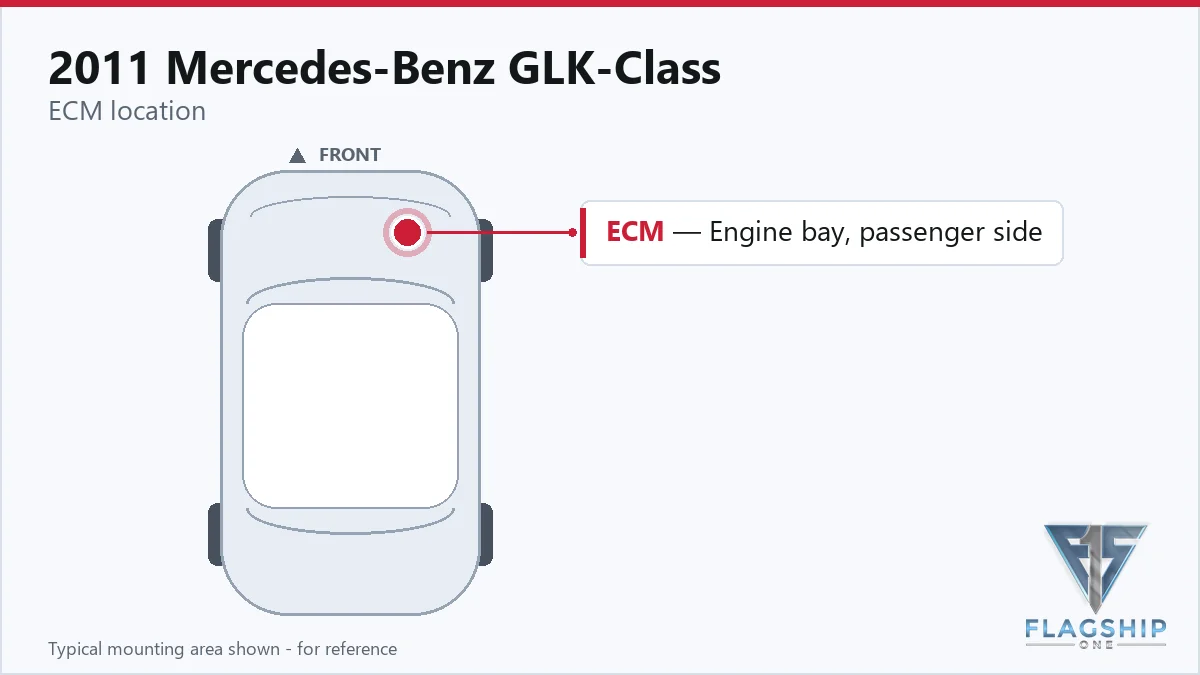
Work with the ignition off, and treat the module as static-sensitive: avoid touching the connector pins at any point.
| Operation | Configuration | Book Time |
|---|---|---|
| Engine Control Module R&R | All configurations | 0.9 hr |
| Engine Control Module Relearn | All configurations | 0.5 hr |
| Powertrain Control Module R&R | All configurations | 0.9 hr |
After installing a new ECM in your 2011 Mercedes-Benz GLK-Class, the factory procedure typically requires a software update and system relearn to synchronize the module with your vehicle’s sensors. This process may involve resetting the trip computer or performing a drive cycle to confirm proper operation. Flagship One provides a VIN-programmed replacement unit, eliminating the need for these additional steps and ensuring immediate functionality without dealer intervention.
A failing ECM in your 2011 Mercedes-Benz GLK-Class may cause a range of symptoms, including intermittent stalling, rough idling, or a complete no-start condition. You might also notice poor acceleration, misfires, or a check-engine light accompanied by codes like internal control module memory check sum error. In some cases, the vehicle may enter a limp-home mode, limiting power to prevent further damage. Scan tool communication failures are another red flag, often indicating a corrupted or unresponsive module.
Mercedes-Benz has issued service bulletins addressing ECM software updates for the 2011 GLK-Class. Bulletin S-B-07.61/89a and S-B-54.21/244a cover flashing procedures for all model years, while S-B-54.50/247 specifies resetting the trip computer after software updates for vehicles equipped with codes 801 (2011) or 802 (2012). These updates aim to resolve potential drivability issues and ensure compliance with emissions standards.
| Bulletin | Subject | What It Addresses |
|---|---|---|
| — | S-B-07.61/89a S-B-54.21/244a: Engine Control Module (N3/10) Flashing MY-All Models All | — |
| — | S-B-54.50/247: Reset Trip Computer After Software Update of ECU Models All with Code 801 MY2011 | — |
The ECM must synchronize with your vehicle’s sensors and immobilizer system. Factory procedures often require a software update and relearn process to ensure proper communication. Skipping this step may result in poor performance or a no-start condition.
While physically replacing the ECM is straightforward, programming it correctly requires specialized tools and software. A VIN-programmed unit simplifies the process by eliminating the need for dealer reprogramming.
Common signs include stalling, rough idling, or a no-start condition. A scan tool may reveal internal control module errors or communication failures. If symptoms persist after checking other components, the ECM may be the issue.
If your 2011 Mercedes-Benz GLK-Class is experiencing ECM-related issues, you have options. A dealer may recommend a new unit with programming, while aftermarket solutions offer cost-effective alternatives. A VIN-programmed replacement ensures compatibility and avoids additional dealer steps, getting your vehicle back on the road faster.
Flagship One stocks a refurbished, VIN-programmed PCM for the 2011 Mercedes-Benz GLK-Class with a lifetime warranty, free shipping and no core charge. The full Mercedes-Benz GLK-Class module lineup covers other engine configurations as well.
The ECM in your 2011 Mercedes-Benz GLK-Class plays a vital role in engine performance and reliability. Recognizing symptoms early and opting for a properly programmed replacement can save time and frustration. Whether you choose a dealer or an aftermarket solution, ensuring the module is calibrated to your VIN is key to restoring smooth operation.