
Last updated on August 25th, 2026 at 12:38 pm
The Engine Control Module (ECM) in your 2010 Mercedes-Benz G-Class manages fuel injection, ignition timing, and emissions systems. Failures may cause rough idling, stalling, or a complete no-start condition, often triggered by voltage spikes or corrosion in connectors.
If your 2010 Mercedes-Benz G-Class has been stalling unexpectedly, refusing to start, or illuminating the check engine light, the Engine Control Module (ECM) may be the culprit. This compact but critical computer oversees fuel delivery, ignition timing, and emissions systems, ensuring smooth operation. When it fails, symptoms can range from subtle drivability issues to a complete breakdown. Replacing the ECM isn’t just about swapping hardware—it requires precise programming to match your vehicle’s specifications. Understanding the module’s role, location, and the steps involved in replacement can help you make informed decisions, whether you’re diagnosing the problem or preparing for a repair. This guide covers what the ECM does, where to find it, common failure signs, and how a pre-programmed unit can simplify the process.
The Engine Control Module (ECM), also called the ME-SFI control unit, serves as the brain of your 2010 Mercedes-Benz G-Class’s engine management system. It continuously monitors sensors for air intake, throttle position, oxygen levels, and engine temperature, adjusting fuel injection and ignition timing in real time for optimal performance. This module also regulates emissions systems, ensuring compliance with environmental standards. A failing ECM may disrupt these processes, leading to poor fuel economy, rough idling, or even a vehicle that won’t start. Because the G-Class relies on this module for seamless operation, addressing ECM issues promptly is essential. If replacement becomes necessary, you’ll need replacement engine control modules for the G-Class, which must be programmed to your vehicle’s VIN to function correctly. Without proper calibration, the new unit may trigger additional fault codes or fail to communicate with other systems.
2010 Mercedes-Benz G-Class
OEM programmed ECM for your 2010 Mercedes-Benz G-Class — plug & play, no dealer visit.
Free shipping · Lifetime warranty
In the 2010 Mercedes-Benz G-Class, the ME-SFI control unit is mounted in the middle of the variable intake manifold. Accessing it requires removing the engine cover and disconnecting the intake components to reach the module’s position. The replacement process involves unplugging the electrical connector, removing the mounting bolts, and installing the new unit in reverse order. While the physical swap is straightforward, the location demands careful handling to avoid damaging nearby sensors or wiring. After installation, the module must be programmed to your vehicle’s VIN to ensure proper communication with the engine and other systems. This step is critical, as an unprogrammed unit will not function correctly and may cause additional issues.
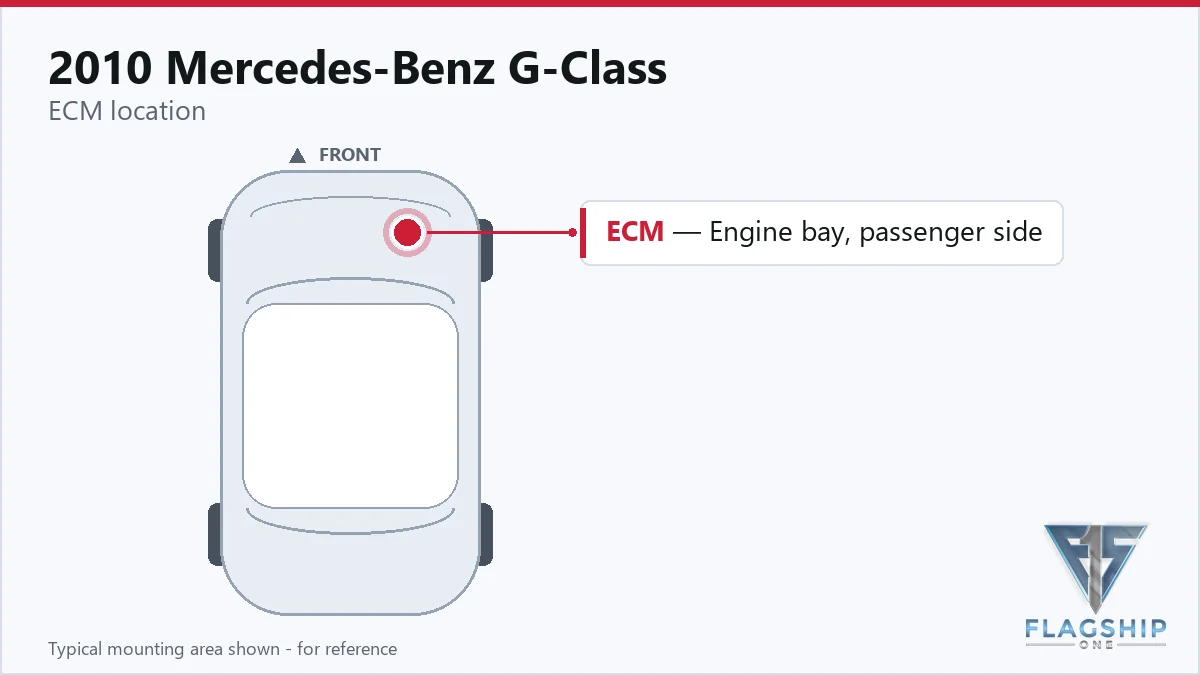
Work with the ignition off, and treat the module as static-sensitive: avoid touching the connector pins at any point.
After replacing the Engine Control Module in your 2010 Mercedes-Benz G-Class, the factory procedure requires VIN-specific programming to synchronize the new unit with the vehicle’s systems. This process ensures the ECM recognizes the engine’s specifications, transmission, and emissions components, allowing for seamless operation. Without programming, the module may fail to communicate with other control units, leading to drivability issues or stored fault codes. However, opting for a VIN-programmed replacement unit eliminates the need for this step, as the module arrives pre-configured to your vehicle’s exact requirements. This not only saves time but also reduces the risk of programming errors that could complicate the repair. Always verify that the replacement unit matches your G-Class’s engine configuration before installation.
A failing Engine Control Module in your 2010 Mercedes-Benz G-Class may produce a range of symptoms, often mimicking other engine or electrical issues. Common signs include intermittent stalling, especially at idle or during acceleration, as the module struggles to regulate fuel delivery. You might also notice rough idling, misfires, or a check engine light accompanied by stored codes like an air injection system fault. In some cases, the vehicle may crank but fail to start, indicating the ECM is not triggering the fuel pump or ignition system. Dead scan tool communication is another red flag, as the module may stop responding to diagnostic requests. Shifting issues, particularly in models with automatic transmissions, can also arise if the ECM fails to send proper signals to the transmission control unit. Because these symptoms overlap with other problems, such as sensor failures or wiring issues, a thorough diagnosis is essential before concluding the ECM is at fault.
Mercedes-Benz has issued several service bulletins addressing Engine Control Module (ECM) issues in the 2010 G-Class and related models. Bulletin S-B-07.61/89a and S-B-54.21/244a cover ECM flashing procedures for all model years, ensuring the module’s software is up to date to prevent drivability issues. Another bulletin, DTB-T-B-14.30/20b, specifically addresses check engine lights with fault codes 0810 or 0814 (P0410), which indicate air injection system malfunctions. This bulletin applies to G-Class models up to VIN A150065 and includes revised warranty operation codes for repairs. These bulletins highlight the importance of keeping the ECM’s software current and addressing stored codes promptly to avoid further complications.
| Bulletin | Subject | What It Addresses |
|---|---|---|
| — | S-B-07.61/89a S-B-54.21/244a: Engine Control Module (N3/10) Flashing MY-All Models All | — |
| — | DTB – T-B-14.30/20b: Check Engine Light On / Fault Codes 0810 0814 (P0410) Stored in Engine ECU | — |
If your G-Class cranks but won’t start after an ECM replacement, the module may not be properly programmed to your vehicle’s VIN. Without programming, the ECM cannot communicate with the fuel pump, ignition system, or other critical components. A VIN-programmed replacement unit eliminates this issue, as it arrives ready to sync with your vehicle’s systems.
Driving with a failing ECM is risky, as it may cause sudden stalling, misfires, or a complete loss of power. In some cases, the vehicle may not restart after shutting off. If you suspect ECM issues, have the module diagnosed and replaced promptly to avoid being stranded.
ECM failures often produce multiple symptoms, such as stalling, misfires, and dead scan tool communication. Sensor issues, on the other hand, typically trigger specific codes (e.g., oxygen sensor or throttle position sensor faults). A professional scan tool can help distinguish between the two by checking for ECM-specific codes or communication errors.
Reprogramming the ECM after a battery replacement is not typically required, as the module retains its programming. However, if the battery was disconnected for an extended period or the vehicle experienced voltage issues, the ECM may reset and require a relearn procedure for optimal performance.
Flashing refers to updating the ECM’s software to the latest version, often to address known issues or improve performance. Reprogramming, on the other hand, involves syncing the module to your vehicle’s VIN and specific configurations. Both processes require specialized equipment and should be performed by a professional to avoid errors.
If your 2010 Mercedes-Benz G-Class is experiencing ECM-related issues, you have two primary options: repair the existing module or replace it with a refurbished unit. While repairs may be cost-effective for minor issues, a replacement is often the more reliable choice for complete failures. Opting for a VIN-programmed replacement unit ensures the new ECM is ready to install, eliminating the need for post-install programming and reducing downtime. Consider your vehicle’s age, mileage, and the severity of the symptoms when deciding the best course of action.
Flagship One stocks a refurbished, VIN-programmed ECM for the 2010 Mercedes-Benz G-Class with a lifetime warranty, free shipping and no core charge. The full Mercedes-Benz G-Class module lineup covers other engine configurations as well.
The Engine Control Module in your 2010 Mercedes-Benz G-Class plays a vital role in keeping your vehicle running smoothly. When it fails, symptoms like stalling, misfires, or a no-start condition can leave you stranded. Understanding the module’s function, location, and replacement process helps you make informed decisions, whether you’re tackling the repair yourself or working with a professional. If replacement is necessary, a VIN-programmed unit can simplify the process and get you back on the road faster. Addressing ECM issues promptly ensures your G-Class remains reliable for years to come.